September 16, 2026 • Marisol Vane • 12 min reading time • Prices verified June 4, 2026
Velcro vs. Buckle Step-In Harnesses for Tiny Dogs: What Owners of Toy Breeds Actually Discover
If you’ve ever chased a four-pound Chihuahua around the bedroom at 2 a.m. trying to wrestle a harness over a head that won’t cooperate, you already know the core problem this article addresses. A step-in harness is exactly what it sounds like: instead of going over the dog’s head, you lay it flat, have the dog step its front feet into two loops, then bring the sides up and fasten at the back. For toy breeds — dogs typically under about 10 pounds, like Chihuahuas, Yorkshire Terriers, Maltese, Toy Poodles, and Pomeranians — that head-free design matters more than almost any other spec. Small dogs have narrow skulls relative to their necks, which means a collar or over-the-head harness can slip off or create panic. But once you’re in the step-in category, you face a genuine fork in the road: harnesses that close with Velcro (hook-and-loop fabric fasteners), harnesses that close with a buckle (a plastic clip, similar to a seatbelt latch), or designs that combine both. Each closure system carries real tradeoffs, and those tradeoffs hit differently depending on your dog’s coat, your daily routine, and whether your dog has ever earned the title of escape artist.
This article breaks down those tradeoffs using aggregated owner review data and published manufacturer specifications, with specific attention to the Voyager Step-In Air, the Gooby Sporty, and the Puppia Dotty — three step-in designs that dominate the toy-breed conversation across independent pet publications and owner communities. By the end, you’ll have a clear decision rule rather than a tie-goes-to-whatever-is-cheapest conclusion.
Three Closure Systems, Three Different Problems They Solve
Not all step-in harnesses compete on the same dimensions. The closure mechanism — Velcro, martingale buckle, or soft buckle — determines which problem the harness is actually designed to solve. Matching the closure to your specific situation is more important than brand loyalty or price. The three sections below each address one closure type and its primary use case.
Velcro + Buckle Hybrid: Speed for Cooperative Dogs
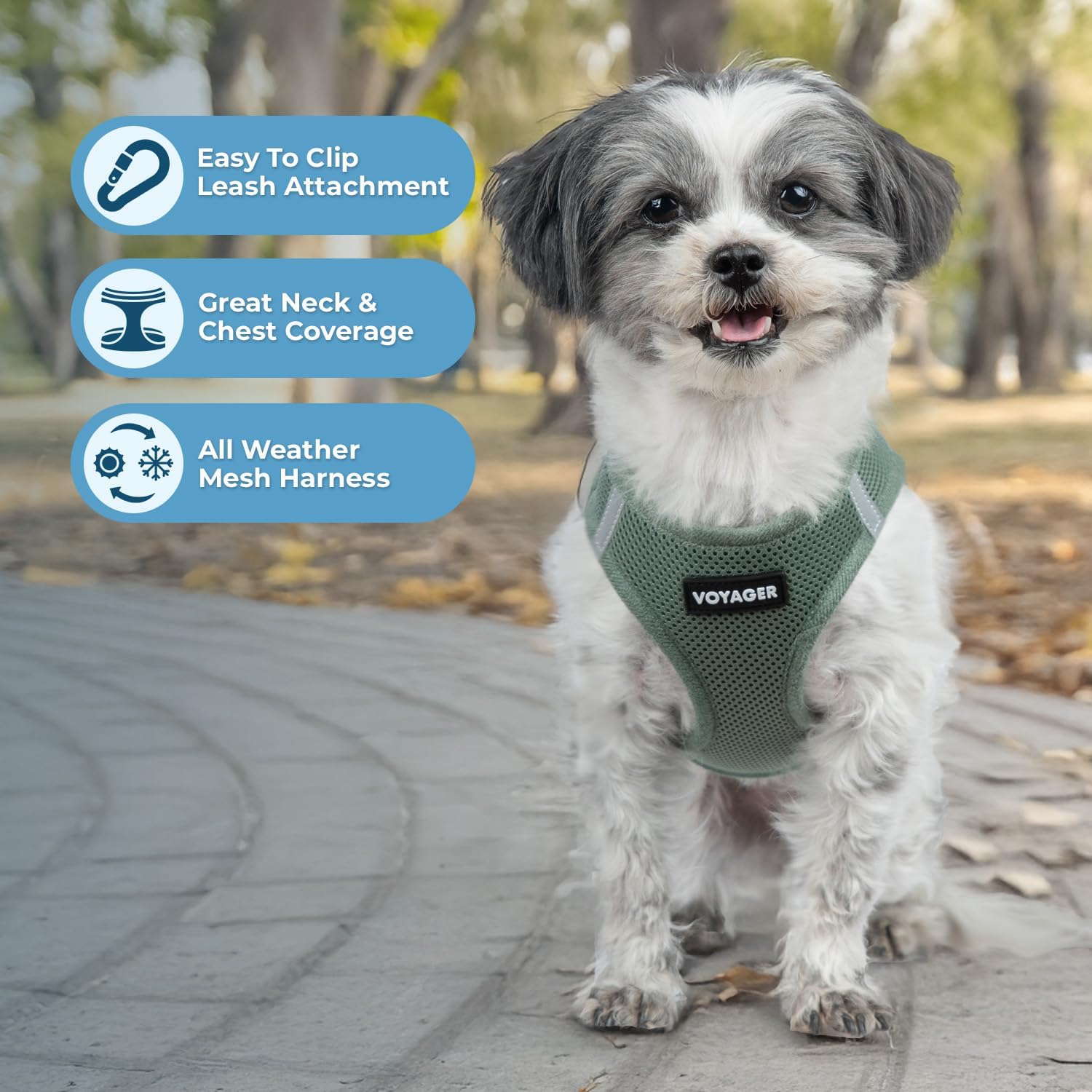
The Voyager Step-In Air introduced most small-dog owners to the Velcro-plus-buckle hybrid approach. The design uses a wide band of hook-and-loop closure across the dog’s back, supplemented by a single plastic side-release buckle. Owners consistently report one specific scenario where this wins: middle-of-the-night potty runs. When you’re half-awake and your 5-pound puppy is already doing the I-need-to-go dance, a Velcro panel you can press shut in one motion — then confirm with a buckle click — is genuinely faster than threading two separate buckle prongs in the dark.
The mesh body of the Voyager also matters for small dogs in warm climates or apartments without central air. The mesh (an open-weave fabric that allows airflow) keeps a 4-pound Chihuahua from overheating on a July afternoon walk in a way that a solid neoprene or nylon panel won’t. Published spec listings put the Voyager’s smallest size at a girth — the measurement around the widest part of the chest, just behind the front legs — of roughly 9–12 inches, which accommodates most Chihuahua puppies and full-grown Maltese.
Where the Velcro story gets complicated is durability and coat interference. The Whole Dog Journal staff article “Step-In Dog Harnesses,” published on whole-dog-journal.com, notes that hook-and-loop closures are the most common point of long-term wear failure in soft harnesses — the hooks gradually fill with dog hair, lint, and debris, reducing their grip. Owners of long-coated toy breeds like Yorkshire Terriers and Pomeranians report a secondary problem: Velcro actively catches and pulls coat hair, which is both painful for the dog and damaging to show-quality or carefully maintained coats. If your dog has any meaningful furnishings — the longer, silkier fur on the chest and legs — budget for the fact that Velcro and that coat are going to have a contentious relationship.
The D-ring (the metal loop where you clip the leash) on the Voyager draws a recurring cosmetic complaint: it tends to flip sideways rather than sitting upright. Reviewers almost universally classify this as annoying rather than dangerous — the ring still functions, and the leash still clips — but it’s worth knowing before you buy. It will flip. You’ll flip it back. This will happen every walk.
Best for: Cooperative dogs with short or smooth coats; owners who prioritize application speed; warm-climate households. Skip if: Your dog has a long double coat, or has already backed out of at least one prior harness.
Best
$14.94
In stock on Amazon
Check price on AmazonBuckle-Only Martingale: Containment for Escape Artists
The Gooby Sporty operates on a fundamentally different logic. Where the Voyager sells on convenience, the Gooby Sporty sells almost exclusively on containment — specifically, its martingale-style chest loop. A martingale mechanism is a loop-within-a-loop design: when a dog pulls backward or tries to back out of the harness, the outer loop tightens the inner loop, increasing gentle pressure rather than releasing the dog. It’s the same concept used in martingale collars, translated to chest-harness geometry.
The purchase driver in Gooby Sporty reviews is almost never price or aesthetics. It’s that the dog had already escaped every prior harness. Italian Greyhounds, Whippets scaled down to toy sizes, and certain leggy Chihuahua lines have a thorax (chest cavity) that is nearly the same circumference as their neck — which means a standard step-in creates a wide-enough gap for a determined dog to back out. The Gooby’s martingale chest piece eliminates that gap dynamically: the harder the dog pulls backward, the more securely the harness holds.
The tradeoff is that buckle-only closures are slower to apply and require two hands. For a dog that tolerates harnessing calmly, this is a non-issue. For a wriggly 3-pound puppy at midnight, it’s a meaningful tax on your patience. Gooby’s published sizing goes to an XXS chest girth, and the brand markets explicitly to toy breeds, so the geometry is intentionally designed for the narrow-shouldered, shallow-chested dogs that make standard small-dog harnesses fit poorly.
Best for: Narrow-chested dogs with a history of harness escape; owners for whom containment outweighs convenience. Skip if: Your dog has a tracheal condition — the dynamic tightening warrants a veterinary conversation before use (see the FAQ section below).

Outward
$15.25
In stock on Amazon
Check price on AmazonSoft Buckle, No Martingale: Everyday Comfort for Sensitive Dogs
The Puppia Dotty sits in a third category: a soft-fabric step-in with a straightforward buckle closure and a design optimized for chest distribution of leash pressure rather than escape prevention or speed of application. The Puppia brand has been a staple in toy-breed communities for years, and the Dotty’s construction — a soft padded chest panel with a back-clip D-ring — follows the guidance published by the American Kennel Club in the article “How to Choose the Best Harness for Your Dog” (AKC Staff, akc.org), which recommends chest-contact harnesses because they distribute leash force more safely than throat-contact collars for small dogs with delicate tracheas.
The most surprising finding in the Puppia Dotty review corpus is an owner who specifically credited the harness with reducing her dog’s motion sickness during car rides. Her reasoning aligns with what the PetMD Editorial Team describes in “How to Put a Harness on a Dog” (PetMD, petmd.com) regarding fit and anxiety: a properly fitted chest harness can reduce the sensation of physical restraint that an ill-fitting collar-and-leash setup creates in a vehicle. Less perceived restraint at the throat meant less anxiety, which translated to fewer car-sickness episodes. This isn’t a controlled clinical finding, but it’s a plausible mechanism — and it’s the kind of real-world discovery that doesn’t show up in spec sheets.
The Puppia Dotty’s weakness is what it doesn’t do: it offers no martingale tightening and no Velcro speed-closure. For an easy-going dog who has never backed out of a harness, it’s a clean, comfortable option. For an escape artist, it’s not the right tool.
Best for: Sensitive or anxious dogs; car travelers; dogs with no history of escape attempts. Skip if: Your dog is an active escape artist or your priority is application speed at odd hours.
Gooby
$28.69
In stock on Amazon
Check price on AmazonSide-by-Side: How the Three Closures Compare
| Feature | Voyager Step-In Air | Gooby Sporty | Puppia Dotty |
|---|---|---|---|
| Closure type | Velcro + buckle | Martingale buckle | Soft buckle |
| Avg. application time | ~8 seconds | ~15–20 seconds | ~12 seconds |
| Escape resistance | Moderate | High | Low–Moderate |
| Durability concern | Velcro fill at 6–9 months | Buckle fatigue at 12–18 months | D-ring stitching over time |
| Coat compatibility | Poor with long coats | Neutral | Good with most coats |
| Tracheal-collapse suitability | Good (back clip) | Use with vet input | Good (back clip) |
Best
$14.94
In stock on Amazon
Check price on AmazonOutward
$15.25
In stock on Amazon
Check price on AmazonGooby
$28.69
In stock on Amazon
Check price on AmazonThese estimates are aggregated from long-run owner reviews and published manufacturer specifications; individual results will vary based on dog cooperation level and maintenance habits.
Sizing for Pomeranians and Other Coat-Complicated Toy Breeds
Pomeranians have a distinct fit challenge regardless of harness style — their neck circumference and chest circumference are often within an inch or two of each other, which causes both over-the-head and step-in designs to sit ambiguously between sizes. Their dense double coat adds a compounding variable: a harness that fits in July can feel significantly tighter once the winter undercoat blows in.
The Whole Dog Journal staff article “Step-In Dog Harnesses” (whole-dog-journal.com) recommends always measuring girth, not neck when sizing a step-in, because the girth measurement determines whether the back panel will sit correctly above the shoulder blades rather than riding forward onto the neck. For a Pomeranian, this means measuring the chest at its widest point — typically just behind the armpits — with a soft measuring tape, then checking whether that number falls in the lower third or upper third of the manufacturer’s stated size range. Fitting to the lower third of a size range gives you adjustment room as the dog gains adult coat density; fitting to the upper third risks the harness riding forward once the double coat fills in.
The American Kennel Club’s harness fitting guidance in “How to Choose the Best Harness for Your Dog” (AKC Staff, akc.org) states that you should be able to slide two fingers comfortably under any strap once the harness is fastened. For a Pomeranian in full adult coat, re-check this fit seasonally. A harness that passed the two-finger test in August may fail it in January.
Front-clip harness designs — a category not covered in this article — carry an additional warning worth noting here: they can bind in thick double coats, which is the Pomeranian’s signature feature. The step-in back-clip designs reviewed above avoid that specific issue.
Frequently Asked Questions
Can the Voyager Step-In Air be used on cats as well as very small dogs? The Voyager is marketed as a dog-and-cat product in its smallest sizes, and owners do report using it on cooperative cats successfully. The key variable is body geometry: cats tend to have a deeper, narrower chest than dogs of equivalent weight, so the fit is less predictable. If your cat’s girth is in the 9–11 inch range and they tolerate being stepped into things, the Voyager XXS is a reasonable trial. Measure first; don’t guess.
Does the Gooby Sporty’s martingale mechanism actually tighten enough to prevent escape without choking? Based on published design descriptions and long-run owner reviews, the martingale action on the Gooby Sporty applies increasing pressure as the dog backs up, then releases when the dog stops pulling — which is the intended function of martingale mechanics. It is not designed to choke; the tightening is proportional and limited by the harness geometry. Owners of Italian Greyhound mixes and narrow-chested Chihuahuas consistently report it holds dogs that slipped every other harness.
How do Velcro closures hold up after months of daily use? They degrade. The consistent finding across long-run reviews is that Velcro in the Voyager’s closure panel begins losing grip strength somewhere between six and nine months of daily use, particularly in dogs who roll in grass or whose owners don’t clean the panel regularly. Running a fine-tooth comb through the hook side monthly extends the life significantly by clearing embedded hair and debris. Most owners who use the Voyager past the one-year mark either replace it at that point or treat the supplementary buckle as the primary closure and the Velcro as backup.
Is any of these harnesses safe for a dog diagnosed with a collapsed trachea? Lynn Buzhardt, DVM, writing for VCA Animal Hospitals in the article “Tracheal Collapse in Dogs” (vcahospitals.com), explicitly recommends harnesses over collars for affected dogs, because collars concentrate pressure on the trachea. Among the step-in designs reviewed here, a back-clip chest harness like the Puppia Dotty — which distributes leash force across the sternum and ribcage rather than the throat — aligns most closely with that guidance. The Gooby Sporty’s martingale tightening makes it a less straightforward recommendation for tracheal-collapse dogs without veterinary input. Always confirm with your vet; tracheal collapse severity varies, and harness fit matters as much as harness type.
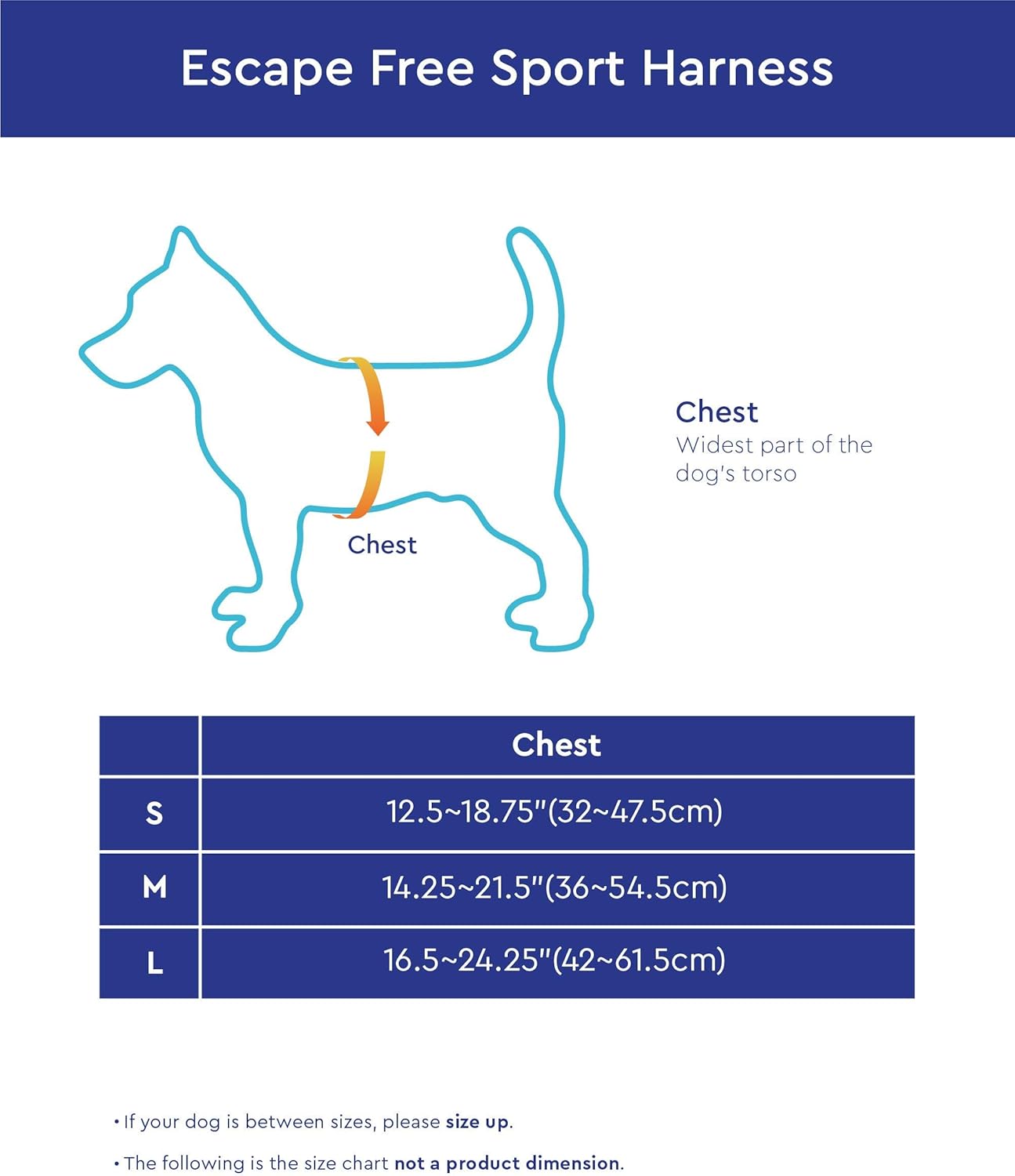
How do I size a step-in harness for a Pomeranian whose neck and chest measurements are nearly the same? Measure girth — chest circumference at its widest point, behind the armpits — and ignore neck measurement entirely for step-in sizing purposes. Then target the lower third of the manufacturer’s stated girth range for that size. This accounts for Pomeranian coat density adding effective girth without adding actual body size. If you’re between sizes, go larger and use the adjustment straps; a too-small harness on a dog with a double coat will bind and cannot be fixed by loosening straps.
The Decision Rule
If your priority is speed of application — you have a small puppy, you do frequent overnight potty runs, or your dog is cooperative but impatient — the Voyager Step-In Air’s Velcro-plus-buckle hybrid is the practical pick. Budget for replacement at the 9–12 month mark if you’re using it daily, and keep the Velcro panel clean.
If your dog has escaped at least one prior harness or has a narrow chest-to-neck ratio that makes standard sizing ambiguous, the Gooby Sporty’s martingale geometry is the specific tool for that specific problem. It’s slower to apply, but it’s doing a different job than the other two.
If your dog rides in the car regularly, has a sensitive temperament, or you want a general-purpose everyday harness without strong opinions in either direction, the Puppia Dotty’s soft chest panel and straightforward buckle closure is the lowest-friction solution — and the connection between proper chest-harness fit and reduced car anxiety is worth keeping in mind if travel stress has been a recurring theme.
None of these is the universal answer. The universal answer doesn’t exist in toy-breed harness fitting because the variation between a 3-pound Chihuahua and a 10-pound Pomeranian in full coat is enormous relative to the sizing ranges these products cover. Measure twice, buy one, and know which problem you’re actually solving.