September 30, 2026 • Marisol Vane • 10 min reading time • Prices verified June 4, 2026
Tactical Dog Harnesses for Everyday Owners: Who Actually Needs One and Who Is Just Buying the Look
A tactical harness is a dog harness built around MOLLE webbing — a grid of horizontal nylon loops sewn onto the surface of the vest that lets you attach pouches, patches, and accessories using a standardized military-derived attachment system. If you’ve seen a working police K9 wearing a structured vest covered in loops, that’s the visual shorthand. Consumer versions of this design have exploded in popularity, mostly because they fit large, barrel-chested breeds better than traditional Y-front harnesses, and because the patch system turns out to solve a real problem: communicating your dog’s temperament to strangers before they reach out a hand. This guide is for owners who already own one of these harnesses or are close to buying one — and want to know what the design actually delivers, where it falls short, and how to set it up so it doesn’t become a liability.
The practical question you probably came in with is either does this actually fit my dog better than what I have or is this just a look. The honest answer is: it depends on body type, use case, and whether you complete the setup. Let’s get into it.
| EDITOR'S PICKCarhartt Nylon Duck No Pull Dog… | Mid-tierrabbitgoo Tactical Dog Harness… | Budget pickrabbitgoo Tactical Dog Harness… | |
|---|---|---|---|
| Size stated | Medium | L | L |
| MOLLE webbing | — | — | ✓ |
| Reflective | ✓ | — | ✓ |
| Material | Nylon | — | — |
| Price | $38.28 | $35.99 | $24.99 |
| See on Amazon → | See on Amazon → | See on Amazon → |
What “Tactical” Actually Buys You (and What It Doesn’t)
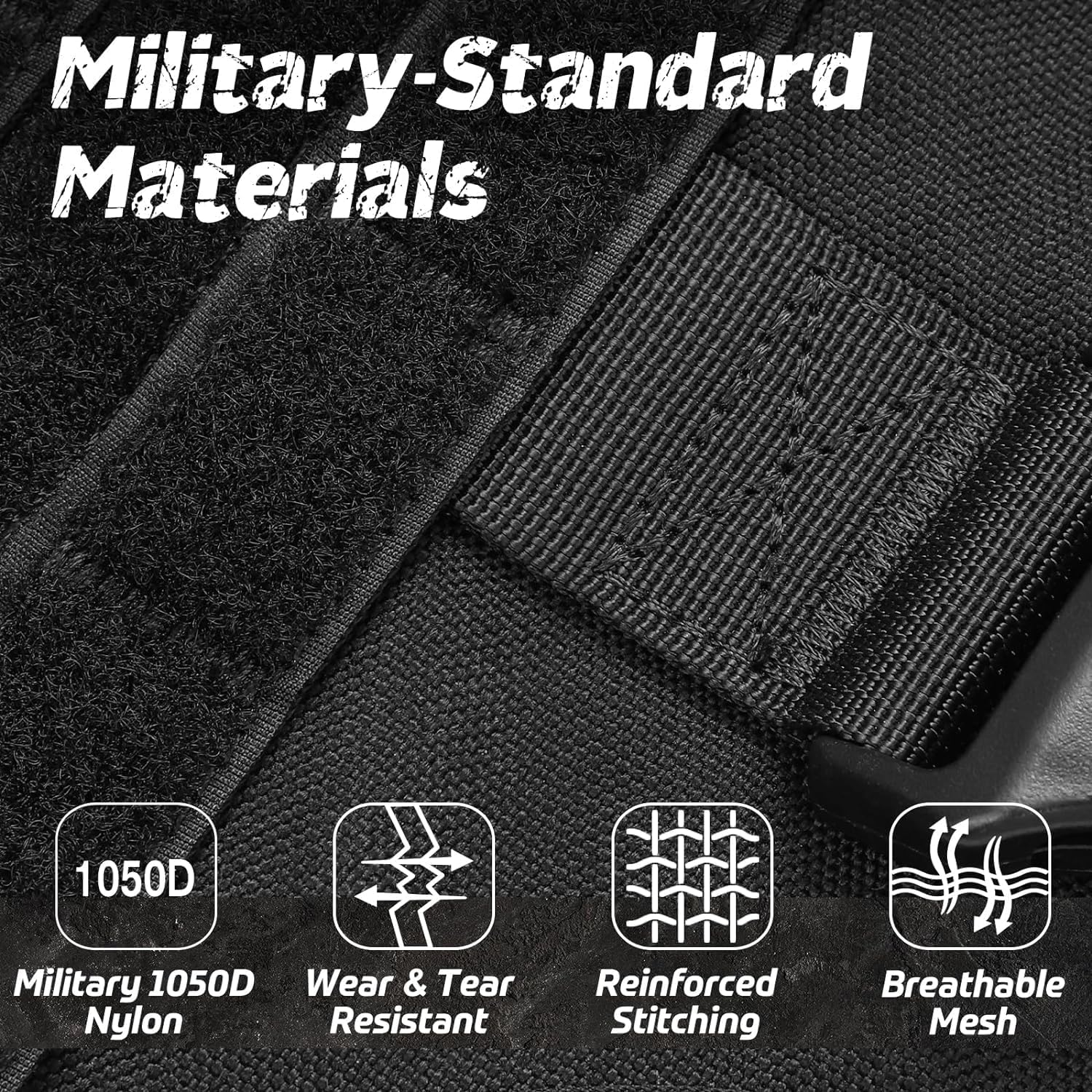
The word “tactical” in dog gear marketing is nearly meaningless as a safety or performance certification — there’s no independent standards body that grades harnesses on tactical criteria the way ASTM certifies climbing gear or ISO audits life jackets. What you’re actually buying is a specific construction approach: thick nylon webbing (typically 1,000-denier nylon — denier is a thread-weight measure, higher numbers mean heavier, more abrasion-resistant fabric), a structured vest body rather than straps, and MOLLE loops sewn in a repeating grid pattern on the dorsal (top) surface.
That construction delivers three real benefits compared to traditional step-in or Y-front harnesses:
1. A larger contact area distributes pressure differently. A vest-style body wraps more of the dog’s chest and sides, which means no single narrow strap is carrying all the tension when the dog lunges. VCA Animal Hospitals, in their guide “Selecting a Collar or Harness for Your Dog,” notes that harnesses distributing pressure across the chest are generally preferable to designs that concentrate load on the neck or behind the front legs. Tactical vests take this further than most.
2. Independent adjustment points fix the thick-neck problem. Many traditional harnesses adjust the neck loop and chest girth off a single shared slider, which means a dog with a neck wider than expected for its weight — common in Pitbull-type breeds, English Bulldogs, and Rottweilers — ends up either with a neck that’s too tight or a chest that’s too loose. Certain tactical designs separate neck and chest adjustment entirely, which is exactly why owners of thick-necked dogs report success with these harnesses when other designs fail.
3. The MOLLE grid is a functional communication layer. This is the finding that surprised even skeptical reviewers: the ability to attach a “Do Not Pet” patch, a “Working Dog” patch, or a “Reactive — Please Give Space” patch changes the social dynamic around a reactive or anxious dog in a measurable way. Owners consistently note that strangers read the patch and stop themselves before approaching, giving the handler more control over the encounter without saying a word.
What tactical construction doesn’t buy you: escape-proofing, leash attachment superiority over a well-fitted conventional harness, or meaningful protection from brush and debris (a canvas-body harness handles that better). It also doesn’t buy a weight reduction — these harnesses are heavier than minimalist designs, which matters for dogs who heat up quickly.
Model-by-Model Decision Frame
The market for consumer tactical harnesses is dominated by a handful of designs that recur across aggregated review data. Here’s the signal from that review pattern, organized as a decision frame. Note: model names are used as product identifiers; no retailer codes are reproduced here.
Rabbitgoo Tactical Harness

rabbitgoo
$24.99
In stock on Amazon
Check price on AmazonOwners of large breeds — 80-to-110 lb German Shepherds and Pitbulls appear frequently in owner feedback — consistently report that the fit geometry works where traditional harnesses bunch or gap. The most common complaint is strap-loosening during walks, but the pattern across reviews is notable: owners who report this problem almost universally skipped or misread the initial setup step, which requires cinching the secondary adjustment buckles fully before the primary buckle is fastened. Once that sequence is followed, the loosening issue largely disappears. The American Kennel Club’s guidance “How to Choose a Dog Harness” emphasizes that correct initial fit is the single biggest variable in harness performance — a finding that tracks directly with what owners of this model report.
Best for: standard large-breed proportions, owners who want MOLLE patch functionality, dogs in the 60–110 lb range with typical neck-to-chest ratios.
WINGOIN Tactical Harness
rabbitgoo
$35.99
In stock on Amazon
Check price on AmazonThis is the design to consider if your dog has a neck-to-chest ratio that defeats standard sizing. The independent neck and chest adjustment isn’t just a minor feature difference — it’s the reason this harness fits English Bulldogs, thicker-built Pitbull types, and certain working-breed mixes when everything else fails. Owners specifically call this out not as a nice-to-have but as the functional reason they chose it over alternatives. If your dog isn’t in that body-type category, the added adjustment complexity doesn’t add much over simpler designs.
Best for: thick-necked breeds, non-standard proportions, owners who have already struck out on standard sizing charts.
Beebiepet Tactical Harness
rabbitgoo
$35.99
In stock on Amazon
Check price on AmazonThe sizing label on this harness has caused genuine confusion: it’s nominally marketed toward smaller dogs but owners of large Bully XL-type dogs report that it fits comfortably and — notably — has a pulling-slowing effect due to the geometry of the chest panel. This is not a certified no-pull harness with a front-clip training design, but the chest fit geometry appears to create mild self-correction. Worth understanding before you size it by the label alone.
Best for: wide-chested Bully-type breeds, owners who find standard large-breed sizing too narrow across the chest.
Carhartt Dog Chore Coat Harness
Carhartt
$38.28
In stock on Amazon
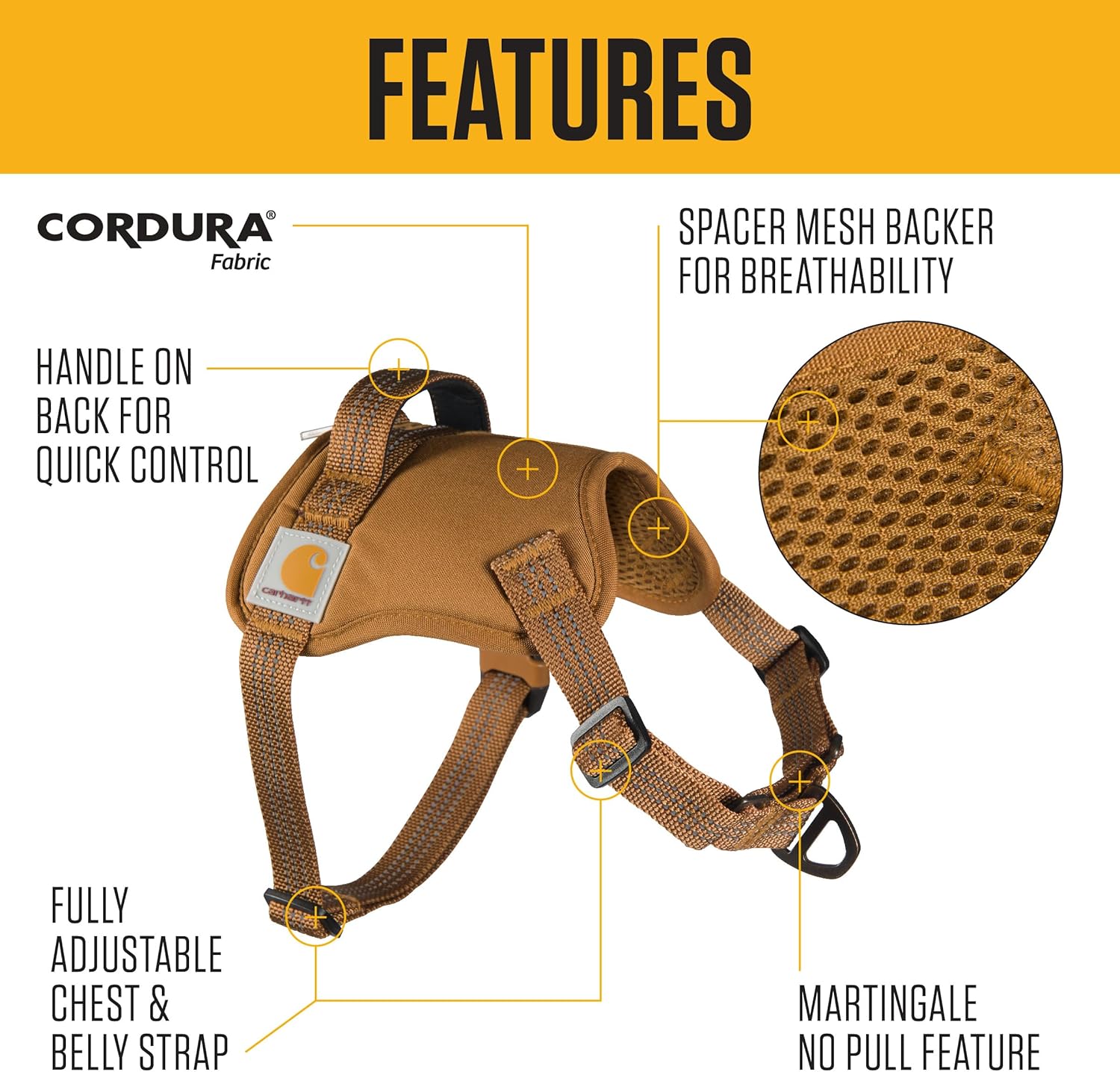
Check price on AmazonThis is the only entry on this list that isn’t MOLLE-compatible. It’s a duck canvas vest harness — duck canvas is a tightly woven cotton-polyester fabric originally developed for workwear — with a single-buckle closure. Owners specifically praise the canvas for shedding sticker weeds and burr-heavy vegetation on trails, a legitimate advantage over nylon-loop designs where debris catches in the webbing. The single-buckle closure is repeatedly mentioned as a practical benefit for excitable dogs who won’t hold still during a multi-buckle fastening sequence. If patch attachment matters to you, this isn’t your harness. If trail debris resistance and fast donning matter more, it’s the outlier worth considering.
Best for: trail dogs, owners in brushy terrain, excitable large breeds who resist a lengthy harness-on ritual.
By the Numbers: Quick Comparison
| Harness | Key differentiator | Best-fit body type | MOLLE-compatible |
|---|---|---|---|
| Rabbitgoo Tactical | Proven fit on 80–110 lb large breeds; setup-sensitive | Standard large-breed proportions | Yes rabbitgoo — $24.99 |
| WINGOIN | Independent neck/chest adjustment | Thick-neck, non-standard proportions | Yes rabbitgoo — $35.99 |
| Beebiepet | Runs larger than labeled; mild pulling correction | Bully-type, wide chest | Yes rabbitgoo — $35.99 |
| Carhartt Chore Coat | Duck canvas; single-buckle; debris-shedding | Trail dogs, excitable large breeds | No Carhartt — $38.28 |
Setup and Long-Term Wear: The Variables Most Owners Skip
The Whole Dog Journal, in their guide “Finding the Right Dog Harness,” makes a point that applies directly to tactical designs: a harness correctly fitted for a dog’s body at rest will behave differently once the dog is moving, pulling, or wearing it for multiple hours. There are two friction points that come up repeatedly in long-run tactical harness owner feedback.
MOLLE webbing and extended wear. The horizontal nylon loops that make patch attachment possible are the same surface sitting against a dog’s back during a long hike or working day. For dogs with short, thin coats — Vizslas, Boxers, certain Pitbull types — the webbing edge can create friction hotspots over two-plus hours of continuous wear. This isn’t universal; dogs with denser coats rarely report it. But if your dog is wearing the harness for a full trail day rather than a 45-minute walk, check the contact points weekly, particularly behind the shoulder blades where the vest edge meets the skin.
Front and back leash clip use. Most tactical harnesses include both a dorsal (back) D-ring and a ventral (front chest) D-ring. Using both simultaneously — attaching a double-ended leash to create a two-point contact — is a legitimate no-pull technique that the Canine Journal, in their “Best Dog Harnesses” round-up, describes as effective for strong pullers in training contexts. That same coverage notes that not all chest D-rings on budget tactical harnesses are rated for the full load a large dog can generate. Check the manufacturer’s stated ring rating before running a dual-clip setup on a dog over 80 lbs.
Escape-proofing. Tactical harnesses are not inherently escape-proof. A dog who has learned to back out of harnesses — tucking the shoulders and reversing — can exit most vest-style designs if the neck loop is sized too generously. The solution is the same as any harness: you should be able to fit two fingers, not four, under the neck loop at the back of the skull. If there’s more room than that, size down or tighten before your next walk.
Frequently Asked Questions
Do tactical harnesses actually run large compared to the size chart? The Beebiepet is the clearest case where the label undersells the actual fit range. Rabbitgoo tends to run true to size chart for standard body proportions. The consistent advice: measure your dog’s neck circumference and chest girth at the widest point behind the front legs, then cross-reference both against the manufacturer’s dimensional chart — not just the weight range on the label.
Will MOLLE webbing chafe a dog who wears the harness for hours? It can, particularly on short-coated dogs. The webbing edge is the friction point to watch. Longer wear sessions warrant weekly skin checks at the shoulder and chest contact zones.
Can I attach a leash to both the front and back clips? Mechanically, yes, on models that have both D-rings. Verify that the front ring is rated for your dog’s full pull load before using a dual-clip setup for training purposes.
Are tactical harnesses escape-proof for dogs who back out? No. The neck loop must be fitted snugly — two-finger clearance at the back of the neck is the standard. A loose neck loop on any harness is an exit point.
Does the “Do Not Pet” patch actually stop strangers from approaching? Based on aggregated owner reports, it meaningfully reduces uninvited approaches. It doesn’t stop every person, but owners of reactive dogs consistently describe it as one of the most practical things the MOLLE system enables — more effective than verbal warnings in many public settings.
How do I stop the adjustment straps from loosening during walks? On the Rabbitgoo specifically, the fix is setup sequence: cinch secondary adjustment buckles fully before fastening the main buckle, not after. Once the straps are locked at the correct length, loosening during walks becomes a non-issue for the vast majority of owners who follow this step.
The Decision Rule
If your dog has standard large-breed proportions and you want MOLLE patch functionality — particularly “Do Not Pet” or working-dog signaling — the Rabbitgoo is the starting point. If your dog has a thick neck that defeats standard sizing, the WINGOIN’s independent adjustment is the reason to go there instead. If you’re on trail regularly and debris in the webbing is a real problem, the Carhartt Chore Coat is the only canvas alternative worth considering, with the understanding that you give up MOLLE compatibility entirely. And if you’re not using the patch system, managing a reactive dog’s social interactions isn’t a priority, and your dog fits traditional harnesses well — the tactical look is doing a lot of work that a well-fitted conventional harness already handles at lower cost and weight.
The functional case for tactical harnesses is real. It’s just narrower than the marketing suggests.