September 17, 2026 • Marisol Vane • 11 min reading time • Prices verified June 4, 2026
Food-Dispensing Puzzle Balls vs. Flat Puzzle Boards: Which Format Fits Your Dog's Play Style
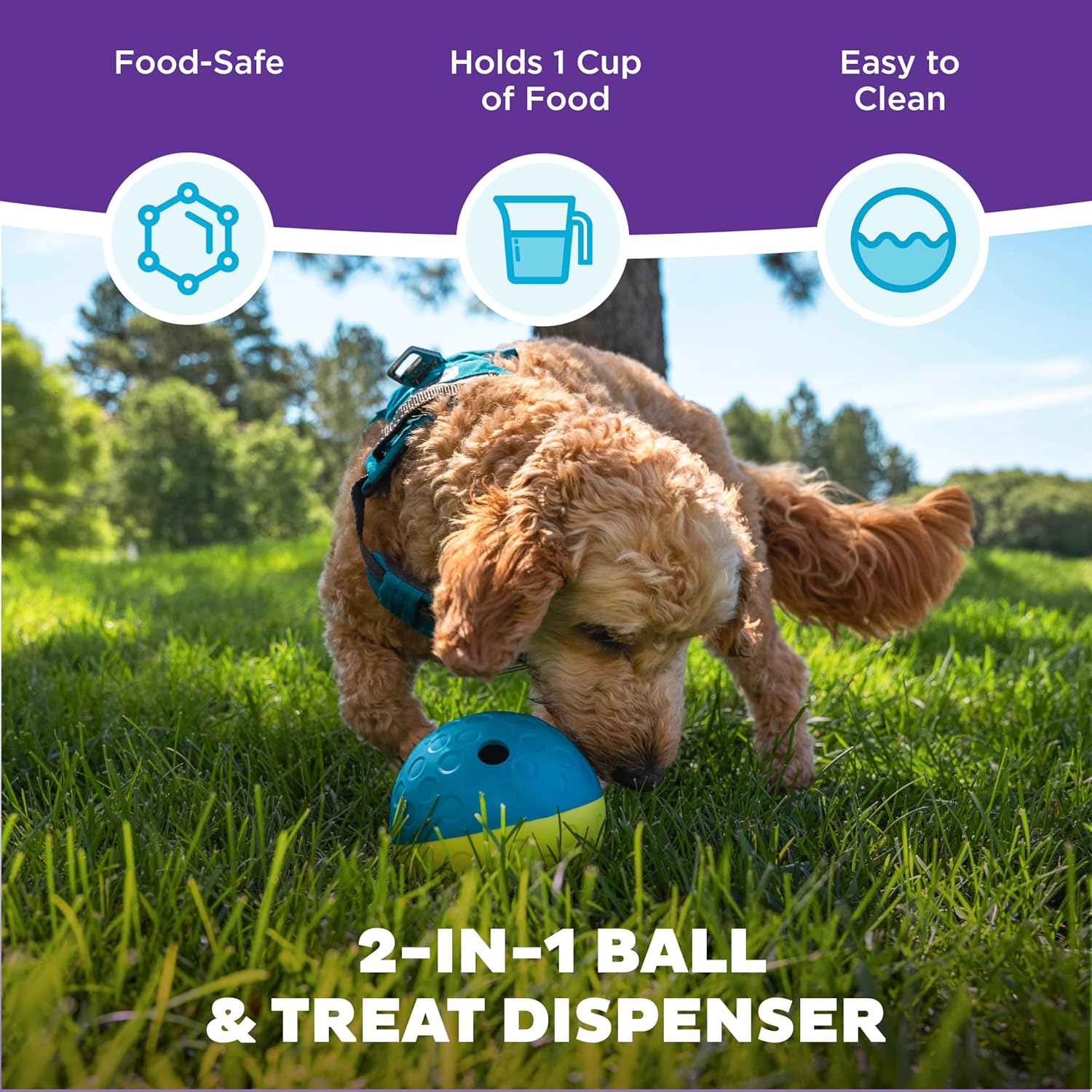
If you’ve been eyeing wobbling treat-dispensing balls and sliding-tile puzzle boards at the pet store, you’re probably asking the same question most owners land on: which format is actually going to hold my dog’s attention past day three? A food-dispensing puzzle toy is any object specifically designed to make your dog work — physically or cognitively — to release kibble or treats. The two dominant formats are puzzle balls (hollow spheres or tumbler shapes your dog nudges and rolls to drop food through a hole) and flat puzzle boards (also called interactive feeders or level puzzles, where your dog flips lids, spins discs, or slides tiles to uncover hidden compartments). Both slow down eating and provide mental enrichment — the deliberate cognitive work that, according to VCA Animal Hospitals in their document “Enrichment for Dogs,” can reduce anxiety-driven behaviors and improve focus in working and companion dogs alike. This article breaks down the real-world tradeoffs between the two formats, maps five specific products to the dogs most likely to thrive with each, and ends with clear “if X, then Y” decision rules so you can stop second-guessing and actually buy something.
The Core Tradeoff: Motion vs. Manipulation
The mechanical difference between the two formats is also their behavioral difference, and understanding it is the whole ballgame.
Puzzle balls reward motion. Your dog bumps, paws, or carries the toy; gravity does the rest. The engagement loop is fast, physical, and low-frustration — which is exactly the feature and exactly the limitation. Dogs who are highly toy-motivated, bored between walks, or prone to gulping food tend to love the format immediately. Dogs who are scent-driven, methodical problem-solvers, or flat-puzzle veterans often find balls insufficiently rewarding after the first session: there’s no “aha” moment, just persistence.
Flat puzzle boards reward manipulation — specifically sniffing, pawing, and sequential problem-solving. Whole Dog Journal, in their overview “Food Puzzle Toys for Dogs,” notes that nose-led puzzles — where scent guides the dog to the correct compartment before the reveal — produce the most sustained engagement, especially in scent-hound breeds and high-drive working dogs. The tradeoff is a steeper early learning curve and, for some dogs, genuine frustration if the difficulty level jumps too fast.
The decision frame, then, is not “which format is better” but “which engagement loop fits this dog’s temperament and this owner’s daily workflow.”
Five Products, Five Honest Assessments
Treat Tumble (Puzzle Ball — Entry Level)
The Treat Tumble is one of the most widely reviewed entry-level dispensing balls on the market, and the owner feedback pattern is consistent enough to be instructive. Reviewers give it high marks for build quality and adjustable opening size — both of which matter if you’re calibrating to kibble size or treat density. The persistent complaint, equally consistent, is the furniture-stuck problem: the ball rolls under couches, dressers, and kitchen appliances, the dog loses the scent trail, and the session ends in frustration rather than completion.
Practical workaround: Use the Treat Tumble in a contained space. A hallway with both doors closed is the cleanest solution — the ball bounces off walls and stays in play. A rubber-backed bath mat or yoga mat on a hard floor also limits travel distance significantly; the mat surface adds friction and the ball tends to orbit the mat’s edge rather than escape under furniture. Owners who adopt one of these setups consistently report that the frustration complaints disappear.
Best fit: High-energy dogs in apartments who need a pre-dinner outlet; owners who want a zero-setup meal replacement option.
Outward
$6.35
In stock on Amazon
Check price on AmazonDog Brick (Flat Board — Level 2)
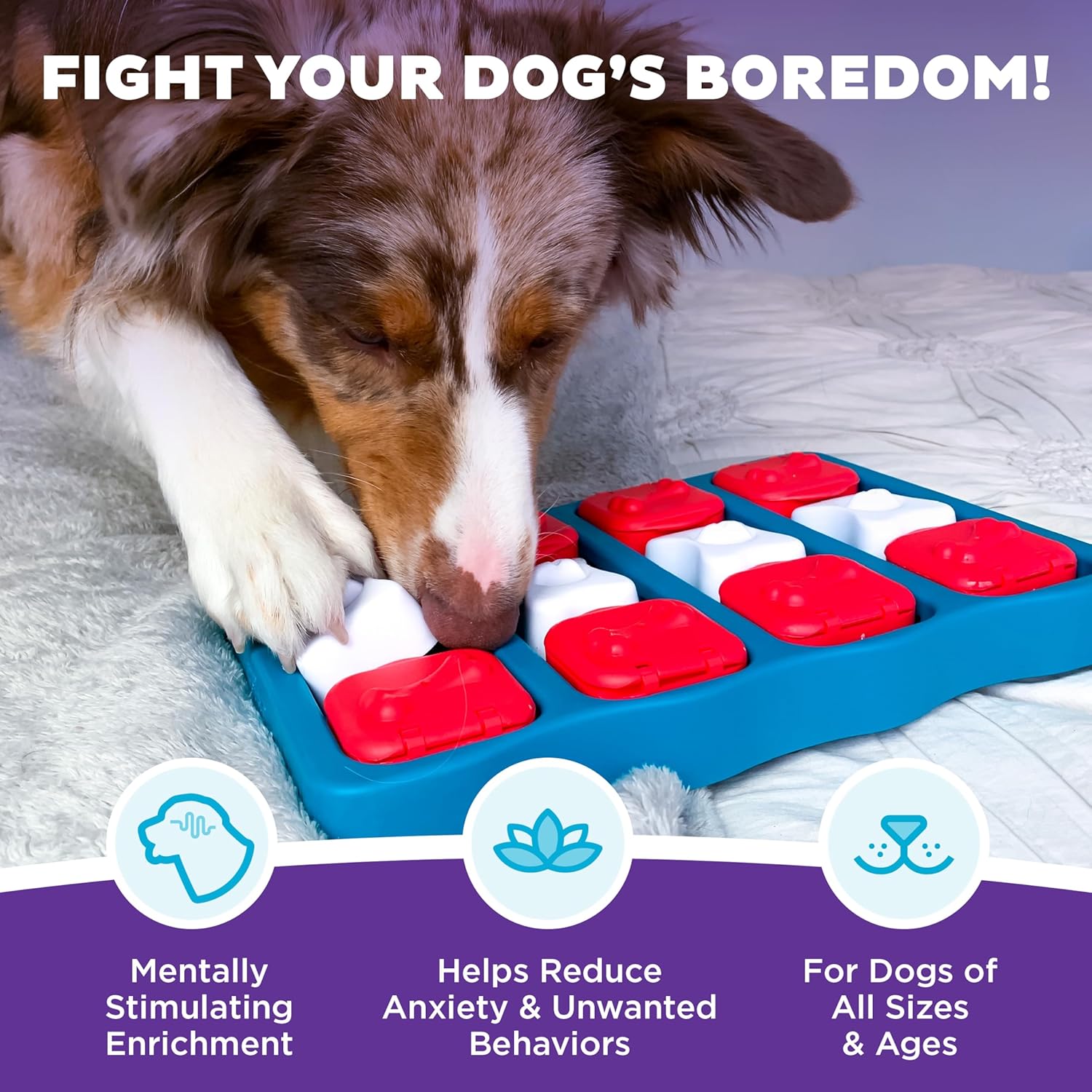
The Dog Brick is the most frequently praised multi-dog household puzzle in its category, and the reason comes through clearly in owner language: the difficulty is genuinely owner-adjustable. The Brick features flip-lid compartments plus a second layer of sliding bone covers that can be left in place (harder) or removed entirely (easier). This means you can run one dog on beginner mode while your more experienced dog works the full configuration — no separate purchase required.
The multi-dog versatility argument is also a durability argument. Flat boards in multi-dog homes get heavy use; the Brick’s thick ABS plastic construction — ABS stands for acrylonitrile butadiene styrene, the same rigid plastic used in most commercial-grade feeding bowls — holds up to competitive pawing better than thinner vacuum-formed boards.
The Dog Brick’s ABS plastic body is reported by owners as top-rack dishwasher safe. The removable sliding covers and flip lids can go on the top rack as well. For stubborn kibble dust in the channel edges, a standard bottle brush or the thin end of a straw-cleaning brush reaches the corners. Owners who use soft treats recommend a warm-water soak before the dishwasher cycle to prevent residue from baking on.
Best fit: Households with two or more dogs at different skill levels; owners who want a single puzzle that can grow with a dog’s improving ability.
Outward
$13.77
In stock on Amazon
Check price on AmazonDR CATCH Interactive Puzzle (Flat Board — Hybrid Level)
The DR CATCH generates an unusually split reviewer profile, and both camps are right. One group uses it as a true sequential puzzle — treats hidden under multiple cover types, dog works through each compartment systematically. The other group uses it as a slow feeder replacement: they load the entire meal into the open channels and let the dog lick and forage without engaging the cover mechanics at all. Both use cases are valid and the product genuinely supports both.
The practical implication: if your primary goal is slowing down a gulper, the DR CATCH works as a meal-rate reducer without requiring the dog to understand the puzzle mechanic. If your goal is cognitive enrichment, you’ll need to start with treats rather than kibble and actively teach the cover-flip behavior before introducing it as a mealtime tool. Trying to achieve both goals simultaneously on day one usually produces a frustrated dog who just licks the surface.
PetMD, in their article “Are Puzzle Feeders Good for Dogs?,” notes that dogs transitioning from bowl feeding to puzzle feeding benefit from a gradual introduction — owner-assisted on day one, supervised solo on day two — rather than cold-turkey replacement. The DR CATCH’s open-channel design makes it one of the friendliest products for this graduated approach.
Best fit: Gulpers who need a slow-feed solution and owners who want enrichment potential as the dog builds confidence.
Outward
$13.77
In stock on Amazon
Check price on AmazonDog Tornado (Flat Board — Level 3)
The Dog Tornado is a three-layer spinning disc puzzle — the dog rotates each disc to align compartments and access treats. It is one of the most recognized products in the Nina Ottosson interactive-puzzle line, and the owner modification data is consistent enough to call a first-day recommendation: remove the white bone pieces before your dog’s first session.
The bones are friction-fit obstacles designed to add difficulty by partially blocking compartments. In practice, reviewers report that dogs — particularly larger breeds — simply pick the bones up and carry them off rather than working around them, which short-circuits the puzzle mechanic and creates a scatter problem. Owners who pull the bones before session one report smoother introduction and better sustained engagement. You can reintroduce them once the dog understands the spin mechanic, typically after session three or four.
Best fit: Dogs who have solved Level 2 flat boards reliably and need a spatial and sequential challenge upgrade. The Dog Tornado is the logical bridge between the Dog Brick’s dual-action format and the full complexity of a Level 4 board.
Outward
$13.77
In stock on Amazon
Check price on AmazonMultiPuzzle (Flat Board — Level 4)
The MultiPuzzle generates the most enthusiastic owner language in the interactive-puzzle category by a significant margin — phrases like “absolute gold standard” and “genuinely tires a dog out better than a long walk” appear repeatedly in owner accounts. The American Kennel Club, in their article “Mental Stimulation for Dogs,” supports the underlying principle: high-difficulty cognitive tasks produce measurable fatigue responses in working and high-drive breeds that physical exercise alone does not replicate.
The cleaning complaint is equally strong and equally consistent, so address it before you buy. The MultiPuzzle has deep compartments, sliding bridges, and interlocking pieces that trap wet treats and kibble dust aggressively. Owners who use only dry kibble or hard training treats report manageable cleaning. Owners who use soft treats, wet food, or peanut butter report a genuine maintenance burden. The consensus workaround is a dedicated soak in warm water immediately after each session — don’t let soft-treat residue dry in the compartments. Most owners note that the top rack of a dishwasher works for the outer tray but not the removable inserts, which can warp at high heat.
Compartment complexity across the five products reviewed here:
| Product | Approximate Compartments | Primary Action Types |
|---|---|---|
| MultiPuzzle | ~23 | Slide, flip, spin, lift |
| Dog Tornado | ~12 | Spin |
| Dog Brick | ~8 | Flip, slide |
| DR CATCH | ~6 | Flip, open-channel lick |
| Treat Tumble | 1 dispensing hole | Motion only |
Dogs who have mastered Level 3 boards still typically require four to eight sessions before they work the MultiPuzzle efficiently. The caveat: a very high-drive dog with strong scent ability will sometimes nose-navigate the compartment sequence faster than the mechanical design intends — in those cases, owners report that using lower-value kibble rather than high-value treats extends session time meaningfully.
Best fit: Confident problem-solvers who breeze through Level 2–3 boards; owners willing to commit to a post-session cleaning protocol.

Outward
$15.87
In stock on Amazon
Check price on AmazonDecision Rules: If X, Then Y
- If your dog is a gulper and you want meal-rate control first, enrichment second: Start with the DR CATCH in slow-feeder mode. Introduce the puzzle mechanic with treats once the bowl-to-puzzle transition is stable.
- If your dog is high-energy and physically active between meals: The Treat Tumble in a hallway or mat-contained setup gives you a daily outlet with zero setup time.
- If you have multiple dogs at different skill levels: The Dog Brick’s removable difficulty layer makes it the most cost-efficient single purchase for a mixed household.
- If your dog reliably solves Level 2 boards in under two minutes: Graduate to the Dog Tornado with bones removed on day one, then reintroduce bones after session three. If the Tornado becomes easy within two weeks, the MultiPuzzle is the correct next step.
- If your dog is a certified problem-solver and you want maximum cognitive load: The MultiPuzzle is the right call — but commit to the cleaning protocol or you’ll stop using it within a month.
Frequently Asked Questions
Can a treat-dispensing ball also work as a slow feeder for a dog’s full meal? Yes, with caveats. Puzzle balls like the Treat Tumble can hold a full kibble meal and will meaningfully slow consumption — a dog eating from a ball typically takes significantly longer than a dog eating from a bowl. Whole Dog Journal, in “Food Puzzle Toys for Dogs,” notes that this pacing benefit is one of the primary documented advantages of dispensing-toy feeding. The limitation is that balls don’t work well with wet food or raw diets, and some dogs get frustrated before finishing the full meal if the opening is too small relative to kibble size. For a reliable full-meal slow feeder, a flat-format option like the DR CATCH in open-channel mode is generally more consistent.
How do I stop the Treat Tumble from getting stuck under the couch? Contain the play space. A hallway with closed doors at both ends is the most effective fix. A non-slip bath mat or yoga mat on hardwood floors also reduces travel distance substantially. Several owners report that placing a low foam-noodle bumper around furniture legs — the foam slides over the leg and raises the clearance gap — eliminates the under-couch problem entirely.
At what age or skill level should a dog graduate from a flat Level 2 puzzle to the Tornado or MultiPuzzle? Skill level matters more than age. The reliable signal is: if your dog solves the current puzzle in under two minutes across three consecutive sessions without any human prompting, it’s time to move up. For most dogs introduced to puzzles at six to twelve months, this happens within two to four weeks of daily use. For dogs introduced as adults, the learning curve is similar but the plateau may come faster.
My dog solves any flat puzzle in under two minutes — is the MultiPuzzle actually harder or just bigger? It’s genuinely harder, not just larger. The MultiPuzzle introduces action-type variety — the dog can’t apply a single “flip everything” strategy, because some compartments require a slide-then-lift sequence and others require a spin-then-flip. The compartment count alone (approximately 23 across four action types, versus 12 on the Tornado and 8 on the Brick) means the dog must build and retain a longer behavioral sequence to complete the puzzle efficiently. Owner accounts consistently report that even dogs who have mastered Level 3 boards need multiple sessions before they work the MultiPuzzle without backtracking.