August 12, 2026 • Marisol Vane • 10 min reading time • Prices verified June 4, 2026
Harness Fit for Dogs That Are Hard to Size: Barrel Chests, Thick Necks, and the Brands That Accommodate Them
A dog harness is simply a webbing structure that distributes leash pressure across your dog’s chest and torso instead of concentrating it on the throat. The problem is that most harnesses are engineered around an idealized dog shape — a medium-build retriever or shepherd with a neck circumference that scales predictably from chest girth. Real dogs don’t cooperate. A Bulldog’s neck is almost as wide as its chest. An Italian Greyhound has a ribcage like a dinner plate bolted to a neck like a pencil. A Pittie mix can have 28 inches of chest girth and weigh the same as a Lab that needs a completely different size. When the geometry doesn’t match, you get a harness that pops over the head when the dog backs up, chafes the armpits (technically the axilla, the fold where the front leg meets the chest wall), or simply refuses to close across the sternum. This guide is for owners who’ve already been through two size exchanges and want to buy correctly the first time.
Why Standard Size Charts Break Down on Atypical Builds
Most harness sizing tables are built around a single measurement — chest girth (the circumference of the ribcage at its widest point, typically just behind the front legs) — occasionally paired with weight as a secondary filter. Per the AKC’s harness measurement guide, chest girth is the correct primary measurement, and weight should be treated as a rough cross-check at best. The problem is that weight tells you almost nothing about proportions.
Consider the math:
| Dog type | Typical weight | Typical chest girth | Neck-to-chest ratio |
|---|---|---|---|
| Standard Lab | 65 lbs | 26–28 in | ~0.65 |
| American Pit Bull Terrier | 55 lbs | 28–32 in | ~0.80+ |
| Italian Greyhound | 10 lbs | 14–16 in | ~0.55 or less |
| English Bulldog | 50 lbs | 28–32 in | ~0.90+ |
The “neck-to-chest ratio” here is informal shorthand — the neck circumference divided by the chest girth. A ratio above ~0.80 means the neck opening and chest girth are close enough that a fixed-neck harness either chokes the dog or slips forward over the skull. A ratio below ~0.60 means the neck opening sized for the chest will be comically loose, causing the harness to migrate back toward the ribcage. Neither scenario is safe or comfortable.
Whole Dog Journal’s harness fitting guide specifically flags bully breeds and sighthounds as the two body types most consistently misfitted by chart-based sizing, and identifies independent neck and chest adjustment as the primary design feature that resolves both problems.
The Design Variables That Actually Matter
Before naming brands, it helps to understand the three hardware decisions that determine whether a harness can accommodate an atypical build.
Step-in vs. overhead vs. side-clip entry. Overhead harnesses require the dog to put its head through a loop. For dogs with wide skulls or heavy jowls — Bulldogs, Mastiffs, American Bullies — the loop sized for the neck often won’t clear the head. Step-in designs bypass the head entirely but require the dog to stand still while you assemble around them; some dogs find this more cooperative. Side-clip or “wrap-and-snap” designs — where the harness is draped over the dog’s back and clipped together at the chest and/or belly — offer the most flexibility for unusual proportions.
Independent neck and chest adjustment. This is the single most important feature for hard-to-fit dogs. A harness with one adjustment point forces a tradeoff: tighten for the chest and the neck is a tourniquet; loosen for the neck and the chest plate slides around. Two independent adjustment sliders let you dial each zone separately, which is the only way to correctly fit a thick-necked bully or a narrow-necked sighthound.
Martingale loops vs. fixed rings. A martingale loop — borrowed from martingale collar design — tightens slightly under leash tension and then releases when the dog relaxes. On harnesses (as implemented by 2 Hounds Design on their Freedom No-Pull), the martingale element runs around the chest and provides a self-correcting fit that prevents backing-out without relying on a tight static circumference. This is especially useful for dogs that “tank up” — pulling in a direction while simultaneously widening the ribcage — which bully breeds do instinctively.
Brands That Build for Proportionally Unusual Dogs
2 Hounds Design Freedom No-Pull Harness. Owners of Pitties, Staffies, and mixed bully breeds consistently return to this harness in long-run reviews, and the reason is the martingale chest loop. Rather than a fixed chest band, the loop tightens gently when the dog pulls and loosens when they stop — which means the harness doesn’t have to be cranked tight to prevent backing-out. Reviewers also repeatedly note that the side-clip entry, combined with the velvet-lined loop, is notably gentler on dogs that have been harness-shy after previous chafing. 2 Hounds’ own fitting guide specifies measuring chest girth at the widest point of the ribcage and calls out that bully breeds should size by chest girth and then adjust the neck strap independently — which is correct protocol and worth following exactly.
Ruffwear Flagline Harness. Ruffwear’s spec sheet for the Flagline lists five points of adjustment, which is the highest count in the mid-to-premium harness market. Owners of Italian Greyhounds — a body type that reviewers describe almost universally as “not fitting the norm” — specifically call out the Flagline’s ability to be tightened at the neck while left comparatively looser across the chest, which is the inverse of what bully breeds need but equally specific and equally unachievable with a one-adjuster design. The aluminum V-ring attachment at the dog’s back keeps the leash centered regardless of body shape, which reviewers note prevents the torso-twisting that happens when the ring migrates to one side on narrow chests.
Embark Adventure Harness. This is a quieter brand name in a market full of loud ones, but it earns a specific and notable call-out from owners: at least one reviewer explicitly cites it as the first harness that correctly fitted a “barrel-chested Chihuahua” after multiple other options failed. That’s an unusually specific data point — Chihuahuas are generally assumed to be easy to fit because they’re small, but the barrel-chested variant has exactly the bully-breed proportion problem scaled down: wide chest, thick neck, close ratio. If the Embark is achieving fit there, the underlying geometry is doing something right. Owners describe the padded chest plate as sitting correctly across the sternum without migration.
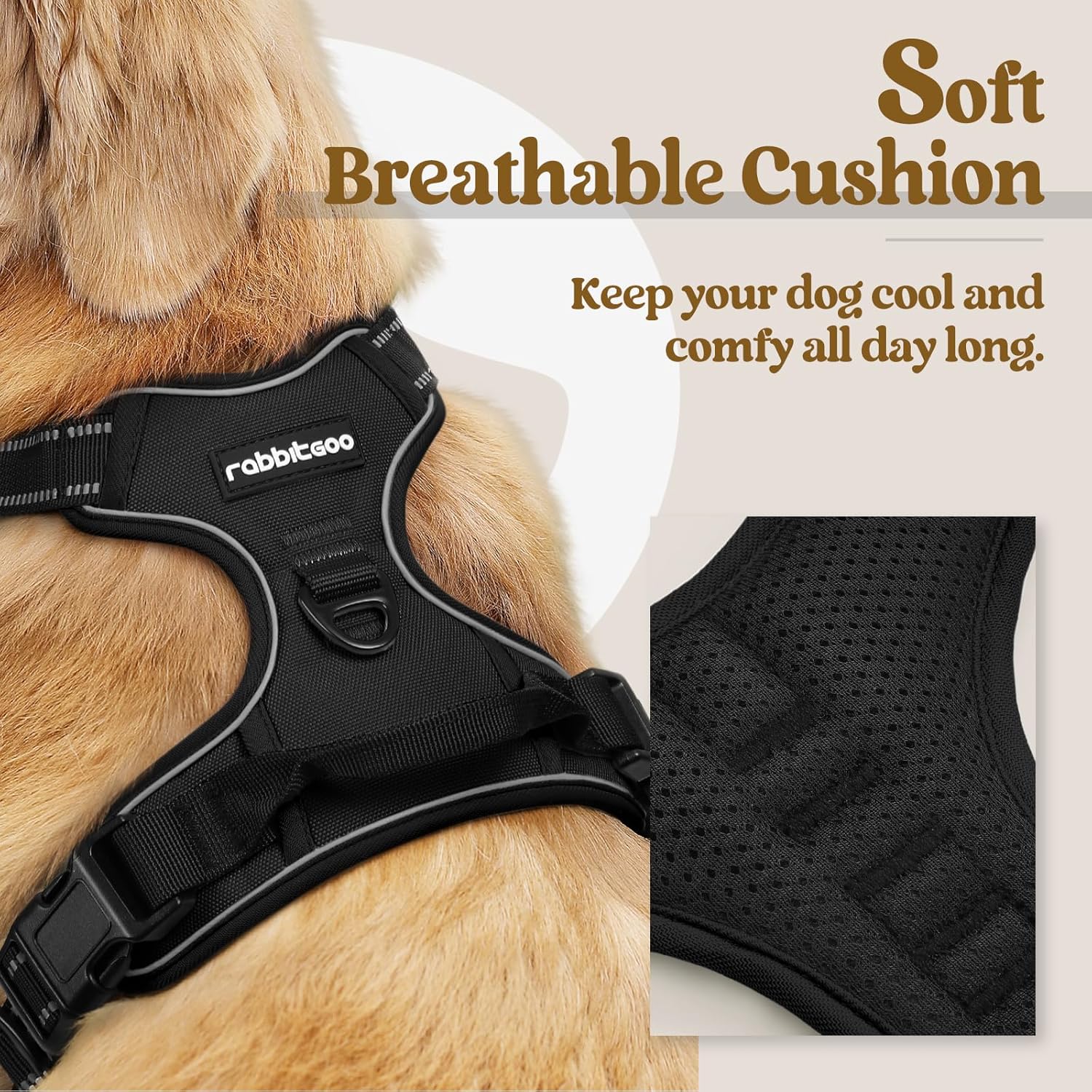
Rabbitgoo No-Pull Harness. This is the volume-seller in the category, and that volume generates useful signal: multiple reviewers — specifically Pittie owners and large-mix owners — report having to exchange sizes because their dog’s chest girth was the binding constraint, not weight. That’s a common sizing mistake the size chart encourages. The lesson here isn’t that the Rabbitgoo is uniquely well-designed for bully builds; it’s that owners have figured out to size it by chest girth alone and ignore the weight column entirely. When sized correctly by girth, reviewers consistently describe a secure, non-chafing fit at a price point well below the Ruffwear tier.
Carhartt Tradesman Harness. The fit story here is secondary to a material behavior story: reviewers note that the duck canvas outer (duck canvas is a tightly woven cotton-polyester fabric rated by weight in ounces per square yard, typically 10–12 oz for harness applications) repels trail debris — burrs, seeds, dried mud — more effectively than nylon webbing. For working or sport dogs that are already difficult to fit and spending hours in the field, a harness that doesn’t turn into a burr-collection device reduces post-activity handling time significantly. Owners note it runs slightly stiff until broken in, which affects early fit assessment — measure accurately, expect the canvas to soften over the first few weeks.
Frequently Asked Questions
How do I measure chest girth correctly on a deep-chested or bully-built dog?
Use a soft tape measure (the fabric kind used in sewing). Find the widest point of the ribcage by running your hands down the dog’s sides from the front legs back — on most dogs this is 1–3 inches behind the front leg attachment. Wrap the tape in a full circle and add two fingers of slack. On barrel-chested dogs, measuring while the dog is standing — not sitting — is critical; the ribcage flares when seated and will give you an artificially large number. Per the AKC’s measurement guide, chest girth taken correctly is always the primary number; note it separately from neck circumference before you open a size chart.
If my dog is between sizes on a size chart, should I size up or size down?
Size up, with one exception. For most harness types, a slightly large harness can be cinched down with adjustment straps; a slightly small harness cannot be let out. The exception is no-pull harnesses with a martingale loop (like the 2 Hounds Freedom): sizing too large on the chest loop defeats the martingale’s self-correcting function, so on those specific designs, size to the smaller option and rely on the independent neck adjuster for comfort.
Why does my dog’s harness fit the chest but slip over the head when they back up?
This is almost always a neck-strap fit issue. If the neck loop is sized for average neck-to-chest proportions but your dog has a thick neck close to its chest width, the neck strap appears to fit until the dog lowers and widens — at which point the harness slides forward and over the skull. The fix is either a harness with an independent neck adjustment (so you can tighten the neck loop without affecting chest fit) or a martingale-loop design that self-tightens under backward tension.
Are there harnesses that adjust the neck and chest independently for proportionally unusual dogs?
Yes, and this should be a filter criterion before you look at anything else. The 2 Hounds Freedom, Ruffwear Flagline, and Embark Adventure all offer independent adjustment at neck and chest. Canine Journal’s harness roundup flags dual-zone adjustment as one of three core features to require for dogs with non-standard proportions, alongside padded axilla cutouts and a front clip option.
My dog refuses to put their head through any overhead opening — what entry styles avoid this entirely?
Step-in and side-clip (wrap-and-snap) designs. Step-in harnesses are assembled on the ground and the dog steps its front feet into two loops; the harness then clips across the back. Side-clip designs drape over the dog’s back like a saddle and fasten at the chest and/or belly with buckles — no head entry at all. The 2 Hounds Freedom uses a side-clip entry that reviewers of overhead-averse dogs consistently praise as the feature that ended their harness standoffs entirely.
The Decision Frame
If your dog is a bully breed or thick-necked mix with a neck-to-chest ratio above 0.75, the 2 Hounds Freedom is the starting point — the martingale loop and independent adjusters solve the core geometric problem, and the side-clip entry sidesteps the overhead battle entirely.
If your dog is a sighthound or narrow-chested breed where the neck is proportionally small relative to the chest, the Ruffwear Flagline’s five-point adjustment gives you the inverse control you need: snug at the neck, looser at the chest, without migration.
If you’re working with a small dog that happens to have a barrel-chested bully build — the scaled-down version of the same problem — the Embark Adventure has the field evidence on exactly this scenario.
If budget is the active constraint and you’re willing to do one size exchange to dial in chest girth correctly, the Rabbitgoo No-Pull is the honest answer: size by girth, ignore weight, and it fits most bully builds reliably at entry-level pricing.
In every case: measure chest girth first, neck circumference second, note both numbers before opening any size chart, and treat weight as a sanity check only.