September 24, 2026 • Marisol Vane • 10 min reading time • Prices verified June 4, 2026
Enrichment Bundles vs. Individual Toys: What a Multi-Pack Actually Gets You
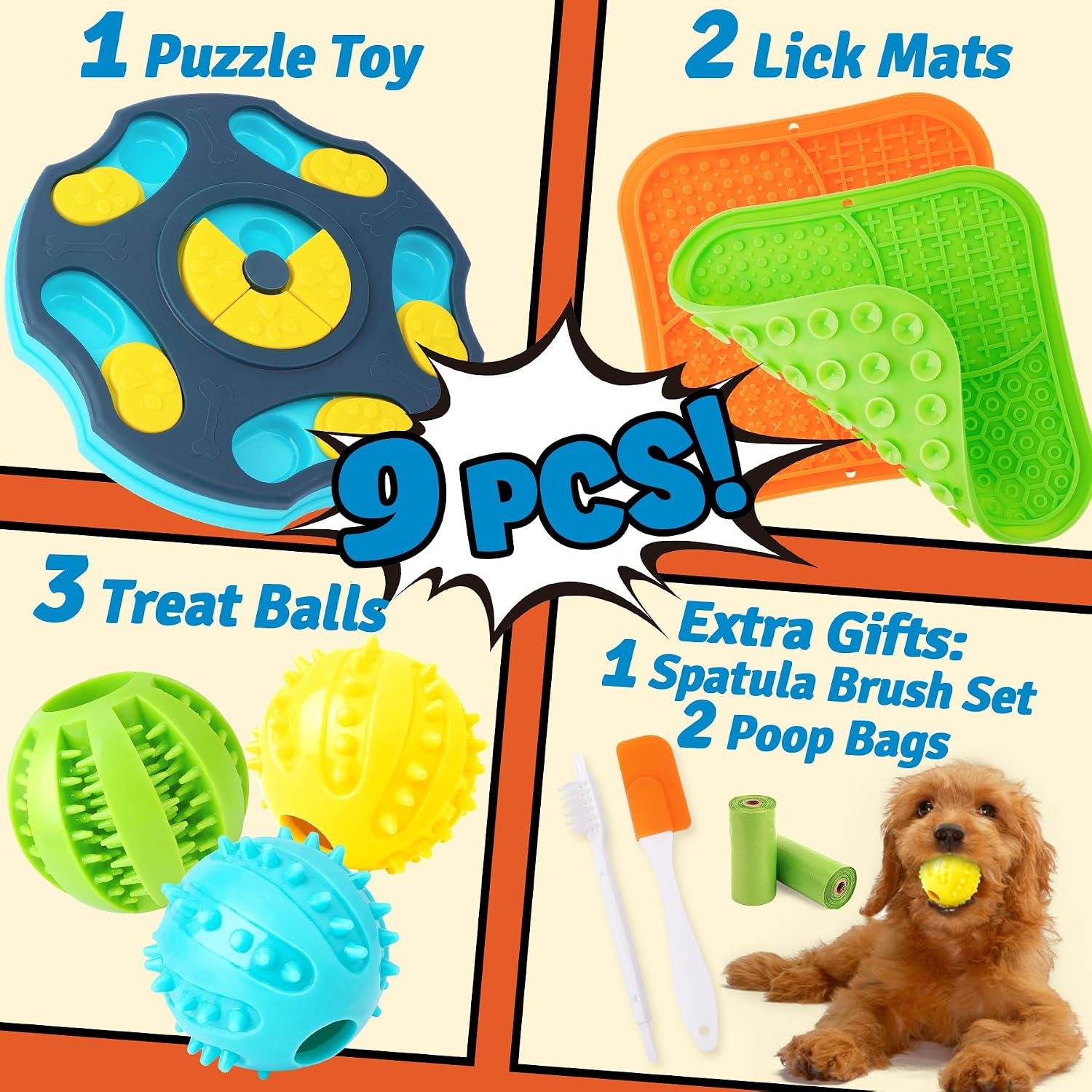
If you’ve been looking at dog enrichment toys — puzzles, snuffle mats, lick mats, treat-dispensing balls — you’ve probably noticed that Amazon and pet retailers love selling them in bundles. Enrichment, in this context, means any activity that gives your dog’s brain a job: sniffing, problem-solving, licking, nosing pieces around to release food. The American Kennel Club’s guidance on mental stimulation notes that dogs need cognitive engagement the same way they need physical exercise, and a bored dog tends to create his own entertainment in ways you won’t enjoy. The pitch for bundles is obvious: one purchase, several tools, problem solved. But “solved” is doing a lot of work in that sentence. Whether a bundle actually delivers depends on your dog’s size, drive, and current skill level — and whether the individual pieces inside it would have earned a spot in your cart on their own merits.
This guide is for owners who already have one or two enrichment pieces and are deciding whether to scale up via a bundle or continue building a deliberate single-item kit. We’ll look at what bundle economics actually look like, where the quality gaps tend to appear, and how to read your dog’s behavior as a reliable signal for when and how to level up.
| EDITOR'S PICKStewart 100% Beef Liver Dog Tre… | Mid-tierOutward Hound by Nina Ottosson… | Budget pickOutward Hound by Nina Ottosson… | |
|---|---|---|---|
| Type | Freeze dried treats | Treat puzzle | Treat-dispensing ball |
| Difficulty | — | Level 2 | Level 1 |
| Size | 21 oz | — | 4.8" |
| Piece count | ~475 | — | — |
| Protein | 50% | — | — |
| Grain free | ✓ | — | — |
| Price | $34.98 | $13.77 | $6.35 |
| See on Amazon → | See on Amazon → | See on Amazon → |
What You’re Actually Buying When You Buy a Bundle
The appeal of an enrichment bundle is the same as any multi-pack: apparent value and the convenience of not having to make six separate decisions. But there are two distinct bundle types on the market right now, and they behave very differently.
Variety bundles (like the Forfon enrichment set) throw a snuffle mat, a lick mat, a treat ball, and sometimes a puzzle board into one box at a price point that looks steep until you price out the parts individually. Difficulty-ladder bundles (like Nina Ottosson’s level-matched sets) focus on one product category — interactive puzzles — and give you a progression path rather than format variety.
Owners report meaningfully different experiences with each. Reviewers of the Forfon bundle are enthusiastic, but when you look closely at who’s enthusiastic, a pattern emerges: small-dog owners — toy poodle and Maltese households, specifically — call it a complete kit that kept their dogs occupied daily. Large-breed owners, by contrast, implicitly reveal in their reviews that the snuffle mat’s pile is too short and the treat openings on the ball are too narrow for a 60-pound dog to work efficiently. The bundle isn’t bad; it’s sized. If you own a dog under roughly 25 pounds, the Forfon set delivers honest variety value. If you own a retriever or a shepherd mix, the components function as starter tools at best and frustration-generators at worst.
The takeaway for practitioners deciding on a kit: bundle value is breed-weight-gated. Do the component size check before the component price check.
The Difficulty Curve Problem — and Why It’s the Real Variable
Here’s the thing about enrichment puzzles that bundle marketing almost never addresses: difficulty is a consumable. The Nina Ottosson Level 1 Treat Tumble is a round ball with openings the dog bumps and rolls to release kibble. On day one, most dogs need a few minutes to figure it out. By week two, owners report that dogs solve it in under 60 seconds and walk away unimpressed. One reviewer documented this so precisely she literally taped over a hole to reduce the number of treat exits and extend engagement — a real-world hack that tells you something important: the out-of-box difficulty ceiling on Level 1 products is genuinely low, and most dogs with any food motivation will outpace it fast.
This isn’t a flaw in the Treat Tumble specifically — it’s doing its job as a Level 1 tool. The flaw is buying it without a plan for what comes next.
The Nina Ottosson Level 4 MultiPuzzle sits at the opposite end. Reviewers consistently describe it as the only puzzle in the lineup that reliably stumps dogs who blow through everything else — smart breeds like Border Collies, Belgian Malinois, and Australian Shepherds included. The design requires dogs to slide, lift, and rotate multiple interlocking pieces in sequence to access treats. Owners report that high-drive dogs return to it with genuine engagement for weeks, not days. That’s the benchmark for a tool that earns its price over time.
The nuance: a 4-star reviewer called cleanup “a total chore,” and that’s worth taking seriously. The MultiPuzzle’s many moving compartments are effective precisely because they’re complex — and complexity means more surface area for treat residue. If you’re running this tool daily with high-value wet treats or freeze-dried liver, build a cleaning routine before you need one (more on that in the FAQ).
By the numbers:
- Nina Ottosson difficulty scale runs 1–4; most food-motivated adult dogs outpace Level 1 in 1–2 weeks
- Level 4 MultiPuzzle has the highest sustained engagement rate in owner-reported reviews across the lineup
- Forfon bundle components are consistently rated as appropriate for dogs under ~25 lbs; size limitations appear in large-breed reviews
Snuffle Mats and Lick Mats: The Underrated Anchors
Before you spend $80 on a puzzle board, consider whether your dog’s enrichment gaps are actually better served by a snuffle mat or a lick mat. These two formats work differently from puzzles: instead of requiring dogs to manipulate objects, they engage the nose and tongue in extended, repetitive sensory work. VCA Hospitals’ enrichment guidance notes that olfactory engagement — scent work, foraging — is cognitively tiring for dogs in ways that are disproportionate to the apparent effort. A ten-minute snuffle mat session can settle a dog more effectively than a puzzle that gets solved in ninety seconds.
The AWOOF Snuffle Mat is frequently recommended in this category, and reviewers generally rate it well — but there’s a quality-control pattern worth flagging. Owners report a notable inconsistency between color variants: the green version receives consistently positive durability feedback, while the yellow variant draws complaints about fleece strips that pull loose faster than expected. If you’re ordering the AWOOF, reviewers effectively recommend defaulting to the green colorway and treating any other variant as a quality question mark until the pattern changes.
On treat pairing: snuffle mat reviewers who name their fill choices specifically keep coming back to Stewart Beef Liver freeze-dried treats as their preferred puzzle and mat fill. The treats are small enough to tuck into snuffle mat fleece without clumping, have a high odor profile that extends nose engagement, and hold up in puzzle compartments without going sticky. This cross-category pairing — a foraging mat with freeze-dried liver fill — shows up repeatedly enough in owner reports to treat it as a validated setup rather than an anecdote.
For dogs that aren’t food-puzzle motivated (and some genuinely aren’t — scent hound owners in particular note that their dogs prefer nose-forward foraging over object manipulation), a snuffle mat as the daily enrichment anchor is a legitimate strategy, not a consolation prize. Whole Dog Journal’s coverage of puzzle toys for dogs acknowledges that engagement preference varies by breed history, and forcing puzzle engagement on a dog who finds it aversive produces stress, not stimulation.
Building a Kit vs. Buying a Bundle: The Decision Frame
Here’s where practitioners need to be direct with themselves. Bundles optimize for purchase convenience. Individual kit-building optimizes for fit. The question is which inefficiency costs you more.
If X, then Y:
-
If your dog is under 25 lbs and you want format variety without the research burden: The Forfon bundle is a defensible starting kit. You’ll likely use every piece.
-
If your dog is over 40 lbs: Skip variety bundles entirely. The size mismatch means you’ll replace half the components within a month. Build individual: start with the Nina Ottosson Level 2 or 3, add a snuffle mat (AWOOF green, specifically), and fill with Stewart Beef Liver.
-
If your dog blazes through Level 1–2 puzzles in days: Go straight to the Nina Ottosson Level 4 MultiPuzzle. Don’t ladder through levels you’ll skip. Budget the cleaning time.
-
If your dog shows low puzzle interest but strong nose drive: Anchor on the snuffle mat daily. Use freeze-dried high-odor treats. Skip the puzzle investment until you see engagement signals.
-
If you’re outfitting multiple dogs or a small training operation: Individual pieces at volume beat bundles on per-unit cost and let you match difficulty to each dog. Bundles are one-size logic that doesn’t survive the second dog.
The honest summary: enrichment bundles are a good deal for one specific buyer — small-dog owner, wants variety, doesn’t want to research. For everyone else, the bundle premium buys you components that don’t quite fit, at a difficulty level you’ll outgrow, in a size that was designed for a smaller dog.
Frequently Asked Questions
Are enrichment bundle sets worth it, or do the individual pieces tend to be lower quality than standalone versions?
It depends on the bundle. Variety bundles like the Forfon set include purpose-built components — they’re not obviously lower quality than equivalent standalones, but they’re sized and designed for smaller dogs, which limits their audience. Difficulty-ladder bundles from Nina Ottosson are simply the same products sold in a set, so quality is identical to standalone purchases. The value question is whether you’ll actually use every piece. Owners consistently report that one or two tools from a variety bundle become daily anchors while the rest sit unused — which makes the effective per-unit cost higher than it looks at checkout.
How quickly do most dogs solve a Level 2 puzzle, and how do you know when it’s time to move up?
Owners report that food-motivated dogs typically solve Level 2 puzzles reliably within one to three weeks of regular use. The signal for moving up isn’t time — it’s behavior: when your dog stops investigating the puzzle and goes directly to the solution in under two minutes without exploration, the cognitive load is gone. That’s the moment to introduce the next level. Tufts Your Dog’s boredom-buster guidance suggests that the goal is sustained sniffing and problem-solving behavior, not just treat access.
Do freeze-dried treats work better than kibble in puzzle toys for extending engagement time?
Owners consistently report yes, with caveats. Freeze-dried treats like Stewart Beef Liver have a stronger scent profile than kibble, which keeps dogs searching longer in snuffle mats and nose-work formats. In puzzle compartments with sliding pieces, freeze-dried treats hold their shape better than wet food and don’t clump the way some semi-moist treats do. Kibble works fine for dogs with strong food drive and low distraction; for dogs who need extra motivation to engage, the scent upgrade matters.
Are Nina Ottosson puzzle pieces dishwasher safe, and how do you actually clean the Level 4 MultiPuzzle?
Nina Ottosson’s published product guidance indicates that most of their plastic puzzle pieces are top-rack dishwasher safe. For the Level 4 MultiPuzzle, owners who use high-value wet or freeze-dried treats report that the most effective approach is a soak in warm water first to loosen residue from the compartment channels, followed by a bottle brush for the narrower track sections, then a dishwasher run. Reviewers who skip the pre-soak step are the ones who land on “total chore” — the two-step process reduces that friction significantly.
Can a single lick mat or snuffle mat be used as the daily enrichment anchor if a dog isn’t food-puzzle motivated?
Absolutely, and the VCA Hospitals enrichment framework supports this directly. Lick mats engage the parasympathetic nervous system through repetitive licking — there’s a reason they’re used in rehabilitation and anxiety-management contexts. Snuffle mats activate olfactory processing, which is cognitively demanding independent of puzzle complexity. For dogs that find object-manipulation puzzles aversive rather than stimulating, a daily snuffle mat or lick mat session is a complete enrichment strategy, not a workaround. The goal is cognitive engagement and a settled dog — the format is secondary.