September 20, 2026 • Marisol Vane • 10 min reading time • Prices verified June 4, 2026
Dog Enrichment Bundle Kits vs. Building Your Own: What a Multi-Pack Gets You at Every Price Point
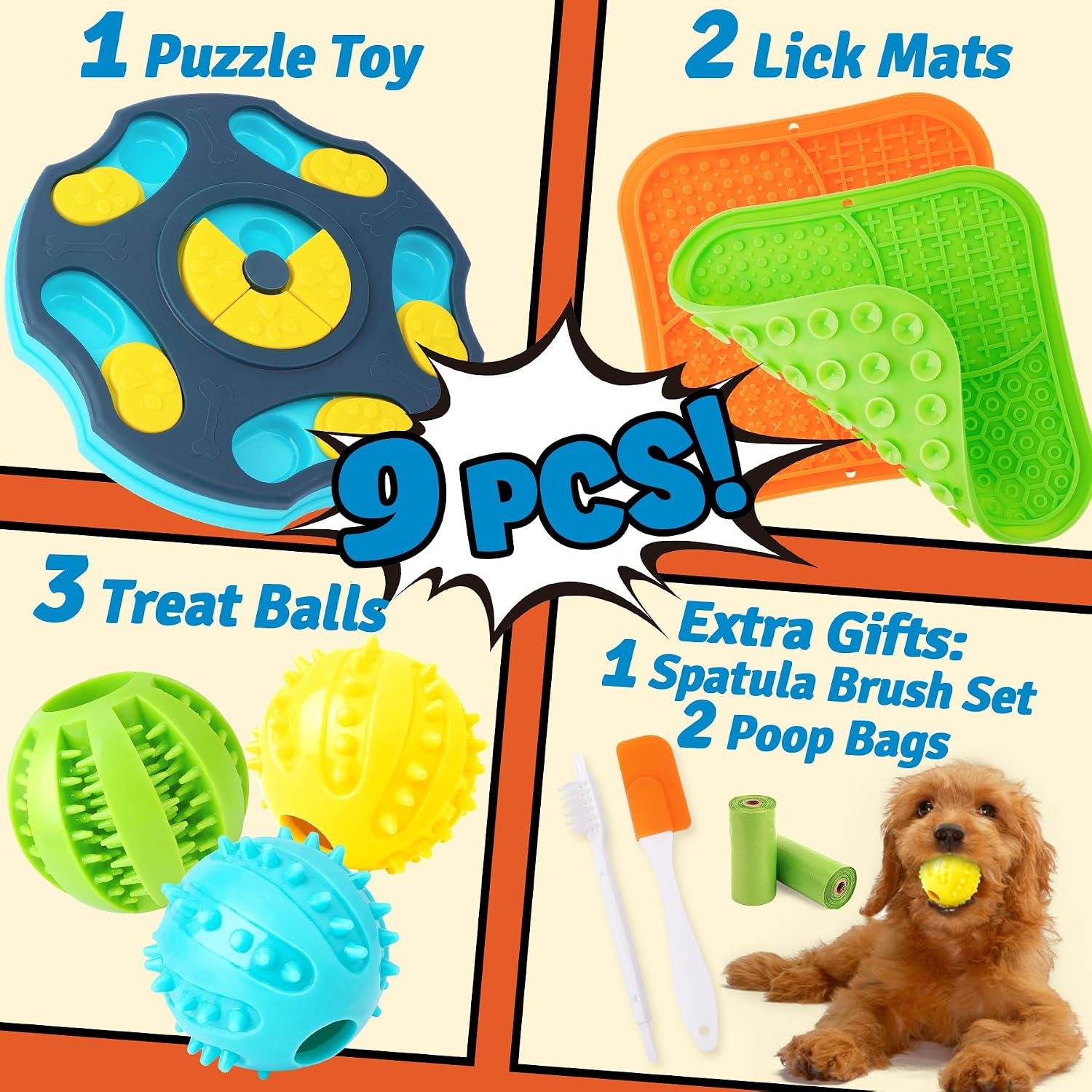
If you’ve ever typed “dog enrichment kit” into a search bar, you’ve hit a wall of multi-packs — eight or nine items in one box, promising to keep your dog mentally busy for months. “Enrichment” just means activities that engage a dog’s brain and natural instincts: sniffing, licking, foraging, problem-solving. Done well, it reduces anxiety, slows fast eaters, and burns energy without a second walk. Done poorly, it’s a $30 pile of plastic your dog solves in four minutes and never touches again. This guide breaks down exactly what you get in a bundle versus what you’d assemble piece by piece — with the real tradeoffs, the real failure modes, and a clear decision rule at the end so you know which path fits your situation before you spend a dollar.
What a Bundle Actually Contains (and What the Packaging Doesn’t Say)
Most enrichment bundles follow a predictable template: one or two lick mats (flat silicone surfaces you smear with peanut butter or wet food), one snuffle mat (a rubber base with fabric strips knotted through it, designed for hiding kibble so a dog has to sniff it out), one or two treat-dispensing balls or rolling toys, and one sliding-tile or lift-the-cup puzzle feeder. That’s roughly the format of the Forfon 9-pack bundle, which is one of the more-reviewed options in this category as of mid-2026.
Aggregated reviewer language on the Forfon kit reveals a clear internal hierarchy: the lick mats — particularly the ones with suction cups — are consistently called out as the standout items, especially for bath time use when suctioned to a tub wall. The dispensing balls draw similar praise. The puzzle feeder, by contrast, reads as filler. Owners describe it as “fun at first” but basic enough that a motivated dog clears it in a session or two. That pattern matters for your buying decision: bundles tend to over-index on lick mats and under-invest in puzzle complexity, because lick mats are cheap to manufacture and photograph well.
Per VCA Hospitals’ enrichment overview, the goal of any enrichment format is to engage the dog’s natural foraging and sniffing behaviors — not just to occupy time. A puzzle feeder that’s solved in ninety seconds isn’t meeting that bar. So before you pay bundle pricing, it’s worth auditing what’s actually in the box against your dog’s current skill level.
The Build-Your-Own Math: When Piece-Parts Win
By the numbers — bundle vs. build at two price tiers:
| Path | Approx. spend | Items | Weakest link |
|---|---|---|---|
| Mid-tier bundle (e.g., Forfon 9-pack) | ~$30–40 | 9 (mixed quality) | Puzzle feeder |
| Targeted build (lick mat + snuffle mat + Level 2 puzzle) | ~$45–65 | 3 (higher individual quality) | None — you chose each |
| Premium build (lick mat + Nina Ottosson Level 3 + snuffle mat) | ~$70–90 | 3–4 | Budget |
The bundle wins on cost-per-item. The build wins on cost-per-useful-item. That’s the whole framework — run the math on what you’ll actually use.
The American Kennel Club’s mental stimulation guide notes that dogs need graduated difficulty to stay engaged with puzzle feeders; a toy that’s too easy stops being enriching within days. That’s exactly the failure mode owners report with the DR CATCH-style puzzles that appear in most bundles: reviewers consistently note that puppies under three months old solve them within a few uses. If you have a fast learner — or an adult dog who has already worked through basic puzzles — bundle-tier puzzle feeders are dead weight almost immediately.
Standalone lick mats tell a different story. The LUKITO standalone lick mat surfaces a genuine empirical finding from long-run reviewers: suction cups fail when the mat is frozen in a warped position, but work reliably when frozen flat. That’s not a product defect — it’s a usage protocol. Freeze flat, apply while still cold, and you get reliable wall adhesion. Reviewers who learned this trick rate the mat substantially higher than reviewers who didn’t. This kind of nuance is harder to surface from bundle reviews, where nine items are being evaluated at once and individual usage patterns get lost in the noise.
Snuffle Mats: The Format With the Most Quality Variance
Of all the enrichment formats, snuffle mats have the widest quality spread — and the most opportunity to get burned by a bundle that includes the wrong version.
The AWOOF snuffle mat is a useful case study. Reviewers note a documented quality inconsistency between colorways: the yellow version has been described as half the quality of the green due to single-ply fabric blades, which collapse under a dog’s nose rather than holding kibble in place. The green version uses thicker, double-ply strips that stand upright and create genuine foraging resistance. If you’re ordering an AWOOF mat, specify green. This is the kind of detail that never appears on a bundle listing, because bundles ship whatever colorway is in stock.
The Vivifying snuffle mat earns one of the more interesting reviews in this category: multiple owners report it works exceptionally well for blind dogs as a scent-based enrichment tool. This makes sense — a blind dog relies on olfactory navigation, and a snuffle mat eliminates the visual component entirely, making it a format-native experience rather than a workaround. Per PetMD’s overview of canine sensory enrichment, scent work engages the same cognitive circuits as tracking and nosework, and a snuffle mat is an accessible on-ramp for dogs who can’t or won’t engage with visual puzzles. If you’re working with a visually impaired dog, a standalone Vivifying mat is worth prioritizing over a bundle puzzle.
Whole Dog Journal’s coverage of food-dispensing toys consistently emphasizes durability of fabric attachment points as the primary failure mode in snuffle mats. Look for mats where the fabric strips are knotted through a rubber or TPE (thermoplastic elastomer — a flexible, rubber-like plastic that’s easier to wash than fabric) base rather than glued or heat-bonded. Knotted construction survives machine washing; glued construction does not.
Treat Dispensing Balls: The Difficulty Calibration Problem
The Treat Tumble ball illustrates a systemic issue with dispensing toys: out-of-box difficulty is almost never calibrated correctly. Owners report a common modification — taping over one or more holes to slow kibble release — because the factory aperture setting dispenses food too quickly for the toy to function as enrichment. A ball that empties in thirty seconds is a bowl, not a puzzle.
The fact that owners are modifying a product with tape to make it work isn’t a failure of the individual buyer — it’s a signal that the product shipped at the wrong difficulty level for most real-world use cases. When you’re evaluating a bundle, ask whether the dispensing toy includes any mechanism for adjusting hole size or fill volume. Most don’t. If yours doesn’t, budget the tape.
The broader lesson: difficulty calibration is the most important spec in enrichment toys, and it’s almost never listed. Manufacturers rate toys as “easy / medium / hard” without defining what that means for an adult Border Collie vs. a twelve-week-old Golden Retriever. The American Kennel Club’s enrichment guidance recommends starting dogs at the lowest difficulty tier and advancing only when the dog solves the current format consistently without frustration — which means even a “hard” bundle toy may need to be retired in a month for a bright adult dog.
Frequently Asked Questions
Are the lick mats in enrichment bundles the same quality as standalone lick mats?
Generally, no. Bundle lick mats are typically thinner silicone with shallower texture channels, which means food releases faster and the mat provides less sustained engagement. Standalone mats like the LUKITO tend to use deeper relief patterns and heavier silicone. If lick mat use is a priority — especially for bath time or high-anxiety moments — buy the standalone.
How do I get suction cups to actually stay stuck to my wall or tub?
Surface prep matters more than suction cup quality. The wall or tub needs to be completely dry, non-porous, and free of soap residue. Reviewers who discovered the LUKITO’s freeze-flat protocol report that applying a cold (but not still-frozen) mat to a dry surface creates reliable adhesion. Avoid textured tile — suction cups don’t seal against grout lines.
What enrichment format lasts longest before my dog gets bored?
Snuffle mats, by a wide margin, because the hiding pattern can be varied every session. Puzzle feeders have a fixed solution path that dogs memorize. Lick mats provide duration (licking takes time) but no cognitive novelty once the smear pattern is familiar. Per VCA Hospitals’ enrichment guidance, rotating formats and varying what’s hidden keeps the activity novel longer than any single product can.
Can I use a snuffle mat as a slow feeder replacement at mealtime?
Yes, and it’s one of the more practical use cases. A snuffle mat typically extends a meal from thirty seconds to five or six minutes, which is comparable to a dedicated slow-feeder bowl. The advantage over a bowl is that a mat engages scent-work behavior rather than just mechanical slowing. The disadvantage is cleanup — kibble dust settles into the fabric, and daily washing accelerates wear. If you’re using a mat for every meal, buy two and alternate.
Are these safe for aggressive chewers or will pieces break off?
Lick mats and snuffle mats are lower risk because there’s nothing small enough to detach and swallow under normal use. Puzzle feeders with small sliding tiles or lift tabs are the real concern — the tabs can be levered off by a determined dog. The DR CATCH-style puzzles in bundles use injection-molded ABS plastic (acrylonitrile butadiene styrene — a hard plastic common in budget toys) that can fracture under sustained chewing pressure. Supervise any puzzle session until you’ve established your dog treats the toy as a puzzle, not a chew object.
How do I wash a snuffle mat without it falling apart?
Machine wash on cold, gentle cycle, in a mesh laundry bag. Skip the dryer — heat degrades rubber bases and loosens knots. Air dry flat. Avoid hot water, which softens the rubber base and causes knots to slip. Whole Dog Journal’s toy maintenance guidance recommends inspecting knot integrity after every third wash and retiring any mat where blades are pulling free.
The Decision Rule
If your dog is a puppy or an enrichment beginner, a mid-tier bundle gives you format diversity at low cost — you’re figuring out which formats your dog actually engages with, and losing money on a $5 puzzle feeder hurts less than losing it on a $25 standalone. Accept that the puzzle will age out fast; treat the lick mats as the keeper items.
If your dog has already worked through basic puzzles and you know lick mats are the primary use case, skip the bundle and buy a quality standalone lick mat plus a Level 2 or Level 3 puzzle feeder separately. You’ll spend more upfront and waste nothing.
If you’re working with a dog with special considerations — visual impairment, extreme anxiety, aggressive chewing — build your own from the start. Bundle manufacturers aren’t designing for edge cases, and the format mismatches cost you more in time and frustration than the price premium of targeted buying ever would.
The bundle is a sampler. The build is a protocol. Know which one you need before you open the cart.