September 7, 2026 • Marisol Vane • 9 min reading time • Prices verified June 4, 2026
Tactical Dog Harnesses: Separating Genuine Heavy-Duty Builds From the MOLLE Aesthetic
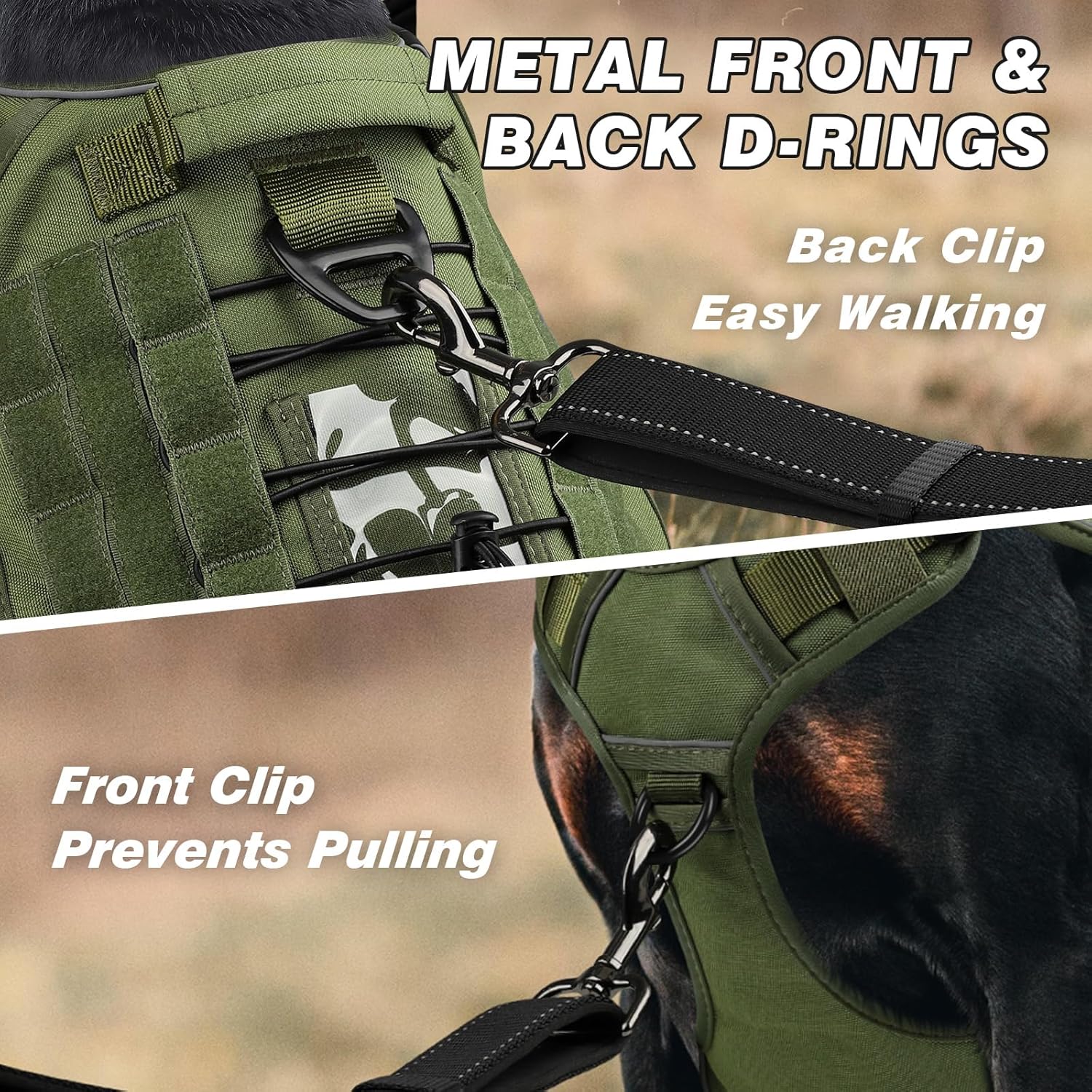
Walk into any pet-supply retailer or scroll through any gear-focused dog community in 2026 and you’ll see them everywhere: harnesses bristling with MOLLE webbing (that’s the grid of nylon loops originally designed for military load-bearing equipment — it’s what lets soldiers, K9 handlers, and now plenty of weekend hikers attach pouches, patches, and tools to a vest or harness without sewing anything). Some of these harnesses are legitimately built for demanding work — search-and-rescue operations, protection sport, off-trail pack carrying, law enforcement K9 duty. Others are essentially fashion items dressed in the visual language of working gear: they look the part, but the stitching, webbing weight, and hardware haven’t been engineered for real loads or real stress. The difference matters, because a harness that fails on a cliff trail or during a bite-work session isn’t just an expensive mistake — it’s a safety problem. This guide breaks down exactly what separates functional tactical builds from the aesthetic, names the specs worth caring about, and gives you a clear decision rule for matching harness to actual use case.
What “Tactical” Actually Means in Harness Construction
The word tactical has no regulated definition in the pet industry, which is precisely the problem. Any brand can slap MOLLE loops on a $25 shell and call it tactical. The characteristics that actually define a working-grade harness come down to four measurable variables: webbing denier, hardware rating, stitching pattern, and load-point geometry.
Denier (abbreviated D) is the unit measuring how heavy — and therefore how strong — a fiber is. Standard consumer harnesses are commonly built from 600D or 900D polyester. Legitimate heavy-duty builds start at 1000D Cordura nylon, with premium K9 working harnesses reaching 1680D. Canine Journal’s updated 2025 tactical harness roundup consistently flags denier as the single most reliable proxy for durability in this category.
Hardware is where the cost-cutting is most obvious. Functional working harnesses use either stainless steel or aircraft-grade aluminum hardware rated for specific load weights (look for ratings expressed in kilonewtons, or kN — 1 kN equals roughly 225 lbs of force). Plastic side-release buckles on harnesses marketed for K9 duty are a tell. They’re fine for a town walk; they’re not rated for the forces generated by a 70-lb Malinois hitting the end of a leash at speed.
Stitching pattern matters more than thread count alone. Box-X stitching — the boxed rectangle with an X through the center sewn at every load-bearing attachment point — is the industry standard for webbing joints under dynamic load. Parallel rows of straight stitching, by contrast, are appropriate for accessories but are not adequate at handle mounts or leash ring attachment points on a working harness.
Load-point geometry refers to where the harness distributes force when a dog pulls, is restrained, or is lifted by the top handle. A well-engineered harness routes webbing continuously from chest plate to dorsal attachment ring without relying on sewn-on patches as the primary structural path. Whole Dog Journal’s March 2025 harness guide flags this as the most commonly overlooked spec: the decorative MOLLE grid may be securely stitched, while the actual force path through the harness runs through a far weaker panel seam.
The Builds That Actually Deliver: Spec Comparison
Here’s where the practitioner-level evaluation earns its keep. Rather than accepting marketing copy, the comparison that matters is published spec versus use-case requirement.
By the numbers — key specs at a glance:
| Harness | Primary Webbing | Top Handle | MOLLE Grid | Approx. MSRP (2026) |
|---|---|---|---|---|
| Ruffwear Web Master Pro | 1680D Cordura | Padded, dual-anchor | No | ~$110 |
| OneTigris MIOS | 1000D Cordura | Reinforced, box-X | Full dorsal + lateral | ~$65 |
| Julius-K9 IDC Powerharness | 1000D nylon | Integrated handle | No | ~$80 |
| LASER/EJB K9 Storm | 1680D Cordura | Padded, stitched | Partial dorsal | ~$185–$220 |
The Ruffwear Web Master Pro is the most cited genuine heavy-duty option at the prosumer price point. Per Ruffwear’s published spec sheet, the harness runs 1680D Cordura throughout its primary load path, uses aluminum hardware, and distributes weight across five adjustment points — a geometry originally developed for search-and-rescue deployments. The Wirecutter’s 2025 dog harness guide notes it as the benchmark for load-bearing builds among non-law-enforcement working dogs, particularly for trail running and pack carrying. It does not have a MOLLE grid — an intentional omission that keeps the load path clean.
OneTigris’s MIOS harness represents the legitimate end of the MOLLE-equipped category. Published specs confirm 1000D Cordura, removable handle with box-X anchor stitching, and a full dorsal and lateral MOLLE grid rated to carry accessory pouches. Canine Journal’s 2025 roundup positions it as the honest value option for sport-dog handlers and trainers who actually need accessory attachment — it concedes that 1000D is the floor, not the ceiling, of working-grade material, but at roughly $65 it represents a defensible cost-per-capability ratio for training environments where appearance during competition demos matters alongside function.
The Julius-K9 IDC Powerharness occupies a middle position. It lacks MOLLE webbing but its integrated handle and published 1000D nylon construction make it a legitimate working harness, not an aesthetic piece. The AKC’s 2024 editorial on service dog gear specifically names it as a commonly specified option among service dog trainers for its simplicity of fit geometry and reliable hardware.
The EJB/LASER K9 Storm sits at the professional procurement end of the market — 1680D construction, stainless hardware options, and a price that reflects purpose-built K9 unit procurement rather than prosumer purchase. It’s worth knowing it exists at this price point so you’re not surprised when a law enforcement supplier quotes it.
The Aesthetic Category: What to Avoid and Why
The majority of “tactical” harnesses sold through mass-market channels — and a significant portion of what appears in marketplace searches — are built to 500D–600D polyester with zinc alloy hardware, sewn-on MOLLE patches (as opposed to woven-through construction), and handle attachments stitched to a top panel rather than anchored to a continuous webbing spine.
The failure mode is predictable. Under a static load — a dog standing calmly — these harnesses behave identically to their working-grade counterparts. Under dynamic load — a dog lunging, being lifted by the handle, or hitting the end of a long line — the weakest sewn joint becomes the failure point. Because these harnesses often look nearly identical to genuine builds in product photography, the practitioner’s shortcut is to skip the images and read the spec table. If denier is absent from the product listing, that is itself diagnostic information.
The Whole Dog Journal’s 2025 guidance on harness evaluation makes the same point from a fitting-and-safety angle: the marketing language “heavy-duty,” “military-grade,” and “tactical” carries no regulatory weight, and the burden of verification sits entirely with the buyer.
One additional red flag specific to MOLLE-equipped harnesses: check whether the MOLLE webbing is load-bearing or decorative. Functional MOLLE webbing is woven through backing material in horizontal rows, allowing pouch clips to thread under the webbing and lock. Decorative MOLLE is sewn as a flat panel on top of the harness shell — it accepts patches and velcro panels but will not correctly seat a modular pouch clip, and it adds weight without adding utility.
Fit Geometry by Breed Type: Where Most Buyers Go Wrong
Hardware and material specs are necessary but not sufficient. A 1680D Cordura harness fitted incorrectly to a dog’s body type creates pressure points, restricts gait, and in worst cases can cause the same kind of shoulder interference that Whole Dog Journal flagged as a concern with front-clip harnesses: the webbing path crossing the shoulder joint and limiting stride.
Deep-chested breeds (German Shepherd Dogs, Belgian Malinois, Dobermans) require a longer sternum-to-girth measurement and a chest plate that sits below the point of shoulder. Barrel-chested breeds (American Bulldogs, English Bulldogs, some Staffordshires) need a wider chest plate and shorter girth-to-spine span. Sighthound builds — notably Greyhounds and Whippets — have a reverse taper that makes most tactical harnesses designed around a standard torso ratio functionally non-adjustable.
The Ruffwear Web Master Pro’s five-point adjustment handles the deep-chested spectrum well. Julius-K9’s sizing system, which uses girth measurement as its primary variable, tends to fit barrel-chested dogs more predictably. OneTigris publishes a sizing chart cross-referencing both neck and girth, which is the minimum data required to fit correctly without measuring the dog in person.
The practitioner takeaway: if you’re specifying harnesses at volume for a training program or small kennel operation, keep at least two harness platforms in rotation. A single model will not correctly fit a working Malinois and a working Bulldog with equivalent accuracy.
The Decision Rule
If you need to make a call today, here’s the frame:
If the dog will be lifted, restrained under dynamic load, carry pouches with real weight, or work in protection or detection sport — specify 1680D Cordura, continuous-webbing load path, metal hardware, box-X stitching at every attachment point. Ruffwear Web Master Pro at the prosumer tier, EJB/LASER K9 Storm at the professional procurement tier. Skip MOLLE unless accessory attachment is a functional requirement, not a preference.
If MOLLE attachment is genuinely needed (modular pouches for medical supplies, identification panels for service or sport work, or patch display for competition contexts) — OneTigris MIOS is the credible budget-to-mid option; verify that the MOLLE is woven-through, not surface-sewn. Confirm hardware is rated aluminum, not zinc alloy, before committing at volume.
If the dog’s primary activity is trail running, urban daily wear, or vehicle-restraint tethering — and the tactical aesthetic is secondary to fit and function — the Julius-K9 IDC Powerharness handles the use case cleanly at lower cost without the MOLLE weight overhead.
If a harness is listed under $40, calls itself tactical, and doesn’t publish denier or hardware material — treat it as an aesthetic item regardless of what the marketing says. It may never fail in normal use. It is not appropriate for situations where failure has consequences.
The tactical harness market in 2026 is large enough that the signal-to-noise ratio has gotten genuinely difficult. The brands worth specifying have published their numbers. The ones that haven’t told you something important by omission.