August 9, 2026 • Marisol Vane • 9 min reading time • Prices verified June 4, 2026
Step-In and Vest Harnesses for Small Dogs: Why the Fit Rules Are Completely Different
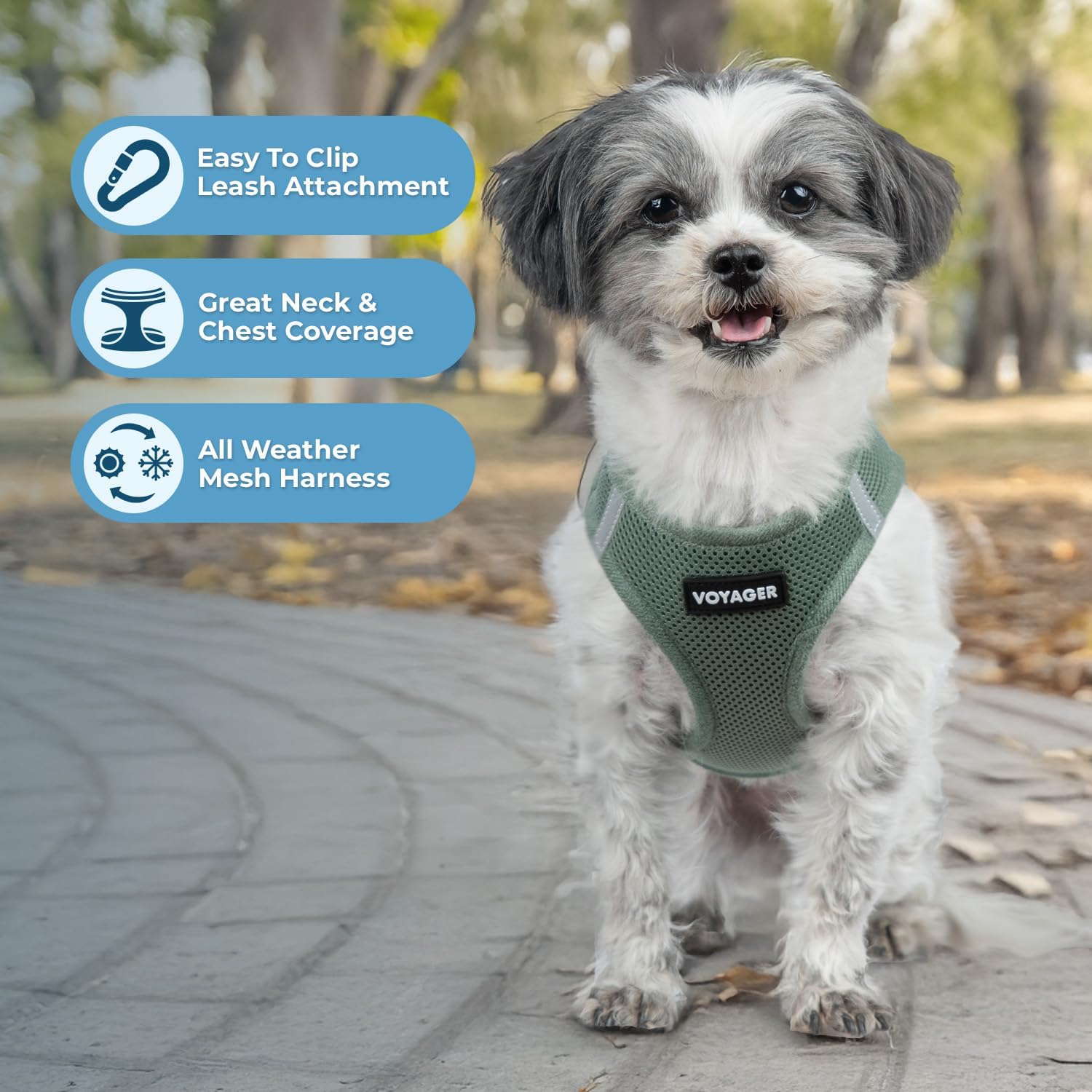
If you’ve ever watched a Yorkshire Terrier squirm out of a “size XS” harness mid-walk, you already understand the core problem: the sizing charts on most harnesses are built around a proportional ideal that small dogs simply don’t inhabit. A harness is a piece of load-bearing webbing (the woven straps that distribute pulling force) designed to move force off the throat and spread it across the chest and shoulders instead. For a 60-pound Lab, an imperfect fit is an inconvenience. For an 8-pound Chihuahua or a 12-pound Pomeranian, the same imperfect fit can concentrate pressure on the trachea (windpipe), restrict the shoulder’s range of motion, or create an escape gap that costs you your dog. This guide breaks down why the geometry of step-in harnesses and vest harnesses behaves differently on small dogs, how to measure correctly, and which configurations actually match the anatomical reality of toy and small breeds — so you can make the call with confidence.
Why Small-Dog Proportions Break Standard Fit Assumptions
The foundational issue is aspect ratio. Large and medium dogs tend toward a body shape where chest girth (the circumference around the widest part of the ribcage) is meaningfully larger than neck girth, and the distance between those two measuring points is long enough to give webbing room to seat properly. Many toy breeds invert that relationship or compress it dramatically.
Consider the math:
By the Numbers
| Breed | Avg. Neck Girth | Avg. Chest Girth | Neck-to-Chest Gap |
|---|---|---|---|
| Golden Retriever (55 lb) | 18–20 in | 28–32 in | 10–14 in |
| French Bulldog (22 lb) | 14–16 in | 20–24 in | 6–8 in |
| Chihuahua (6 lb) | 8–10 in | 12–14 in | 3–5 in |
| Yorkshire Terrier (7 lb) | 9–11 in | 13–15 in | 3–5 in |
When neck girth and chest girth are only 3–5 inches apart, a harness designed with a “normal” drop between the neck loop and chest loop will either sit on the throat instead of behind it, ride up into the armpits, or do both simultaneously. As VCA Hospitals’ overview of tracheal collapse in dogs notes, toy and miniature breeds — including Chihuahuas, Pomeranians, Miniature Poodles, and Yorkshire Terriers — are already predisposed to collapsing trachea, a condition where the cartilage rings of the windpipe weaken and partially collapse. Any harness that generates intermittent throat pressure, even briefly during a lunge, is a clinical concern with these dogs, not just a comfort issue.
There’s a second geometric problem: the scapula (shoulder blade). Whole Dog Journal’s harness coverage consistently flags that the front strap of a poorly fitted harness crossing the scapula — rather than sitting in front of it — restricts the dog’s forward stride, effectively shortening the gait and creating cumulative musculoskeletal stress. On a small dog, the scapula is proportionally closer to the sternum, so the margin for front-strap placement error is much smaller than on a large breed. A strap that clears the scapula on a Labrador by two inches may bisect the scapula on a Maltese at the identical “size.”
Step-In vs. Vest: What the Structure Actually Does to Fit
These two harness types solve different problems and fail in different ways on small dogs. Knowing the structural logic helps you predict where each one will go wrong.
Step-in harnesses use two loops — one for each front leg — that the dog literally steps into, and a single connection point or spine strap that runs along the back to a leash ring. The geometry is clean, hardware is minimal, and they put on quickly. The tradeoff: the two leg loops must be independent and stable, which means they depend on the chest girth being wide enough to keep them seated. On a dog with a very narrow, keel-shaped chest (think Miniature Dachshund or Italian Greyhound), step-in loops migrate toward each other and up the sternum, which pushes loading back toward the throat. Step-ins also offer almost no torso coverage, so all leash tension resolves to whatever contact the two loops make — a small surface area on a small dog.
Vest harnesses (also called H-harness vests or wrap harnesses) distribute force across a padded panel that covers most of the chest and belly. Because there’s actual fabric contact across the sternum and ribcage, the pressure-per-square-inch (PSI) delivered during a pull is far lower. For dogs with collapsing trachea risk or post-surgical chest sensitivity, the distributed-load design is the clinically preferred configuration, per PetMD’s review of small dog harness options. The fitting complexity is higher — you’re adjusting four or more points rather than two — but you have far more control over where the hardware sits relative to the scapula and trachea.
The practical decision rule: if the dog is healthy, structurally proportionate for its breed, and the primary goal is quick on-and-off convenience for urban walks, a well-fitted step-in can work. If the dog has any tracheal vulnerability, an atypical chest shape, or you need reliable escape prevention (a spooked rescue dog, an intact male who spots a distraction), a vest harness with at least two chest adjustment points is the defensible choice.
The Four Measurements That Actually Matter
The AKC’s harness measuring guide covers the basics — chest girth, neck girth, back length — but for small dogs, two additional dimensions change the outcome significantly.
1. Chest girth (the standard): Measured at the widest point of the ribcage, just behind the front legs. This is the primary sizing input for almost every harness brand. On small dogs, pull the tape snug but not compressed; fat compression on a small chest creates false readings.
2. Neck girth (the standard): Measured at the base of the neck, where a collar would sit. The delta between neck and chest girth is your first indication of whether a step-in will be stable.
3. Sternum-to-withers drop: This is the vertical distance from the top of the sternum (breastbone) to the top of the withers (the ridge between the shoulder blades). On a small dog with a compressed neck-to-chest gap, this measurement tells you whether a harness’s front panel will actually sit on the chest or ride up into the throat. Most brands don’t publish this spec — you have to request it from customer service or find it in user-posted photos with measurements. Whole Dog Journal recommends measuring this on your own dog and comparing it to any brand’s physical front-panel height before buying.
4. Scapula clearance: Stand the dog squarely and mark with a finger where the leading edge of the scapula sits on each side. The front strap of any harness should fall at least a half-inch ahead of that line. On dogs under 10 pounds, “half an inch” is a meaningful fraction of the total available space — which is why fitting in person, or using a brand with a generous trial/return window, is strongly preferred over size-chart ordering.
Configurations That Consistently Work — and the Tradeoffs to Name
For the ultra-small and trachea-vulnerable (under 10 lbs): A wide-front vest harness with a padded sternum plate — such as the Puppia Soft Harness or the RC Pet Products Clip ‘n Go — spreads contact across the broadest possible area. Owners of toy breeds consistently report these seat well behind the throat and hold position through quick direction changes. The tradeoff is that single-clip vest designs (one attachment at the back) still allow some forward surge, so dogs who pull hard will eventually work these forward. For pullers in this weight class, a dual-clip vest with both a back clip and a front chest clip gives you the option to redirect momentum from the front.
For small breeds with athletic builds (10–25 lbs, proportionate chests): The step-in design works here if you confirm the sternum-to-withers drop clears the throat by at least an inch at rest. The Ruffwear Front Range Harness — which publishes detailed sizing geometry on its product pages — is frequently cited by reviewers as one of the few step-adjacent designs that fits proportionate small dogs correctly, because the front loop is shaped to seat low on the chest rather than riding up. Owners of dogs in the 12–20 lb range consistently report the chest pad stays in position through moderate trail activity.
For escape artists and anxious dogs: No step-in should be your primary containment strategy for a fear-reactive or spooky dog. The escape mechanics of a step-in — two loops that can be slipped by tucking chin to chest and backing up — are exploited by exactly the dogs who need the most secure fit. A vest harness with an over-the-head neck loop plus a belly strap, adjusted to two-finger tightness at both points, is significantly harder to back out of. The Gooby Escape-Free Harness and the Puppia Harness B are designed specifically around this problem and carry consistent reviews noting the anti-escape geometry holds even with determined small dogs.
The Decision Frame: If X, Then Y
This is where the spec knowledge resolves into an actual choice:
If your dog is under 10 lbs OR has any tracheal history → go vest, wide sternum plate, back clip for everyday use. Step-ins are not appropriate as a primary harness.
If your dog is 10–25 lbs, healthy, with a chest girth at least 5 inches larger than neck girth → a step-in can work, but measure sternum-to-withers drop before ordering and verify the harness front panel is shorter than that measurement.
If your dog is a known escape artist or fear-reactive → vest with both neck loop and belly strap, adjusted to two-finger clearance. A step-in is the wrong tool regardless of size.
If you’re fitting a brachycephalic breed (flat-faced dogs: French Bulldogs, Pugs, Boston Terriers) → the neck-to-chest geometry is compressed differently, and the throat is already under structural stress. Vest harnesses with a low front-strap placement are non-negotiable; confirm the front panel sits fully below the throat before walking.
If you’re a trainer or rehabilitation practitioner fitting multiple dogs: Build a breed-specific measurement template using all four dimensions above, not just girth. The two “non-standard” measurements — sternum-to-withers drop and scapula clearance — are the ones that separate adequate fits from genuinely protective ones. Size charts are a starting point; those two numbers are the actual decision criteria.
The short version: small dogs are not small versions of large dogs. Their geometry demands fit logic built around the compressed distance between neck and chest, the proximity of the scapula to the sternum, and the elevated tracheal risk that many toy breeds carry before the harness ever goes on. Get those four measurements, match them to actual panel dimensions, and the right harness becomes obvious. Skip them, and you’re just guessing in XS.