May 29, 2026 • Marisol Vane • 10 min reading time • Prices verified June 4, 2026
Orthopedic Dog Beds for Large and Giant Breeds: What Separates a $60 Bed From a $300 One
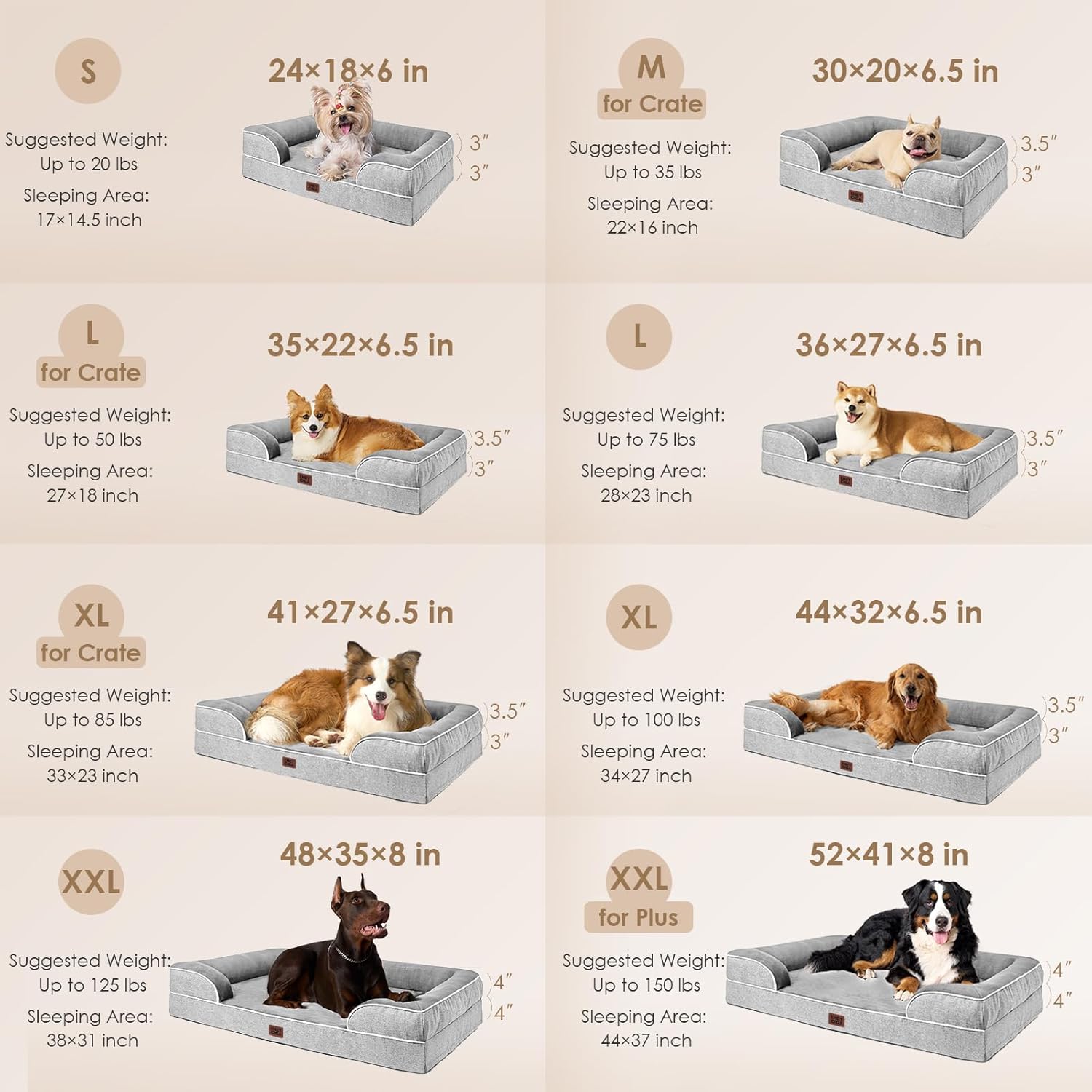
If you’ve ever watched a 90-pound Labrador heave himself up from a too-flat bed — the grunt, the wobble, the deliberate redistribute — you already understand why the word “orthopedic” on a dog bed tag matters more than the price. Orthopedic, in this context, means the foam inside is dense enough to support the dog’s body without fully compressing under their weight — keeping the joints (hips, shoulders, elbows) in a neutral, pressure-relieved position rather than sinking them down to a hard floor. For a 15-pound Beagle, a $40 bed from a big-box store might genuinely do the job. For a 100-pound German Shepherd with early hip dysplasia — a condition where the hip joint fits loosely in its socket, documented by the AKC in their resource “Hip Dysplasia in Dogs” — the difference between adequate foam and insufficient foam is the difference between a dog who rises easily and one who dreads getting up in the morning. This article breaks down what the specs actually mean, where the price gap comes from, and which beds earn the premium for large and giant breeds.
| EDITOR'S PICKBarker Beds Giant Orthopedic Do… | Mid-tier[Bedsure ComfyFleece™ Orthopedic…](https://www.amazon.com/dp/B0DH2MZ52G?tag=greenflower20-20) | Budget pick[EHEYCIGA Orthopedic Dog Beds fo…](https://www.amazon.com/dp/B0BDLGZCTY?tag=greenflower20-20) | |
|---|---|---|---|
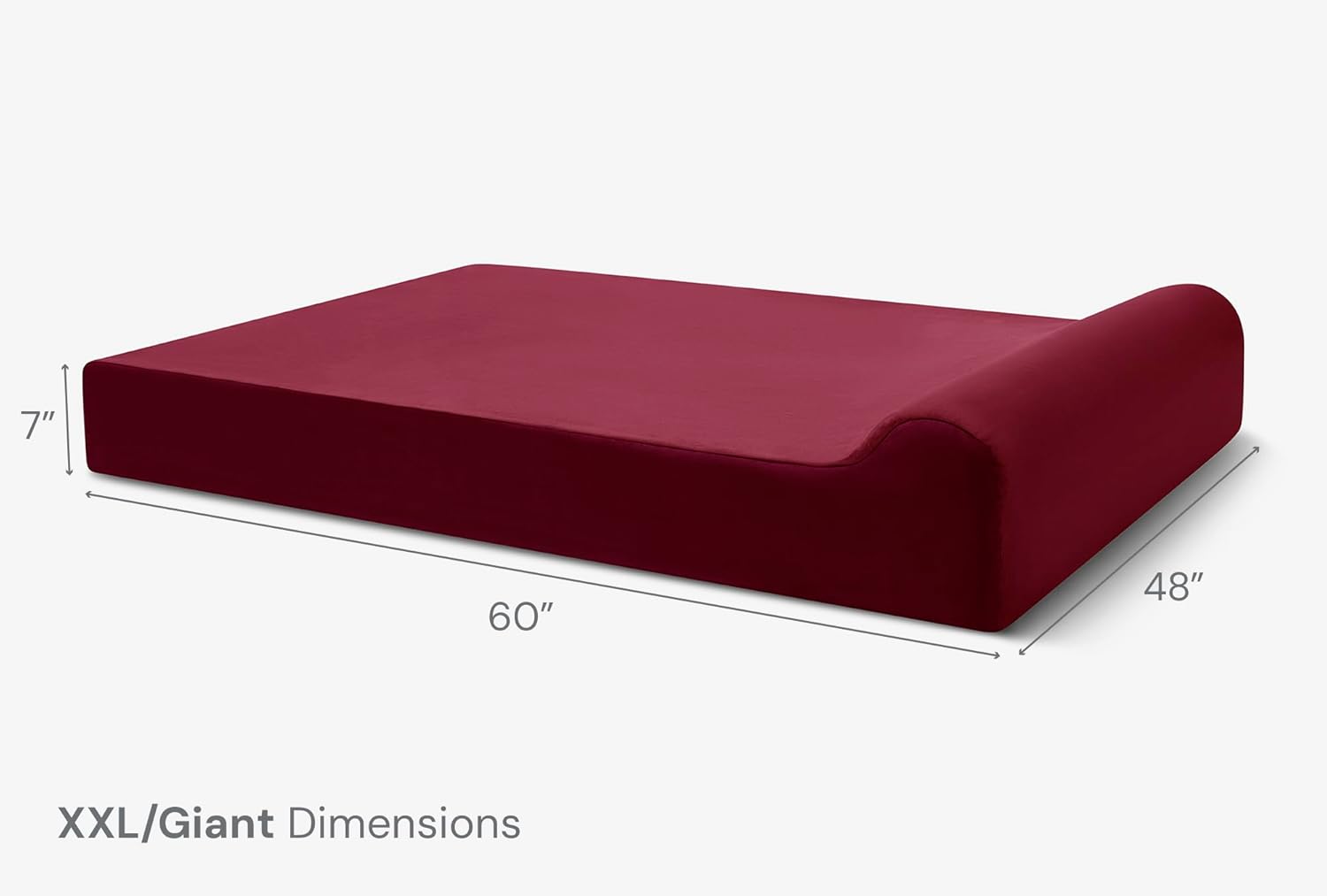
| Dimensions | 60"×48"×7" | — | 44"×32" |
| Weight capacity | 100-300 lbs | — | — |
| Foam type | Memory Foam | Egg-crate foam | Egg-crate foam |
| Waterproof | ✗ | ✓ | ✓ |
| Price | $399.95 | $42.99 | $39.99 |
| See on Amazon → | See on Amazon → | See on Amazon → |
The Foam Is Everything: ILD, Density, and Why Cheap Beds Go Flat
The single most important number on a dog bed spec sheet is ILD — Indentation Load Deflection. ILD measures how many pounds of force it takes to compress a 4-inch foam slab by 25%. A foam rated at ILD 15 is soft and will compress easily under a large dog’s weight, bottoming out against the floor. A foam rated at ILD 30–40 is firm enough to resist that compression — keeping the dog’s skeleton supported rather than bridged between two edge-points. Whole Dog Journal, in their guide “How to Choose an Orthopedic Dog Bed,” specifically flags that many beds marketed as “orthopedic” use low-density poly foam that collapses within weeks under a dog over 60 pounds.
Density is the companion metric: measured in pounds per cubic foot (PCF), it tells you how much raw material is in the foam. Higher density (1.8 PCF and above for memory foam, 2.0+ for support-base foam) means slower breakdown over time. Budget beds often use foam in the 1.0–1.5 PCF range — it feels plush in the store but compresses into a pancake within 60–90 days of nightly use by a large dog.
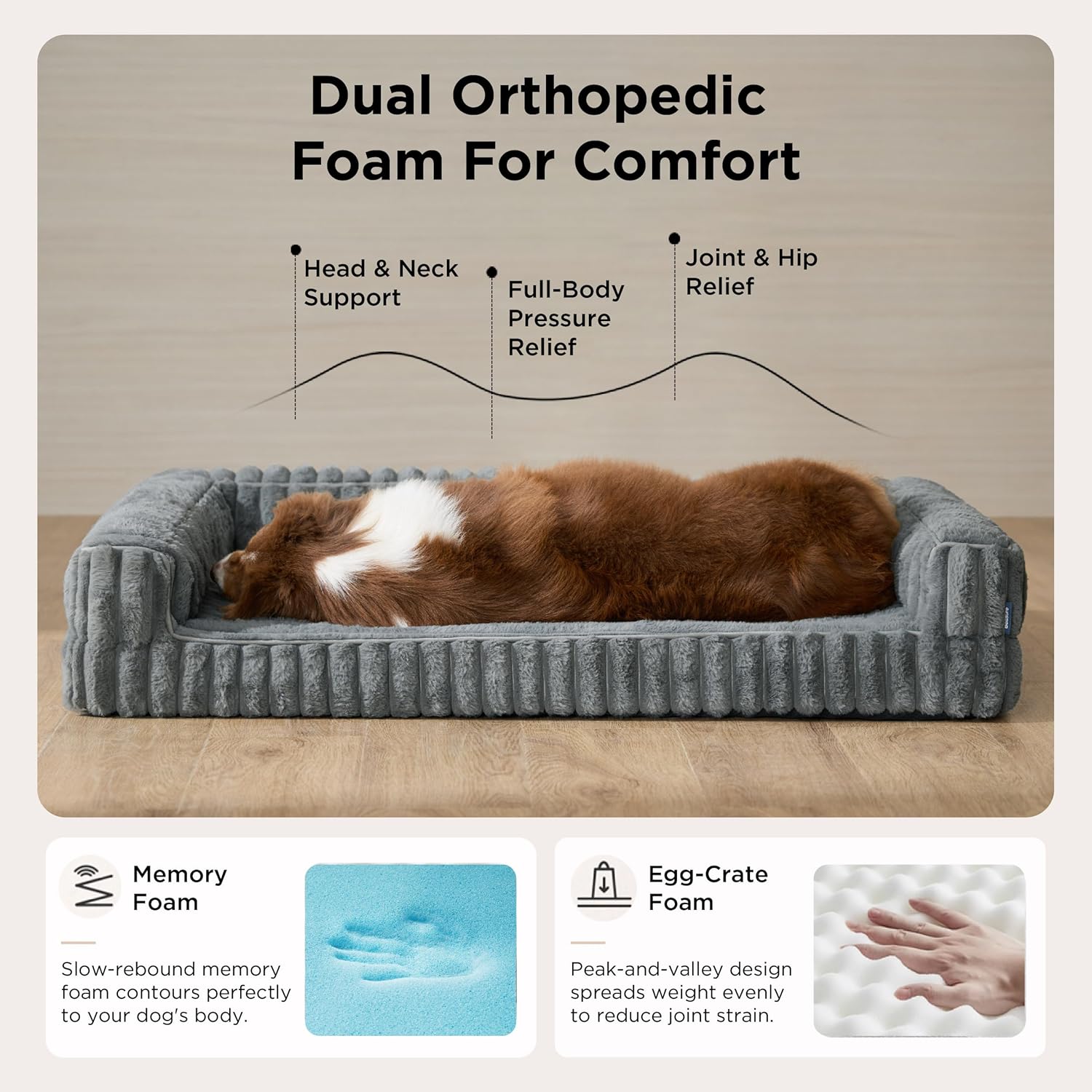
The second structural variable is layering. Better beds use a two-layer system: a firm base foam (high ILD, high density) that handles the load, topped with a comfort layer — either memory foam (viscoelastic, slow to rebound, conforms to body contour) or egg-crate foam (the wavy, peak-and-valley cut that distributes pressure across a wider contact surface). Memory foam wins for joint-specific pressure relief; egg-crate is cheaper to manufacture and performs adequately for dogs without diagnosed joint issues. PetMD, in their care article “What Is the Best Dog Bed for Dogs with Arthritis?”, recommends memory foam specifically for dogs with osteoarthritis, noting that the slow-rebound property allows the foam to conform around the joint rather than pushing back against it.
The Price Tiers: What You Actually Get at Each Level
Understanding the three price bands in this category requires looking at foam specifications, owner-reported lifespans, and warranty terms together — not any single factor in isolation. The following three sections break each tier down individually before a direct comparison.
Budget Tier: $40–$80
At this price point, foam ILD typically falls between 10 and 18. The foam density is almost universally under 1.5 PCF. The result is a bed that feels adequately soft in the first few weeks and then compresses progressively under nightly use by a dog over 60 pounds. Owner-reported useful lifespans in this tier range from 6 to 18 months for large breeds. Covers are often not fully removable or not machine-washable, which compounds the hygiene problem as the foam degrades.
For a young, healthy large-breed dog with no joint history and an owner on a strict budget, a budget bed is a serviceable short-term solution — but the replacement cycle makes the math less favorable than it first appears. Cost per year in this tier typically runs $40–$80, because most owners replace the bed once or twice annually.
EHEYCIGA
$39.99
In stock on Amazon
Check price on AmazonMid-Tier: $100–$180
The mid-tier category has improved meaningfully over the past three years as manufacturers began releasing foam density specifications under pressure from more informed buyers. Foam ILD in this range typically runs 20–28, with base foam density closer to 1.8 PCF — enough to resist the worst of the compression problem for two to three years of large-breed use.
The Bedsure ComfyFleece orthopedic bed earns something more specific than generic praise in its owner review pool: senior-dog-specific functional outcomes. One owner of a 15-year-old arthritic Staffordshire Terrier described — in detail unusual for a consumer review — her dog’s ability to change sleeping positions throughout the night without losing balance or struggling to reposition. That is a clinically meaningful observation. VCA Hospitals, in their document “Arthritis in Dogs,” notes that one of the primary quality-of-life markers in arthritic dogs is ease of positional change during rest, because dogs in pain will avoid moving, which compounds joint stiffness. A bed that allows mid-sleep repositioning without a struggle is performing a real orthopedic function.
The ComfyFleece’s value proposition is a denser foam base than most beds in its price range, combined with a fleece-topped removable cover that resists the kind of surface slip that can cause a dog with reduced hindquarter strength to struggle when rising. It is not a seven-year foam. It carries no decade-long warranty. But for owners who replace bedding every 2–3 years anyway — or who are managing a senior dog in the final chapter of life rather than investing for a decade — the cost-per-outcome math is defensible. Cost per year in this tier typically runs $45–$75.
Bedsure
$42.99
In stock on Amazon
Check price on AmazonPremium Tier: $200–$320
The premium tier is defined not just by higher ILD (typically 28–40) and higher density foam (2.0+ PCF for base layers), but by two things budget and mid-tier beds almost never offer: published foam specifications and structural warranties.
The Big Barker is built on a three-layer American-made foam system — a firm orthopedic base, a therapeutic middle layer, and a softer top — with ILD ratings the manufacturer publishes openly, which is a rarity in this category. It is the only bed in this price range that comes with a 10-year warranty against flattening greater than 10%. That warranty is the structural reason that multi-year owner reports are credible rather than lucky. One owner documented the same Big Barker bed supporting multiple large dogs sequentially — a 95-pound Golden Retriever, followed by additional dogs — with the foam still performing without notable compression after seven years of use. Seven years. The same foam. That report is not common in any other bed category.
The compounding arithmetic favors the premium tier from year two onward. Cost per year for a Big Barker, based on owner-reported lifespans of 5–7 years, typically runs $35–$55 — lower than the budget tier’s replacement cycle and comparable to the mid-tier’s annual cost, with better foam performance throughout.
Barker
$399.95
In stock on Amazon
Check price on AmazonDirect Comparison: Cost Per Year and Foam Specs by Tier
| Tier | Typical foam ILD | Typical lifespan (large breed) | Est. cost per year |
|---|---|---|---|
| Budget ($40–$80) | 10–18 | 6–18 months | $40–$80 |
| Mid-tier ($100–$180) | 20–28 | 2–3 years | $45–$75 |
| Premium ($200–$320) | 28–40 | 5–8 years | $35–$55 |
The premium tier’s per-year cost is actually lower than the budget tier’s when replacement cycles are counted. That inversion is the core argument for investing in foam quality upfront for a large breed expected to use the bed for many years.
Quality Flags and Assembly Notes: What to Watch at Delivery
Two beds in this comparison category carry specific handling notes based on aggregated owner experience.
Chez Paw beds have received multiple reports of deformed or hardened foam bases on second units — not first purchases, but replacement or additional units from the same buyer. The pattern suggests quality control inconsistency at the manufacturing run level rather than a design flaw. The protocol is straightforward: inspect the foam base immediately on delivery, before the dog uses it. Foam should be uniformly firm, with no compressed sections, hard spots, or visible deformation. A flattened or misshapen base means the foam was stored under compression during shipping or warehousing. Contact the retailer within the return window — this is not a break-in quirk, it is a defect.
EHEYCIGA beds have a documented assembly frustration pattern: the foam insert appears too large for the cover on first attempt, leading owners to conclude the product was mislabeled. The correct insertion method — which the manufacturer documents but many buyers skip — requires folding the foam lengthwise, inserting one end at an angle, then unrolling it into the cover cavity. Owners who learn this method universally report a clean fit; owners who attempt a flat push return the product unnecessarily. Do not attempt to force the foam in flat. The diagonal insertion angle resolves the apparent sizing mismatch in under two minutes.
Frequently Asked Questions
Is the Big Barker actually worth $200–$300 compared to a $60 orthopedic bed?
For large breeds over 70 pounds, yes — with the math shown above. The cost-per-year for the Big Barker, based on owner-reported lifespans of 5–7 years, is comparable to or lower than replacing a $60 bed annually. For dogs with diagnosed joint disease, the foam ILD difference is functionally significant. For a young, healthy large breed with no joint history and an owner on a tight budget, a quality mid-tier bed at $100–$150 is a reasonable bridge.
How long should a quality memory foam dog bed last before flattening?
A well-built memory foam bed for a large breed should maintain functional support for 3–5 years under nightly use. Premium beds with high-density base foam — Big Barker’s warranty threshold is no more than 10% compression over 10 years — can extend past that significantly. Budget foam beds in the $40–$80 range typically compress visibly within 6–18 months under a dog over 60 pounds.
What is the difference between egg-crate foam and memory foam for large-dog joint support?
Egg-crate foam distributes pressure across more contact points, which reduces localized hot spots — useful for any dog. Memory foam (viscoelastic, slow-rebound material) actively conforms to the dog’s body contour and joint geometry, reducing pressure at specific anatomical points like the hip and elbow. PetMD’s arthritis care article “What Is the Best Dog Bed for Dogs with Arthritis?” recommends memory foam for dogs with diagnosed joint conditions because the contouring effect is more targeted than surface distribution alone.
Can I wash the entire dog bed including the foam insert, or just the cover?
Almost universally, cover only. Submerging memory foam or high-density orthopedic foam in water — especially in a washing machine — breaks down the cell structure and accelerates compression. Most quality beds in this category are designed with fully removable, machine-washable covers for exactly this reason. Spot-clean the foam insert with a damp cloth and enzyme cleaner for accidents; air dry fully before replacing the cover.
My dog’s orthopedic bed flattened within a month — what went wrong?
Likely one of three things: the foam ILD was too low for the dog’s weight (common in beds marketed as orthopedic without published specs), the foam density was under 1.5 PCF, or the bed was sized too small — concentrating the dog’s full body weight on a smaller foam area than the material was rated for. Size up for dogs over 90 pounds, erring toward XXL even if your dog curls when sleeping, because stretching positions during deep sleep distribute weight across the full surface area.
At what age should I switch my large-breed dog to an orthopedic bed?
Earlier than most owners expect. The AKC’s resource “Hip Dysplasia in Dogs” notes that large and giant breeds can show joint stress as early as 12–18 months due to rapid skeletal growth. VCA Hospitals’ document “Arthritis in Dogs” recommends proactive joint support before symptoms appear in at-risk breeds. A practical rule: move a large breed (70+ pounds) to a proper orthopedic foam bed no later than age 2, and ideally from puppyhood once they’re past the chewing phase. Senior dogs (7+ for large breeds) with any mobility change should be on the highest-ILD foam their budget supports.