May 28, 2026 • Marisol Vane • 10 min reading time • Prices verified June 4, 2026
Lick Mats and Snuffle Mats for Anxious and Destructive Dogs: What Actually Holds Up
If your dog is destroying shoes, pacing during departures, or redirecting boredom into your furniture, two tools come up over and over in honest owner conversations: the lick mat and the snuffle mat. A lick mat is a flat silicone or rubber surface covered in ridges, grooves, and nubs — you spread soft food across it, and your dog spends several minutes licking it clean. A snuffle mat is a fabric mat with dozens of fleece strips tied through a rubber or mesh base; you hide kibble or small treats in the strips, and your dog roots through them using their nose. Both tools work through the same behavioral mechanism — they give a dog something effortful, species-appropriate, and time-consuming to do instead of whatever destructive behavior you’re trying to interrupt. The American Kennel Club’s guidance on separation anxiety identifies predictable, calming pre-departure routines as a foundational management strategy; both of these tools slot directly into that framework.
This guide is for owners who are past the “what even is this” stage and are now asking the harder question: which specific product survives real use, and what are the failure modes I should know before I buy?
The Behavior Case: Why These Tools Work on Anxiety (Not Just Boredom)
Licking and sniffing both activate the parasympathetic nervous system — the branch responsible for calming the body down. VCA Hospitals’ overview of canine enrichment notes that nose work and foraging behaviors measurably reduce cortisol indicators in dogs, which is why a five-minute snuffle session before a departure can blunt the spike of anxiety that follows. This is the mechanism that explains why reviewers across multiple products report that their dogs stopped chewing shoes while left alone once a snuffle mat was introduced as a pre-departure ritual. One reviewer of the AWOOF snuffle mat explicitly described the mat as the intervention that ended shoe destruction, framing it as a separation-anxiety aid rather than a general enrichment toy. That framing is clinically accurate.
The Whole Dog Journal’s coverage of lick mats reinforces this: the slow, rhythmic licking motion specifically engages the calming reflex in a way that a chew toy or puzzle feeder does not, because licking is inherently repetitive and low-arousal. For dogs whose anxiety expresses as hyperarousal (spinning, barking, destructive surges before you leave), low-arousal engagement is exactly what you need.
The practitioner decision point here: If your dog’s destructive behavior is primarily departure-triggered, a snuffle mat used as a departure ritual is probably your highest-leverage starting intervention. If the behavior is generalized stress or crate anxiety, a frozen lick mat — which extends engagement time to 15–20 minutes versus 3–5 minutes unfrozen — is the better prescription.
The Suction-Cup Problem: LUKITO’s Counterintuitive Fix
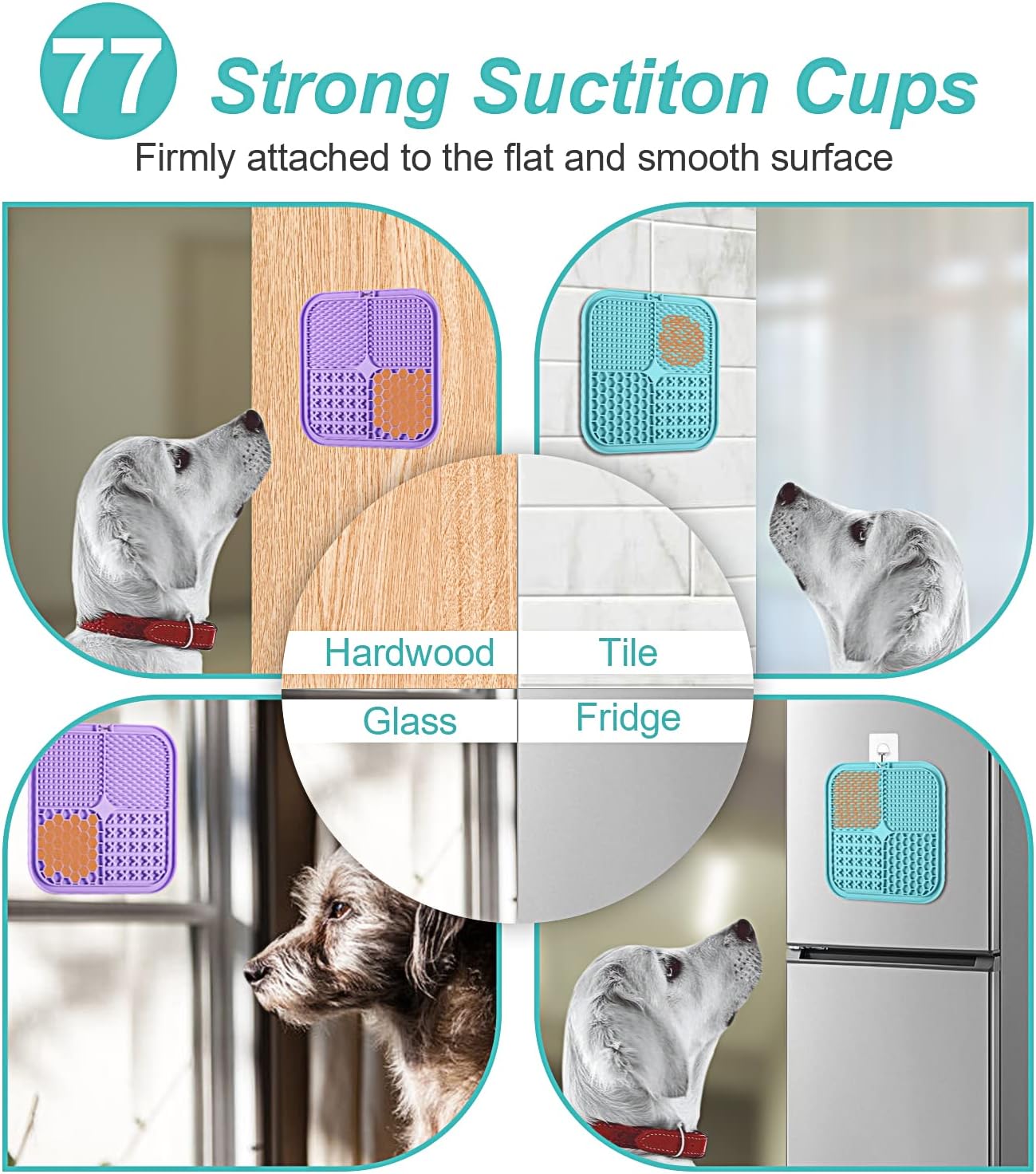
The LUKITO lick mat is one of the more widely reviewed silicone lick mats in its price tier, and its suction-cup base is a genuine value-add for dogs who nose the mat across the floor. But there’s a documented failure pattern worth calling out explicitly: multiple owners report that the suction cups stop gripping after a few uses, often rating the product down before discovering the fix.
The fix is counterintuitive: freeze the mat completely flat before first use, and re-freeze between uses when suction weakens. Owners who discovered this updated their ratings upward after the fact, noting that a flat freeze resets the silicone geometry so the cups seat properly against smooth surfaces. If you introduce the mat without freezing first, the slight warp from packaging or previous use breaks the vacuum seal.
The practical implication for anxious dogs is meaningful: a mat that slides and flips during use is a frustration event, not a calming one. It can spike arousal exactly when you need the opposite effect. Freeze flat, load, and present. That’s the protocol that holds.
AWOOF Snuffle Mat: The Colorway Quality Trap
The AWOOF snuffle mat has strong aggregate ratings, but there’s a purchasing trap buried in the review data that’s easy to miss unless you read owner-to-owner comparisons: the construction quality varies by colorway. At least one owner who purchased both color variants reported that the green colorway used double-ply fleece strips — denser, harder to extract treats from, and significantly more durable — while the yellow colorway used single-ply strips that flatten faster and offer less sniff resistance. That’s not a small difference. Single-ply strips lose their loft after repeated washing, which reduces the mat’s difficulty and shortens its useful life as an enrichment tool.
Buying rule: If the AWOOF is your pick, select the green colorway. If the colorway you want is yellow, treat durability as an unknown and factor that into your cost-per-use calculation. For a dog with a daily snuffle habit, a mat that loses loft after six weeks is a different value proposition than one that holds up for six months.
PetMD’s guidance on evaluating dog toy safety emphasizes material durability as a first-order evaluation criterion — not just ingestion risk, but the rate at which degradation creates new ingestion risks. A single-ply strip that shreds more easily raises both concerns simultaneously.
Supervision and Destruction Resistance: The Decision Matrix
The supervision question is where practitioners need to be most honest with their clients. Two data points from owner reviews bracket the real range:
- A LUKITO lick mat owner reported their puppy destroyed the mat within minutes of being left unsupervised with it.
- A Vivifying lick mat owner reported weeks of use with no destruction attempt from a dog who was also left unsupervised.
These aren’t contradictions — they’re different dogs, different arousal profiles, and different mat durability levels. The decision matrix is roughly:
By the numbers:
| Dog profile | Recommended supervision level | Best format |
|---|---|---|
| Puppy or known hard chewer | Always supervised | Thicker silicone lick mat, no snuffle mat |
| Adult dog, moderate chewer | Supervised introduction, then assessed | Either format once confirmed safe |
| Adult dog, non-destructive | Unsupervised after introduction | Snuffle mat as departure ritual |
The Vivifying mat’s durability record in owner reviews suggests thicker silicone construction is more forgiving with unsupervised use than thinner mats, though no manufacturer-published durometer or Shore hardness ratings are available to give this a precise spec-based comparison. What the pattern in aggregate reviews supports is this: if you cannot supervise, choose the thickest silicone product you can find, introduce it supervised first, and watch for chewing behavior before leaving the dog alone with it.
The Forfon Bundle: Why the Cleaning Brush Matters More Than It Sounds
The Forfon bundle set — which typically includes multiple lick mat surface patterns plus a cleaning brush — gets specific praise in owner reviews for a reason that seems minor until you’ve tried to clean a lick mat with a sponge: the brush reaches into the grooves. Lick mat grooves are where peanut butter, pureed pumpkin, and softened kibble pack in and go rancid between uses. A standard dishwasher cycle cleans the surface but doesn’t always dislodge material from the deepest channels of complex textures.
For a dog that uses a lick mat daily as an anxiety management tool, this is a hygiene question, not an accessory question. Owners who reported using the Forfon brush noted that it simplified daily cleaning enough that they actually did it consistently — which matters because inconsistent cleaning is where lick mats become a source of bacterial exposure rather than a calm, safe ritual.
If you’re already considering a bundle format, the Forfon set is the one where the included accessory earns its place on practical grounds.
What to Put on a Lick Mat (Beyond Peanut Butter)
Peanut butter is the default, but it’s also calorie-dense and can cause digestive upset in dogs sensitive to fat. Owner reports and veterinary nutrition guidance suggest a broader set of options:
- Plain pureed pumpkin (not pie filling — just plain canned pumpkin): low calorie, high fiber, slow to lick
- Plain Greek yogurt (unsweetened, no xylitol): probiotic benefit, freezes well
- Mashed banana: high sugar, use sparingly, but dogs find it highly motivating
- Wet dog food or bone broth: species-appropriate, nutritionally integrated with the dog’s existing diet
- Softened kibble paste: grind the dog’s regular kibble with water — zero novel-ingredient risk, diet-consistent
The freezing protocol extends engagement time significantly regardless of filling. A frozen lick mat with plain pumpkin will outlast an unfrozen mat with peanut butter by 10–15 minutes in most owner-reported use cases.
One constraint to know: Always confirm your peanut butter is xylitol-free. Xylitol is acutely toxic to dogs; per PetMD’s safety guidance, it causes rapid insulin release and can be life-threatening even in small quantities. Check the ingredient label every time, especially if you’re switching brands.
Frequently Asked Questions
Why did my lick mat’s suction cups stop working after a few uses? The most common cause is silicone warp from heat, improper storage, or simply the geometry shifting after the mat has been used and washed. The documented fix — specifically confirmed by LUKITO owners — is to freeze the mat completely flat before use. A flat freeze resets the silicone so the cups can form a proper vacuum against smooth surfaces. Store flat, not rolled or folded.
Is it safe to freeze a lick mat with peanut butter on it? Yes, with one critical caveat: confirm the peanut butter contains no xylitol before freezing or serving. Xylitol is toxic to dogs; plain peanut butter (ingredients: peanuts, maybe salt) is safe. Freezing the loaded mat is not only safe — it’s the standard protocol for extending engagement time and is specifically recommended for anxious dogs who finish too quickly at room temperature.
Can I use a snuffle mat as my dog’s regular meal bowl? You can, and many owners do for dogs who eat too fast or benefit from daily foraging activity. The practical constraint is cleaning frequency: a snuffle mat used for every meal needs to be washed every one to two days, and most require either hand-washing or a delicate machine cycle to avoid matting the fleece. If your dog’s food is wet or contains high-fat content, daily cleaning is not optional. For dry kibble fed once daily, many owners use the snuffle mat as a primary feeding vessel without issue.
How do I know if my dog is too aggressive a chewer to use a lick mat unsupervised? The honest answer is: you supervise a test session first. Give your dog the lick mat loaded with food, sit nearby, and watch. If the dog finishes the food and then begins mouthing, biting, or chewing the mat itself rather than walking away, treat it as supervised-only gear. Dogs who finish and disengage — sniff around, look at you, walk off — have demonstrated the pattern you need for unsupervised use. One session is not enough; observe three to five sessions before leaving the mat unattended.
What can I put on a lick mat besides peanut butter? Plain pureed pumpkin, unsweetened Greek yogurt, mashed banana (sparingly), wet dog food, plain bone broth, or a paste made from the dog’s regular kibble and water. The priority is a food that smears into the grooves, is safe frozen, and fits within the dog’s daily caloric budget. Because lick mats are typically used once or more daily, treat the filling as part of the dog’s overall diet rather than an add-on — especially if you’re also managing weight.
If X, Then Y: The Decision Rule
- If the behavior is departure-triggered and your dog is an adult non-destructive chewer: Start with a snuffle mat as a pre-departure ritual. The AWOOF in the green colorway is the documented pick for durability.
- If the behavior is generalized anxiety, crate distress, or vet/groomer reactivity: A frozen lick mat extends low-arousal engagement time long enough to matter. The Vivifying mat has the strongest durability record in owner reviews for unsupervised-safe use.
- If you need a daily-use tool and cleaning friction is what derails consistency: The Forfon bundle set’s included brush is a real practical differentiator — owners who have it actually use it.
- If you have a puppy or a confirmed hard chewer: Supervised use only, thickest silicone available, snuffle mat off the table until destructive chewing behavior has been assessed and addressed.
The tools are cheap enough that buying one to assess your dog’s response is low-stakes. The behavior information you get from that first supervised session is not.