June 21, 2026 • Marisol Vane • 11 min reading time • Prices verified June 4, 2026
Harness Fit for Weird Body Types: Deep Chests, Long Necks, and Bully Builds
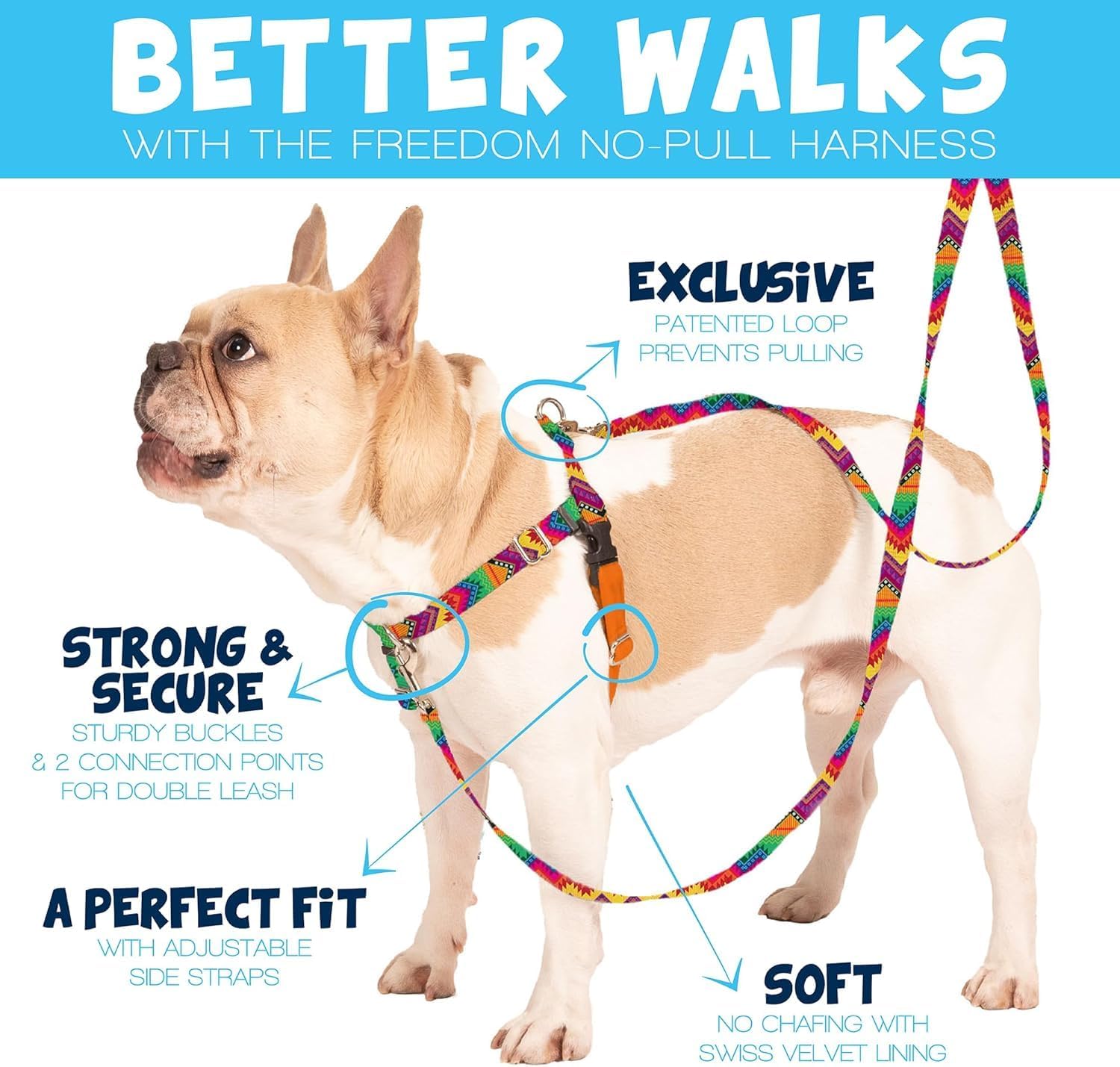
A harness is a webbing system — straps, buckles, and padded panels — that distributes leash pressure across a dog’s chest and shoulders instead of the throat. For a dog with a textbook build, any decent harness off a sizing chart will probably work. But a significant share of dogs have proportions that break those charts: deep barrel chests relative to narrow necks, long greyhound-style necks attached to wide rib cages, compact bully builds where the chest girth nearly matches the neck girth, or extra-small frames where a belly strap lands in entirely the wrong place. For those dogs, a harness that technically “fits” by the numbers can still slip sideways, restrict shoulder movement, cause a dog to freeze mid-walk, or press against a sensitive area. This guide works through the geometry of unusual body types, explains which harness designs address each one, and gives you the decision logic to choose without guessing.
Why Standard Sizing Charts Fail Atypical Builds
Most harness sizing is built around two measurements: neck girth (the circumference just behind the ears, where a collar sits) and chest girth (the widest circumference of the rib cage, usually just behind the front legs). Some brands add a third — back length from collar to tail base. The AKC’s guidance on harness measurement, published in their harness-fitting resource, confirms this two-to-three-measurement standard and recommends always taking girth measurements at the widest points, not at an average.
The problem is ratio, not raw size. A Dachshund, a French Bulldog, and a Greyhound can all have identical chest girth numbers yet need completely different harness geometries:
- The Dachshund has a long back and a chest that is deep front-to-back but not especially wide.
- The French Bulldog has a chest that is nearly as wide as it is deep, with a thick neck that’s close in circumference to the chest.
- The Greyhound has a chest girth that can be 8–14 inches larger than its neck girth, with a dramatically tucks-up belly and almost no torso behind the ribcage.
VCA Hospitals, in their harness selection overview, note that improper harness fit is a common but underappreciated source of gait restriction and pressure sores, particularly in brachycephalic (flat-faced, barrel-chested) and sighthound breeds — the two extremes of the ratio problem.
When sizing charts collapse all of this into “Medium: 18–22 inch chest,” the geometry never gets solved. You need to match harness design type to body type, not just size to measurement.
Body Type Breakdown: What Each Build Actually Needs
Deep Chest, Narrow Neck (Sighthounds, Setters, Vizslas, some Pitties)
This is the hardest profile to fit off the shelf. The neck girth may land in a small or even extra-small, while the chest girth is solidly medium or large. A harness adjusted to clear the neck will be loose everywhere else; one tightened to the chest will strangle.
The design solution is a dual-adjustment neck loop — a harness where the neck opening and the chest panel are independently adjustable, not linked by a single sliding loop. The 2 Hounds Design Freedom Harness is the most-cited example in owner reviews for this exact situation. The Freedom uses two distinct adjustment points: one that sizes the neck loop independently, and a second that sizes the chest panel. Owners of Whippets, Greyhounds, and narrow-necked mixed breeds consistently report this as the only configuration that sits correctly without constant re-tightening. One frequently cited review describes a dog who would completely freeze and refuse to walk in other harness styles, but moved willingly in the Freedom — a behavioral signal that the harness was no longer restricting shoulder rotation or creating pressure points.
The Whole Dog Journal’s harness coverage identifies dual-adjustment neck loops as a critical feature specifically for sighthound-type builds, noting that the breed group’s unusual proportions make single-loop step-in designs nearly nonfunctional.
Wide Chest, Thick Neck (Bully Breeds, Mastiffs, Staffies, English Bulldogs)
Here the problem inverts: the neck and chest girth are close together, so there’s little margin between “too loose in front” and “too tight in back.” The second challenge is behavioral — many bully-type dogs are excitable and strong, which means any harness with multiple buckle adjustments or fragile webbing becomes a management headache during on/off.
The design solution here is a single-buckle front-entry system with wide, load-rated webbing. The Carhartt Firm Duck Dog Harness draws repeated owner praise in this category specifically because its single-buckle closure makes it fast to put on an excited, squirming dog without fumbling through a four-point adjustment sequence. Reviewers of bully breeds note that the wide chest plate distributes pressure across the sternum rather than pinching inward — important when the chest is wide and the dog pulls with lateral force.
For this body type, chest strap placement is also critical. A harness where the front chest strap sits high on the sternum (near the throat) will creep up on a dog with a thick, muscular neck; you want the front strap to land mid-sternum or lower.
Long Belly, Small Frame (Chihuahuas, Italian Greyhounds, Toy Breeds Under 8 lbs)
Reviewers of several step-in harness styles — including the PHOEPET — consistently flag the same problem for very small dogs: the belly panel is sized for a dog that has meaningful torso length between the front legs and the rear legs. A 6-pound Chihuahua may have 2–3 inches of usable belly real estate. When a belly strap sized for a 12-pound dog is cinched down, it doesn’t compress symmetrically — it bunches forward, sometimes riding up toward the face when the dog sits or crouches. This is not a weight issue; it’s a proportional torso-length issue.
The design fix is a harness with a genuinely short belly panel, or a figure-8 / Roman-style harness (two loops connected by a short bridge, with no extended belly strap). The PHOEPET earns strong marks for athletic medium breeds with room to grow into the adjustment range, but the same owner reviews that praise it in that context specifically warn it doesn’t scale down to toy proportions.
The Benign Growth or Skin Condition Variable
This is an underappreciated fit variable. One owner’s review of the Embark Adventure Harness surfaced an unusual but legitimate reason to care about chest pad placement: the dog had a benign growth on the ribcage, and most harness chest pads pressed directly on it. The owner specifically chose the Embark because its chest pad sits further back on the sternum, clearing the growth entirely.
This matters more broadly for dogs with lipomas (benign fatty lumps, extremely common in older Labradors and Goldens), post-surgical sites, or skin conditions along the lateral chest. Pad placement — not just size — is a real purchase criterion. PetMD’s harness guidance notes that any hard pressure on a skin abnormality warrants veterinary sign-off before using any constricting equipment; beyond the medical clearance, harness pad geometry is how you solve the mechanical problem.
The Tactical Harness Sizing Trap
A recurring pattern across aggregated reviews for tactical-style harnesses — including the Rabbitgoo and WINGOIN designs — is that sizing runs large, sometimes by a full size. This is distinct from measuring incorrectly. Owners who measure carefully, follow the brand’s own chart, order the recommended size, and then receive a harness with a full inch or more of slack are not making an error. They’re running into a product-specific calibration drift, likely because tactical harness molds are scaled from working-dog (German Shepherd, Belgian Malinois) templates and shrunk imprecisely for the consumer size range.
The practical rule: for any tactical-style step-in or vest harness with MOLLE webbing (a grid of nylon loops used to attach pouches and accessories) and rigid side panels, order one size down from what your measurements indicate — and confirm the brand’s return policy before committing. The measurement-to-product gap in this category is documented and predictable.
By the Numbers: Chest-to-Neck Ratio by Body Type
| Body Type | Typical Chest:Neck Ratio | Key Fit Risk |
|---|---|---|
| Bully/Mastiff | 1.1 : 1 to 1.3 : 1 | Front strap rides up; neck loop too loose |
| Sighthound/Setter | 1.6 : 1 to 2.0 : 1 | Neck loop gaps; chest slips sideways |
| Standard mixed breed | 1.35 : 1 to 1.5 : 1 | Usually fits standard charts |
| Toy/teacup | Variable; torso length is the binding constraint | Belly panel bunches or misplaces |
Frequently Asked Questions
How do I measure a dog with a disproportionately wide chest relative to neck?
Take both measurements on the same day with a soft fabric tape, dog standing squarely. Neck girth goes just behind the ears (not at the collar resting point — higher, where a harness neck loop actually sits). Chest girth goes at the widest point of the rib cage, which on a barrel-chested dog is often further back than you expect. Calculate the ratio, not just the numbers. If your chest girth is more than 1.5× the neck girth, you need a dual-adjustment or full-vest design; single-loop step-ins will not stay centered. The AKC’s measurement guide reinforces that harness neck loops should be measured at the base of the neck, not the mid-throat.
Will a front-clip ring actually sit in the right place on a barrel-chested dog?
Not automatically. A front-clip ring is meant to sit at the center of the sternum (breastbone), low enough to redirect a pulling dog’s momentum sideways rather than upward. On a barrel-chested dog, if the chest panel is too narrow or the ring is sewn high, it migrates up toward the throat and either restricts breathing or provides no redirection benefit. Look for harnesses where the chest plate width is specified, not just the chest girth range — a wide chest plate physically holds the ring in position.
What harness works for a dog with a growth or skin condition on the ribcage?
The priority is locating where any chest pad or strap crosses the affected area. Ask for the harness’s pad-placement diagram before purchasing, or check owner photos in review threads. The Embark Adventure Harness’s rearward chest pad placement has been specifically cited by at least one owner for exactly this reason. If no off-the-shelf harness clears the site, a custom leather or rolled-webbing harness from a small maker (measured to your dog’s specific anatomy) is a legitimate option, and a canine rehabilitation practitioner can advise on pressure distribution.
Why does my correctly sized harness still slip sideways on my dog?
Sideways migration usually means the back panel is too wide for your dog’s back, or the girth strap is sitting too far forward or backward. On narrow-backed dogs (sighthounds, Dobermans, lean mixed breeds), a wide tactical back panel has nothing to grab onto and rotates freely. The fix is either a harness with a narrower back panel or one with a true center-of-gravity strap (a belly/girth band that runs behind the rib cage, not just under the belly). The 2 Hounds Freedom Harness’s dual-point design addresses this specifically by adding a behind-the-elbow loop that anchors the chest plate from rotating.
Can a martingale-style harness work on a dog who also pulls hard?
A martingale harness — one that tightens gently under tension and loosens when tension releases, similar in concept to a martingale collar — is designed primarily for escape prevention, not pulling management. On a dog who actively pulls, a martingale harness will cycle between constricting and releasing constantly, which creates intermittent pressure that can actually reinforce pulling behavior (pressure → release = reward). For a dog who both escapes and pulls, the better solution is a dual-clip harness (front and back clips) used with a double-ended leash. The front clip redirects pulling; the back clip can be used in low-distraction contexts and doesn’t apply tightening pressure.
The Decision Rule
If your dog’s chest-to-neck ratio is above 1.5 : 1 (sighthound or deep-chest builds), start with the 2 Hounds Design Freedom Harness and size to chest girth.
If your dog is a bully or mastiff build with a ratio under 1.3 : 1 and you need fast daily on/off, the single-buckle Carhartt design is the most operationally practical option owners in that category consistently point to.
If your dog is under 8 pounds with a short torso, skip belly-strap step-in designs entirely and look for a figure-8 or vest-style harness with a genuinely short torso panel.
If you’re buying a tactical harness and sizing by the chart, order one size smaller than your measurements indicate and verify the return window before the box ships.
And if pad placement matters — because of a growth, surgical site, or skin condition — locate where the chest pad actually hits before you purchase, not after.