June 27, 2026 • Marisol Vane • 11 min reading time • Prices verified June 4, 2026
Front-Clip Harnesses for Strong Pullers: Six Options Tested by Pit Bulls, Huskies, and Labs
Front-Clip Harnesses for Strong Pullers: Six Options Reviewed for Pit Bulls, Huskies, and Labs
Your dog is 60 pounds of enthusiasm and zero concept of leash manners. Every walk is a shoulder workout you didn’t sign up for. A front-clip harness — a body harness with the leash attachment ring on the dog’s chest rather than the back — redirects a pulling dog toward you the moment it surges forward, using the dog’s own momentum as a correction. It doesn’t choke, it doesn’t shock; it just turns the dog. Done well, it’s the single most effective passive management tool for strong pullers short of a structured training program. Done poorly, it rubs armpits raw, twists sideways mid-walk, and gets tossed in a drawer after two uses.
This article breaks down six front-clip options by how they actually perform on the body types that make or break harness design: the broad-chested pit bull, the deep-keeled husky, the barrel-ribbed Lab. We’ll name the tradeoffs, show the fit math, and end with a clear decision framework so you can stop second-guessing and start walking.
What Makes a Front-Clip Harness Work — or Fail
Before the comparisons, it helps to understand what you’re evaluating. A front-clip harness redirects a pulling dog by rotating the dog’s center of mass when it lunges. The leash attaches at the sternum (breastbone) rather than the dorsal (back) D-ring. When the dog pulls, the leash angle swings the dog’s front end to the side — toward the handler — instead of letting the dog drive straight ahead.
The mechanics are simple. The failure points are in the geometry:
- Chest strap placement: Too high and it compresses the trachea. Too low and it slides into the shoulder joint and restricts the dog’s front-leg extension. Whole Dog Journal’s “Harness Fit and Gait Impact” (2023) raises this as a documented concern for any chest-crossing strap that lands on the point of the shoulder rather than across the sternum.
- Belly strap fit: This strap stabilizes the harness. If it rides forward on short-backed dogs, the whole harness migrates and the front clip ends up in the wrong place.
- Webbing denier: Denier is the thread-count equivalent for woven fabric — higher numbers mean heavier, more abrasion-resistant webbing. Budget harnesses often use 600–900 denier polyester; premium options run 1,000–1,500 denier nylon.
- Martingale loop vs. fixed ring: Some harnesses use a martingale-style sliding ring at the front that self-corrects when the dog moves. Others use a fixed D-ring. The martingale loop tends to stay centered better on wide-chested dogs.
With that frame, here’s how six harnesses shake out.
The Six Harnesses, Compared
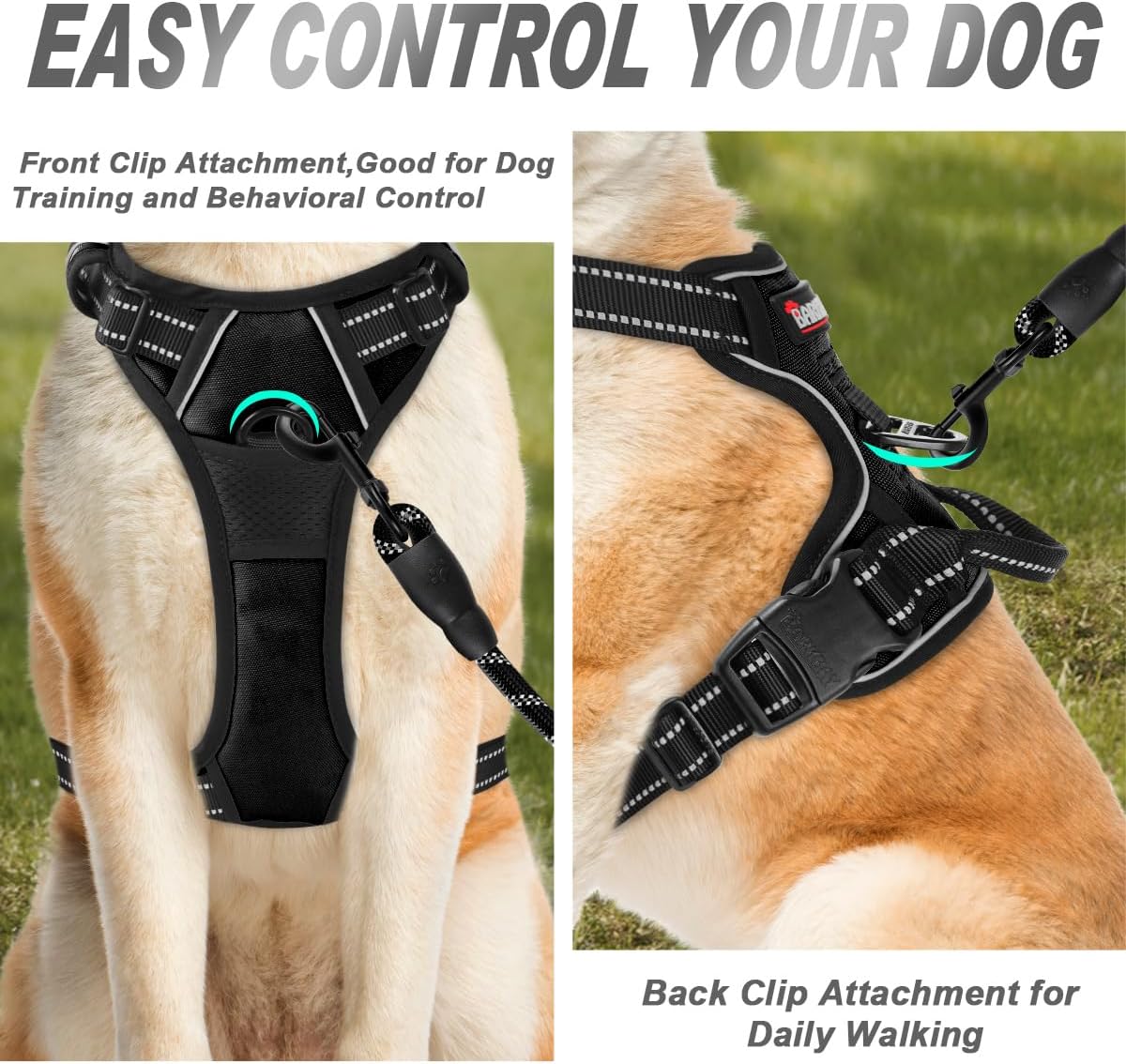
1. PetSafe Easy Walk
The Easy Walk is the entry point most trainers hand owners first, and for good reason. The front strap sits in a martingale-style loop that self-centers on the sternum when the dog surges. VCA Hospitals’ “Teaching Your Dog to Walk on a Leash” (2023) names this style of design as appropriate for dogs who pull hard but aren’t confirmed escape artists. Owners across aggregated retailer reviews describe near-instant results — dogs who had been too strong to walk becoming manageable within a single outing.
The tradeoff is breed specificity. The Easy Walk’s sizing runs broad, and Canine Journal’s “Best No-Pull Dog Harnesses” (2025) notes that the front strap can ride too high on small, densely coated dogs, sitting closer to the throat than the sternum. The same limitation appears in owner feedback for short-snouted or steep-shouldered small breeds.
For the 50–80 pound pit bull or Lab demographic, this is one of the most field-validated options in its price class. The math is simple: low cost, quick results, limited adjustability.
BARKBAY
$18.95
In stock on Amazon
Check price on Amazon2. Rabbitgoo No-Pull Harness
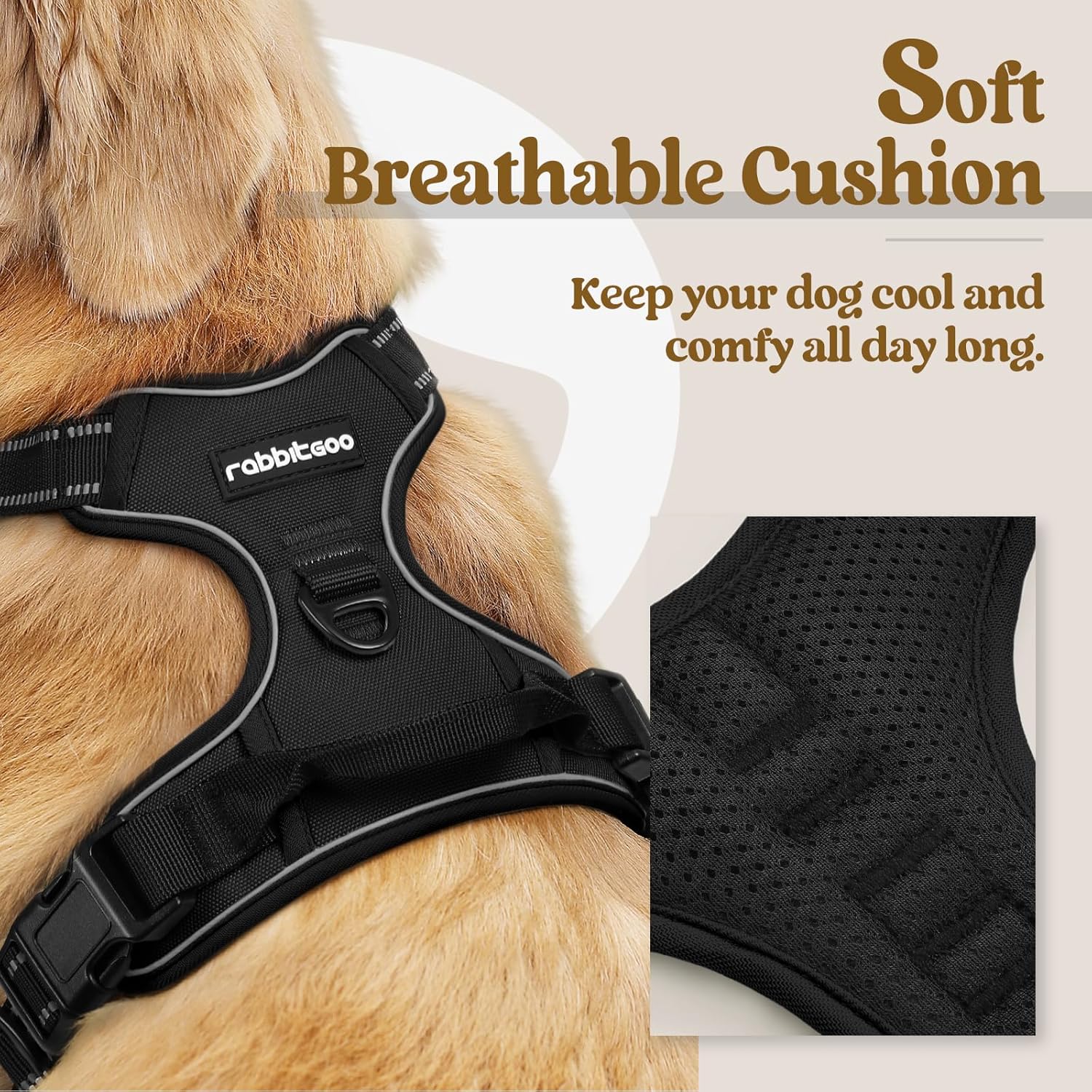
The rabbitgoo sits at the budget-to-mid tier and punches above its price point on durability. Owner reports across long-run review threads document consistent daily use on 60-pound dogs for three or more years without hardware failure or significant webbing wear — that’s the kind of longevity signal that matters when you’re evaluating cost-per-use rather than sticker price.
Rabbitgoo uses a dual-clip design (front D-ring plus a dorsal ring), four-point adjustment, and reflective stitching on most colorways. The chest strap is fixed rather than martingale, which means it needs more precise initial sizing to stay centered on wide-chested breeds. Owners of barrel-ribbed Labs consistently report it fits well once dialed in; owners of narrow-chested sighthound types note more sideways twisting during walks.
By the numbers:
- Reported lifespan: 3+ years of daily use on 60 lb dogs (aggregated owner reports)
- Adjustment points: 4 (neck, chest, both sides of belly strap)
- D-rings: 2 (front sternum + back dorsal)
- Webbing: manufacturer-rated 900D polyester on standard models
The belly strap bunching complaint that recurs across budget front-clip harnesses applies here on very short-backed dogs. For medium-to-large working breeds, it’s largely a non-issue.
BARKBAY
$18.95
In stock on Amazon
Check price on Amazon3. 2 Hounds Design Freedom Harness
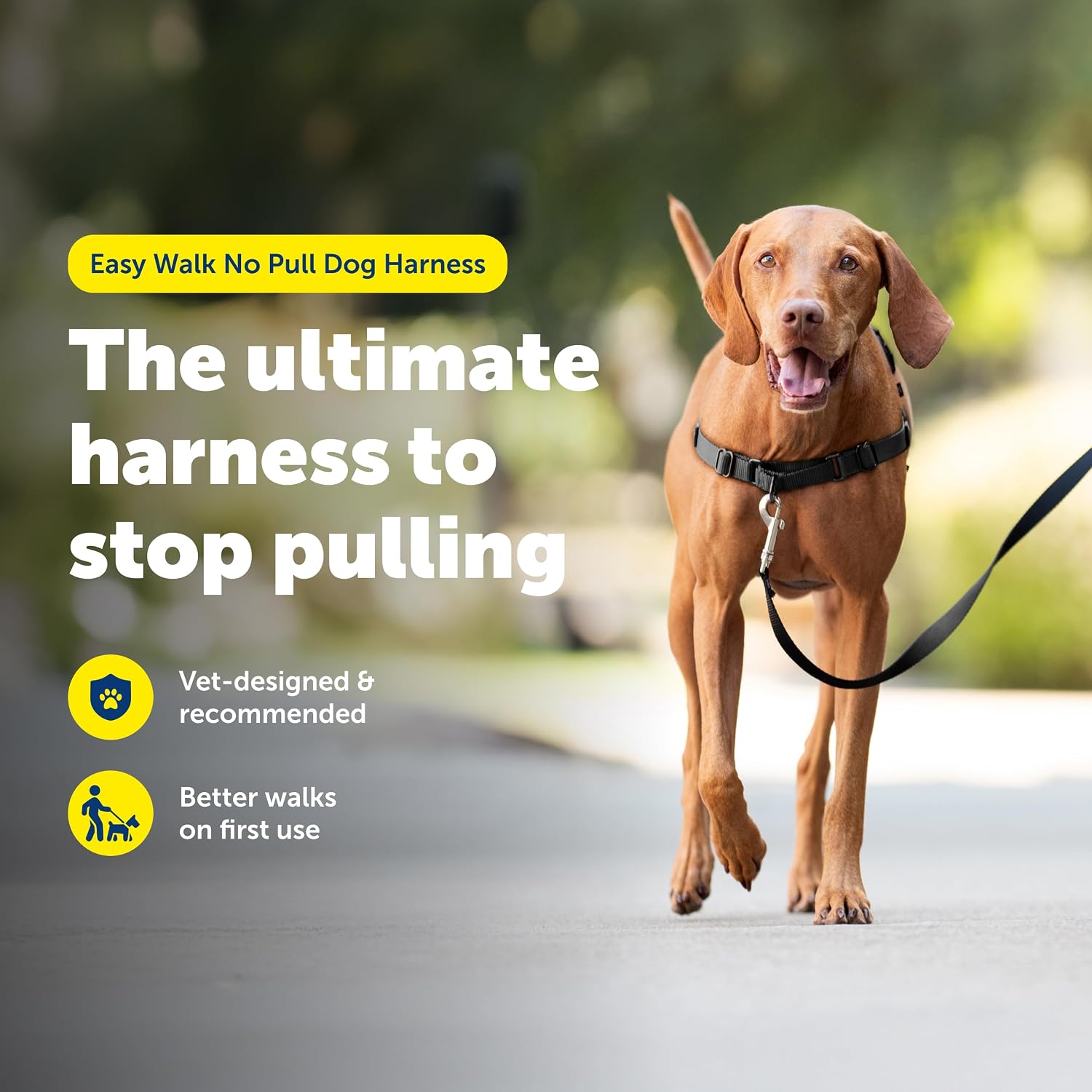
The Freedom Harness earns its name with owners of adolescent working-breed mixes — the 7-to-18-month window when a dog is near full size but nowhere near full impulse control. Across aggregated reviews, owners of large-breed adolescents describe it as the first harness that gave them genuine directional control, not just friction.
The design difference is a velvet-lined chest strap that reduces armpit chafing on active dogs, plus a bungee loop connector that links the front and back D-rings when you use both clips simultaneously. That dual-clip connection actively discourages both forward lunging and backing out — two failure modes that often travel together in reactive dogs.
Whole Dog Journal’s “How to Choose a No-Pull Harness” (2024) highlights dual-clip designs as current best practice for dogs who both pull hard and occasionally try to reverse out of their gear. The Freedom Harness is the most refined implementation of that concept in the under-$50 tier.
If X, then Y: If your adolescent dog pulls hard AND has figured out that backing up creates slack, the Freedom Harness used with both clips and a double-ended leash is the clearest decision here.
PetSafe
$22.26
In stock on Amazon
Check price on Amazon4. Ruffwear Front Range
Ruffwear’s Front Range is the most popular harness the company makes, and it earns that position on adjustability and hardware quality rather than any single breakthrough feature. The aluminum V-ring on the chest distributes leash tension better than a single small D-ring on a surging 70-pound dog, and the four-point adjustment gives genuine latitude across body shapes.
AKC’s “The Best Dog Harnesses for Every Type of Dog” (2025) names the Front Range as a reliable choice for active, high-energy breeds. Owners with Labs and huskies consistently cite the padded chest and belly panels as the difference between an hour hike and a chafe complaint. This is the harness that makes the most sense when your dog wears gear four or more days a week and you want hardware that won’t fail at mile six of a trail.
PetSafe
$22.26
In stock on Amazon
Check price on Amazon5. Ruffwear Flagline
The Flagline is where body-shape outliers find their answer. One owner report that recurs across Ruffwear feedback describes a greyhound-build reactive dog — deep chest, narrow waist, steep tuck — whose owner found the Flagline to be the only harness that could be fitted to her dog’s unusual silhouette without twisting or sliding. That’s what happens when a harness has a hip belt and a sternum loop that adjust fully independently of each other.
The Flagline sits in Ruffwear’s performance tier, with higher-denier webbing and hardware rated for trail use. It’s overbuilt for casual neighborhood walks, but if you have a dog with an unusual silhouette and you’ve already burned through two or three ill-fitting harnesses, the geometry here justifies the step up in price. Whole Dog Journal’s “Harness Fit and Gait Impact” (2023) identifies independent hip and chest adjustment as the key variable for atypical canine body proportions — the Flagline delivers that more completely than any other harness in this comparison.
2
$34.98
In stock on Amazon
Check price on Amazon6. Julius-K9 IDC Powerharness
The Julius-K9 is the European working-dog standard that crossed over into the enthusiast market, and its front-clip variant offers a different engineering philosophy: the harness is designed to stay put on high-drive dogs, full stop. The quick-release chest buckle, thick webbing, and handle on the dorsal panel are all borrowed from protection and search-and-rescue applications.
Canine Journal’s “Best No-Pull Dog Harnesses” (2025) identifies it as particularly well-suited for strong, high-arousal breeds. The tradeoff is price and setup time — this is not a harness you put on a distracted husky in a parking lot in under 30 seconds. But for a 70-pound dog who has defeated three other harnesses, the security margin is real and the construction is in a different class from anything in the budget or mid-tier categories.
2
$34.98
In stock on Amazon
Check price on AmazonHow to Fit Any Front-Clip Harness Correctly
Fit is where most front-clip harnesses fail in practice, regardless of quality. The two-finger rule applies: you should be able to slide two fingers — not one, not four — under every strap. The chest strap should cross the sternum roughly in the center of the dog’s chest, below the throat and above where the front legs join the body. If it sits on the point of the shoulder (the bony protrusion at the front of the leg socket), it will restrict gait — a concern Whole Dog Journal’s “Harness Fit and Gait Impact” (2023) documents specifically for front-crossing chest straps.
Check for twist by watching the dog walk from the front. If the front D-ring migrates to one side within the first block, the belly strap is too loose or asymmetric. Tighten the belly strap first; then re-check chest strap position.
Frequently Asked Questions
Does a front-clip harness actually work for a 60-pound pit bull who lunges? Yes — this is exactly the body type front-clip designs were developed for. The redirection mechanic works better as dog weight increases, because the dog’s own momentum does the work. Owners of 60-pound pit bulls report consistent results with the PetSafe Easy Walk, rabbitgoo, and 2 Hounds Freedom. Pair any harness with even basic leash-manners training for faster results; the harness manages the behavior, training changes it.
Can my Pomeranian use a standard front-clip chest harness? With caution. The PetSafe Easy Walk, in particular, has been flagged in owner reports as positioning the front strap too high toward the throat on small, heavily coated breeds, rather than across the sternum. Look for small-breed harnesses with narrower chest straps and more granular neck adjustment. The standard versions of most harnesses reviewed here are not optimized for dogs under 10–12 pounds with heavy neck coats.
Should I use the front clip, the back clip, or both at the same time? For active pullers: front clip only, or both clips with a double-ended leash. Using the back clip alone on a confirmed puller provides no redirection — it functions like a standard back-clip harness. The dual-clip approach, which the 2 Hounds Freedom is specifically engineered for, discourages both forward lunging and backing out simultaneously.
Why does my dog’s harness twist to one side during walks? Almost always a belly strap issue. If the belly strap is too loose, the harness rotates with the dog’s gait rather than staying fixed. Tighten until the belly strap has no more than two fingers of slack. On narrow-waisted breeds — sighthound builds, adolescent dogs who are deep-chested but hippy — no standard belly strap adjustment will hold, which is when the Ruffwear Flagline’s independent hip belt becomes relevant.
What’s the difference between the 2 Hounds Freedom and the rabbitgoo for a strong adolescent dog? The rabbitgoo wins on verified long-term durability and is the better pure value play. The 2 Hounds Freedom wins on control features: the velvet liner reduces chafe on high-activity dogs, and the bungee connector between front and back clips is a meaningful functional difference for dogs who combine hard pulling with escape attempts. If durability-per-dollar is your frame, rabbitgoo. If you’re managing a genuinely reactive adolescent who has already defeated simpler gear, the Freedom Harness earns the price difference.
The Decision Framework
- Budget-first, Lab or pit bull, 40–80 lbs, no escape history: Rabbitgoo. The three-year durability reports make it the clearest cost-per-use winner at its price point.
- Immediate management needed, any breed, first harness: PetSafe Easy Walk. Owner results are among the most consistent in this category, and it’s widely available. Skip it only if your dog is under 15 pounds or heavily coated around the neck.
- Adolescent working-breed mix, pulls hard AND backs up: 2 Hounds Freedom Harness with a double-ended leash using both clips.
- Active trail use, any breed 35–90 lbs, standard body shape: Ruffwear Front Range. Hardware quality and adjustability justify the step up for dogs who wear a harness four or more days a week.
- Unusual body shape — deep chest, narrow waist, greyhound or sighthound build: Ruffwear Flagline. The owner evidence on atypical body types is clearer here than for any other harness in this comparison.
- High-drive, high-arousal dog who has defeated other harnesses: Julius-K9 IDC Powerharness with front attachment. Built to working-dog security standards; setup is slower but the hold is in a different class.