June 11, 2026 • Marisol Vane • 11 min reading time • Prices verified June 4, 2026
Escape-Proof Harnesses for Dogs Who Back Out, Slip Free, or Full-Send Bolt
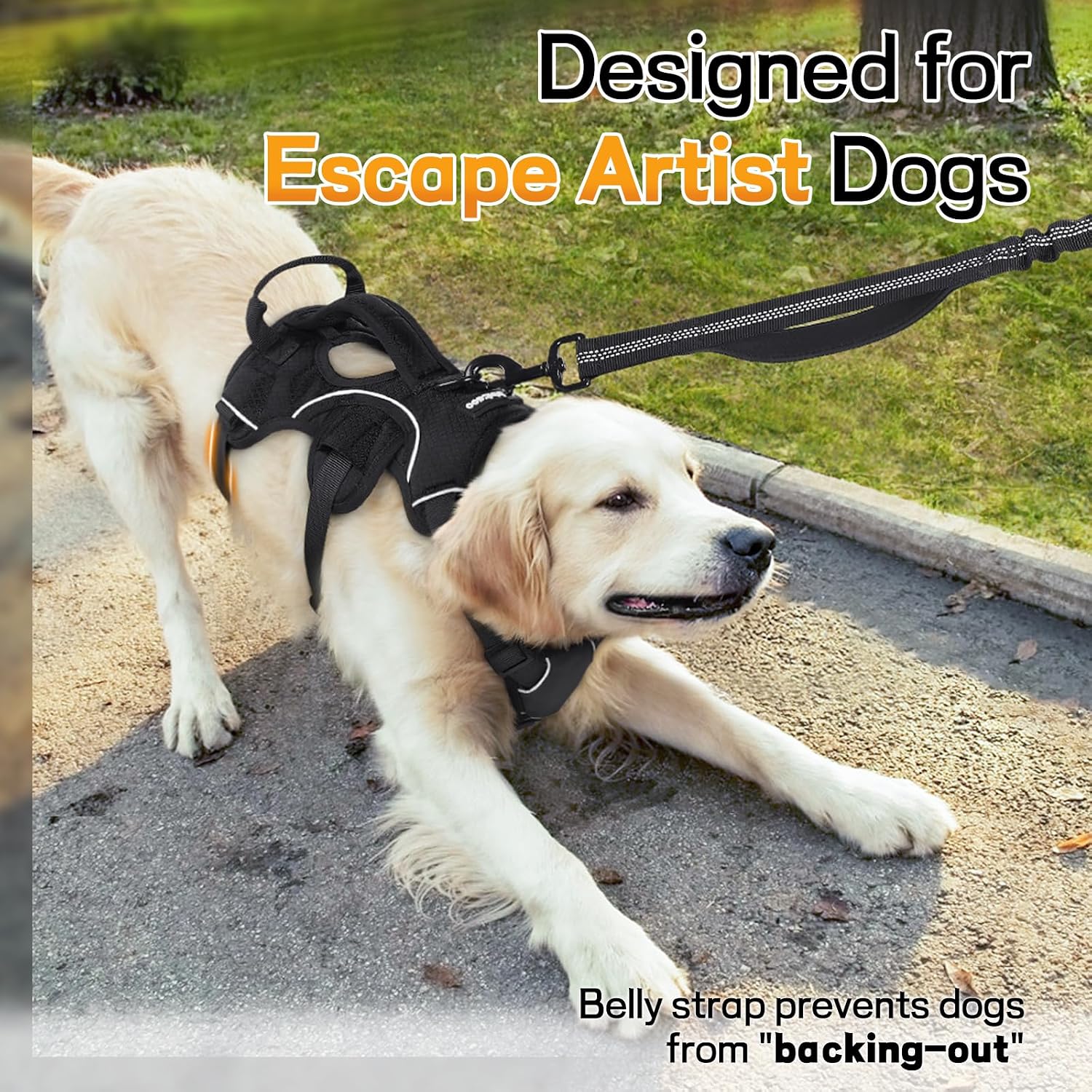
If your dog has slipped out of a harness, you already know the specific brand of panic that comes with it — the limp leash, the dog twenty feet away, the traffic. A harness is simply a webbing framework that distributes leash pressure across a dog’s chest and torso instead of concentrating it on the throat the way a collar does. “Escape-proof” is the industry shorthand for harnesses engineered with additional retention geometry — extra contact points, wrap-around chest panels, or dual-closure systems — specifically to prevent a dog from reversing or wiggling free. Most standard harnesses are designed for dogs who accept walking calmly on leash. This article is for everyone whose dog hasn’t gotten that memo yet: the reactive dog who lunges full-force, the anxious rescue who freezes and backs straight up, the wriggly small breed who treats every walk like an audition for a magic act. By the end, you’ll know exactly which design feature solves which escape style, and which specific harnesses owners keep coming back to after everything else failed.
Why Your Dog Keeps Escaping — and Why It’s a Design Problem, Not a Fit Problem
The instinct when a dog slips a harness is to tighten the straps. Sometimes that works. More often, it doesn’t — and it can’t, because the geometry of a standard H-style harness (two loops, chest strap in front, belly strap behind, connected by a spine piece) creates a fundamental vulnerability: a determined dog can flatten their shoulders, drop their head, and reverse straight out. The American Kennel Club’s harness guidance explicitly notes that dogs with “greyhound builds” — narrow-skulled, deep-chested breeds like Whippets, Italian Greyhounds, and even Dachshunds — are especially prone to this because their chest circumference and neck circumference are nearly equal, leaving an H-harness with nowhere to anchor.
But it’s not just sighthound builds. Across aggregated long-run reviews on both the Canine Journal’s escape-proof harness roundup and in community feedback compiled by Whole Dog Journal, the same pattern surfaces repeatedly: owners had already tried and failed with two, three, sometimes five harnesses before finding a solution. If that’s you, the problem almost certainly isn’t that you haven’t tightened the right buckle. The problem is that you need a different contact geometry.
There are three failure modes, and each has a corresponding design fix:
| Escape Style | Root Cause | Design Fix |
|---|---|---|
| Backs straight out | Shoulder-width close to neck-width | Wrap-around chest panel or martingale loop |
| Wiggles out sideways during a lunge | Single-buckle chest closure | Dual-lock closure or hook-and-loop + buckle combo |
| Chews or paws hardware loose | Front ring accessible to mouth | Ring positioned on back, out of reach |
Understanding which failure mode your dog uses cuts the shortlist from twenty harnesses to two or three.
The Harnesses Owners Actually Stuck With (After Everything Else Failed)
Rabbitgoo No-Pull Escape-Proof Harness
The Rabbitgoo escape-proof harness is the one that shows up most consistently in “I’ve tried everything” reviews, particularly from owners of reactive and rescue dogs. One frequently cited review describes two Lab mixes described as “haunted by past demons” — reactive, fear-driven, and prone to explosive lunges — and calls the Rabbitgoo the “holy trifecta” of escape-proof construction, high-visibility color options, and quality webbing that holds up to repeated stress.
What makes it work structurally: the harness uses a padded chest plate that wraps significantly further around the torso than a standard H-style, combined with both a front clip and back clip — a dual-clip system (two leash attachment points, one at the sternum, one at the back, allowing either pressure point depending on training context). The vest-style coverage means there’s substantially more surface area in contact with the dog, which dramatically raises the force a dog needs to generate to collapse and reverse out. For reactive dogs who lunge hard on leash, owners consistently report that the front-clip geometry redirects the dog’s momentum toward the handler rather than pulling straight ahead.
Sizing note: the chest-plate fit is critical. Published fit guides recommend measuring chest girth at the widest point behind the front legs — not at the front of the chest — and sizing to that number rather than body weight.
Voyager All Weather No Pull Step-In Air Mesh Harness
The Voyager Air Harness has accumulated a distinctive review pattern: owners specifically name it as the harness that worked after every previous model failed. One reviewer documents using it successfully on a 13-pound mini goldendoodle who had escaped H-style, vest-style, and front-clip harnesses alike. The critical feature reviewers cite is the dual-fastening system — hook-and-loop closure (like Velcro, but the brand-agnostic term) layered under a traditional side-release buckle. To escape, the dog would have to defeat two independent closure mechanisms simultaneously, which functionally closes the gap that single-buckle harnesses leave open.
The step-in design (the dog steps their front paws into two loops, and the harness is secured over the back) also removes the over-the-head fit entirely, which matters for dogs with neck sensitivity or dogs who are reactive about things approaching their face. At the 13-pound end of the sizing range, the published dimensions hold up to the claim — this is one of the few genuine escape-proof options that works reliably in the under-15-pound range where most “escape-proof” harnesses either run too large or lose their geometry.
Gooby Sporty Step-In Harness
The Gooby Sporty earns a different kind of attention: a medical-use case. Reviewers who mention consulting a vet before purchasing for a dog with tracheal collapse (a condition where the cartilage rings supporting the windpipe weaken, making collar pressure genuinely dangerous, per VCA Animal Hospitals’ overview of the condition) consistently point to the Gooby’s soft mesh chest panel and step-in configuration as the features that made it vet-compatible. The absence of any overhead fitting matters for dogs who resist handling; the chest-forward pressure distribution keeps all loading away from the throat.
It is not the most escape-proof option on this list for a dog with a serious bolt history — the single buckle on the back gives a very determined escape artist more room to work than the Voyager’s dual-lock system. But for a small breed with tracheal vulnerability whose primary need is secure, low-force walking rather than containment of hard lunges, owners report it as the right tool.
Puppia Dotty Harness
The Puppia Dotty solves a specific problem that almost no other harness addresses: dogs who chew or paw at their own leash hardware. One documented review from a Pomeranian owner describes trying multiple highly-rated alternatives before choosing the Puppia specifically because it is the only style her dog cannot reach and access the D-ring (the metal loop where the leash clips on) to chew. The ring is positioned on the upper back, geometrically out of reach for a dog turning its own head. For owners dealing with obsessive hardware-chewing — common in anxious and under-stimulated dogs — this is a meaningful functional difference, not an aesthetic one.
The tradeoff: like the Gooby, the Puppia Dotty is a soft mesh harness built primarily for comfort and moderate security. It is not the right answer for a dog who generates serious forward force during a lunge. If your problem is escape-through-chewing rather than escape-through-backing-out or escape-through-lunging, it belongs on the shortlist.
Fitting for Actual Escape Prevention (Not Just “Snug”)
The standard two-finger rule — you should be able to slide two fingers under any strap, but not your whole hand — is the industry baseline, per guidance from both the AKC and Whole Dog Journal’s harness coverage. For escape-prone dogs, the Canine Journal’s roundup adds a useful active fit check: after fitting, gently hold the harness from behind and ask the dog to back up or pull forward. If the harness shifts, slides, or creates enough slack that the dog’s shoulder can rotate inside the chest panel, it needs adjustment before it’s actually secure.
By the numbers — fit checkpoints:
- Chest girth: measured at widest point behind front legs (not at sternum)
- Neck girth: measured at mid-neck, not base of skull
- Two-finger clearance on every strap, confirmed after the dog moves
- Back-up test: harness should not travel more than 1 inch rearward when dog reverses
One underappreciated factor: fit requirements shift with seasonal coats. A dog who fits correctly in May may have meaningful extra coverage in December, and a harness that was adequately snug can become an escape risk under a thick winter coat if the fit isn’t re-confirmed.
Frequently Asked Questions
My dog backs straight out of every harness — what design actually stops this? The backing-out escape specifically requires a wrap-around or vest-style chest panel that physically cannot be reversed through. Standard H-style harnesses, no matter how tight, leave the shoulder girdle accessible for collapse. The Rabbitgoo and Voyager are the two options most consistently cited by owners of dogs who mastered the H-harness escape; both use extended chest coverage and dual closures that close the geometric gap an H-style leaves open.
Is the Voyager Step-In harness secure enough for a dog that has escaped H-style harnesses? Based on owner reviews and the published dual-closure design (hook-and-loop plus side-release buckle), yes — it’s specifically the harness that shows up in “finally worked” accounts from owners of H-style escape artists. The step-in geometry also removes the vulnerable over-the-head fitting that some dogs learn to resist and exploit. For dogs under 15 pounds, it is one of the strongest options in this size range.
Can a dog with a collapsed trachea safely wear a chest harness? Per VCA Animal Hospitals’ clinical overview of tracheal collapse, redirecting leash pressure from the neck to the chest is the standard recommendation for affected dogs — a chest harness is not only safe, it’s preferred. The key is confirming the harness does not have any strap crossing the throat. Soft-panel step-in harnesses like the Gooby Sporty are specifically documented in owner reviews as vet-approved options for this condition; always confirm the specific fit with your veterinarian before purchase.
Does the Rabbitgoo escape-proof harness work for reactive dogs that lunge hard? Across aggregated reviews from reactive-dog owners, the answer is yes — with the front-clip attachment being the functional piece. The front clip redirects a lunging dog’s momentum toward the handler, reducing the force of full-extension lunges. The extended chest panel prevents the shoulder collapse that allows the reverse escape. Owners of fear-reactive and prey-driven reactive dogs both describe it working where other options failed, though no harness eliminates the need for accompanying training work.
What’s the difference between a martingale harness and a standard step-in for escape prevention? A martingale harness (sometimes called a no-slip harness) has a loop that cinches — tightens slightly — under leash tension, closing off the slack that allows a dog to back out. It loosens again when tension releases. A step-in harness uses a fixed fit with closures but no cinching action. Martingale harnesses are particularly effective for the backing-out escape because the escape attempt itself triggers the tightening response; step-ins work through the dual-closure mechanical advantage. For sighthound-build dogs specifically, a martingale harness is often the AKC-recommended geometry.
How do I know if my dog’s harness is actually fitted tightly enough to be escape-proof? The two-finger rule is the baseline (two fingers fit under any strap, no more). The active test that matters more: hold the harness stationary from the back clip and invite the dog to move forward and then reverse. If you can feel the harness migrate more than an inch rearward, or if you can see slack forming at the shoulder, it is not secure for an escape-prone dog at that setting. Re-fit and re-test until the harness stays in place under both forward and reverse pressure. Recheck every few months, and any time there’s a significant weight or coat change.
The Decision Rule
If your dog backs straight out: vest-style or wrap-around chest panel, full stop. The Rabbitgoo is the most consistently documented solution in this category.
If your dog defeats single-buckle closures: dual-lock system, specifically hook-and-loop plus buckle. The Voyager Air Harness is the option with the strongest evidence base in small-to-medium sizes.
If your dog has a medical contraindication to neck pressure: soft-panel step-in with no throat contact. Gooby Sporty, with vet sign-off on the specific fit.
If your dog chews or paws at hardware: back-mounted ring out of jaw reach. Puppia Dotty is the documented solution for this specific failure mode.
And if you’ve already tried two or three of these and still have an escape: go back to the fit checklist before trying a fourth harness. In most cases, the geometry was right and the fit wasn’t confirmed under active movement. The back-up test is the one step most owners skip — and the one that most often explains a technically correct harness still failing.