September 6, 2026 • Marisol Vane • 9 min reading time • Prices verified June 4, 2026
Building an Enrichment Toolkit for Under $50: Lick Mats, Snuffle Mats, and Puzzle Bundles That Work Together
If you’ve ever come home to a shredded couch cushion or a dog that simply won’t settle, you’ve already met the problem that enrichment tools exist to solve. Enrichment — the practice of giving a dog meaningful mental and sensory work to do — is one of the highest-leverage interventions available to any owner, and it doesn’t require a $200 puzzle system or a professionally designed training program. A lick mat (a textured silicone or rubber surface that holds soft food and requires a dog to use its tongue slowly and repetitively), a snuffle mat (a rubber base threaded with fabric strips that hides dry kibble or treats for a dog to sniff out), and a puzzle feeder (a tray or box with movable pieces the dog must manipulate to release food) each target different cognitive and sensory pathways. The goal of this guide is straightforward: show you how to build a functional three-tool enrichment bundle for under $50 in 2026, understand where the meaningful spec differences actually live, and deploy those tools together for cumulative behavioral effect rather than novelty alone.
Why a Bundle Beats a Single Tool
The single-tool trap is the most common mistake practitioners — trainers, rehabilitation specialists, and engaged owners alike — make when first building out a dog’s enrichment routine. A dog that gets the same lick mat every afternoon will habituate to it within two to three weeks; the arousal response flattens, the calming benefit erodes, and you’re back to square one. The research framing here is well-established: per VCA Hospitals’ overview on enrichment for dogs, novelty and variation are core mechanisms for sustained enrichment benefit, not just the act of offering the tool once.
A three-tool rotation solves this structurally. You’re cycling through three distinct cognitive demands:
- Lick mat: repetitive lingual motion, slow calorie delivery, documented parasympathetic (calm-down) effect in anxious dogs
- Snuffle mat: olfactory foraging, nose-led work, engages scent-processing systems independently of food-delivery speed
- Puzzle feeder: motor problem-solving, requires trial-and-error, builds frustration tolerance over time
These aren’t interchangeable. Swapping one lick mat for another lick mat doesn’t give you the rotational benefit. Swapping a lick mat for a snuffle mat does. That distinction drives the bundle logic below.
The $50 Budget, Broken Down
By the numbers — 2026 retail snapshot:
| Tool | Budget-tier pick | Price (approx.) |
|---|---|---|
| Lick mat | LickiMat Classic or Splash | $10–$14 |
| Snuffle mat | PAW5 Wooly Snuffle Mat | $25–$30 |
| Puzzle feeder | Nina Ottosson Dog Tornado (Level 2) | $14–$18 |
| Bundle total | $49–$62 at full retail |
That $62 ceiling can be brought under $50 through Chewy auto-ship discounts (typically 5–10% on repeat items as of May 2026) or by substituting the Nina Ottosson Tornado with the simpler Dog Brick at around $12. The tradeoff on the Brick vs. Tornado is discussed below.
The PAW5 Wooly Snuffle Mat is the line item where most owners try to save money — and where the savings are most likely to backfire. Reviewers across aggregated retail platforms consistently flag that ultra-budget snuffle mats (sub-$12, often unbranded) shed fabric strips within a month of regular use, creating an ingestion hazard. The PAW5 mat’s rubber base and knotted fleece construction have been noted across long-run owner reviews as meaningfully more durable. This is the budget line worth defending.
Lick Mat Selection: Where the Specs Actually Matter
Lick mats look deceptively simple. The meaningful spec variables are texture pattern, suction capacity, and material hardness.
Texture pattern determines how much surface area the dog must work across and how effectively soft food (plain Greek yogurt, canned pumpkin, wet dog food, xylitol-free peanut butter) gets trapped in crevices. The LickiMat Classic uses a square-grid pattern; the LickiMat Splash uses a more irregular radial pattern that owners consistently report holds thicker spreads better. For anxious dogs or those new to lick mats, the Classic’s simpler grid is an easier entry point — less overwhelming, faster initial success. For dogs that have habituated to basic lick mats, the Splash’s geometry extends engagement time.
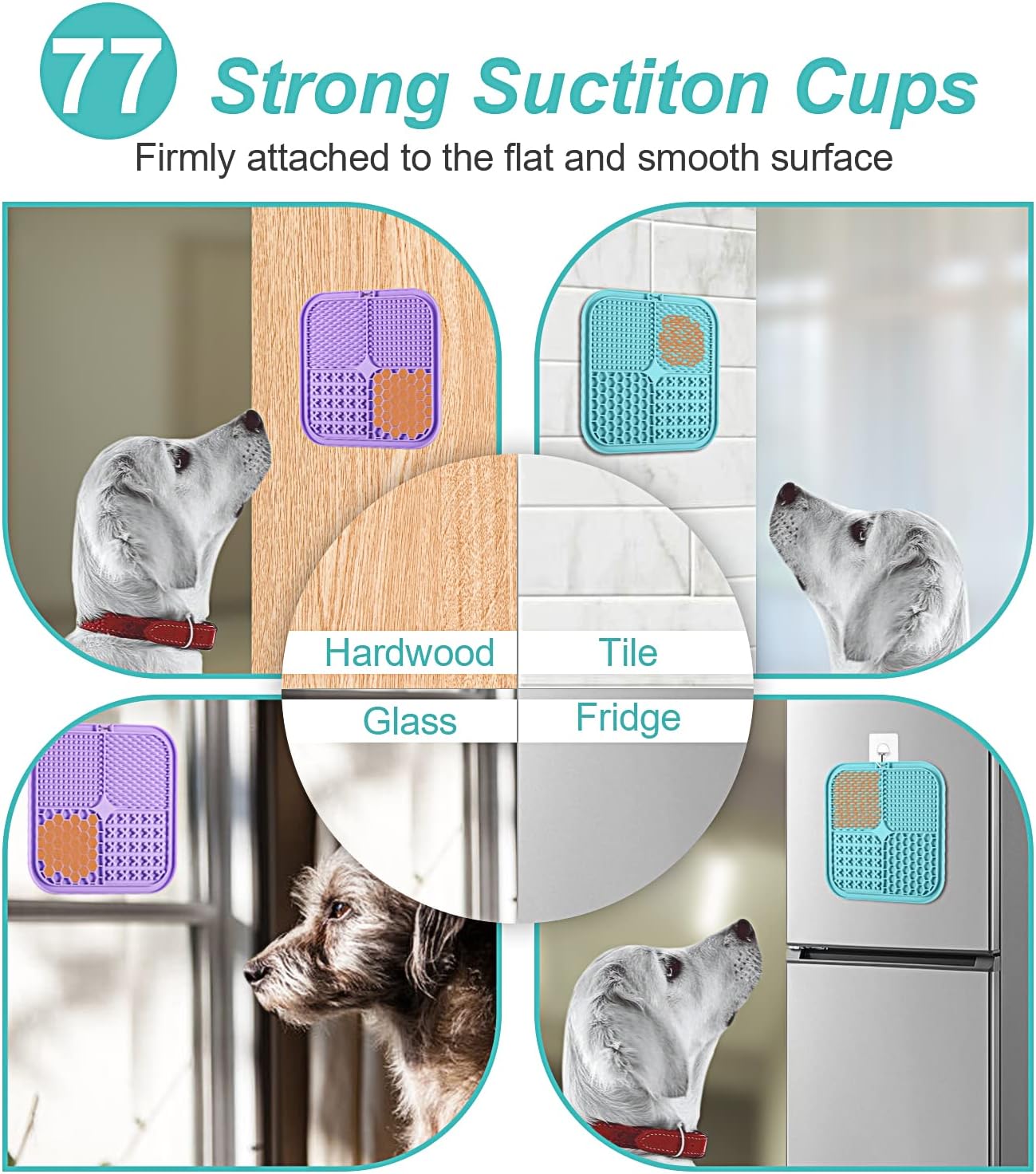
Suction capacity matters if your dog is a vigorous licker or has a heavy paw. Both LickiMat variants include suction cups; owners report the cups hold adequately on smooth tile or stainless surfaces and less reliably on textured rubber mats or uneven flooring. Freezing the loaded mat (a common and well-documented technique for extending engagement time, per the Whole Dog Journal’s coverage of food puzzles) partially offsets the suction issue by anchoring the food itself.
Material hardness: LickiMat products are manufactured from TPR (thermoplastic rubber), which is food-safe and dishwasher-safe on the top rack. Some reviewers with power-chewing dogs note edge wear over time — lick mats are not chew toys and shouldn’t be left unsupervised with dogs that redirect to destruction.
If X, then Y: If your dog is anxious and you’re using the lick mat primarily as a calming intervention (vet visits, grooming, thunderstorm protocols), buy the Classic and freeze it loaded. If your dog has already plateaued on basic lick mats and you’re looking to extend engagement, the Splash or the similar-priced Sodapup designs offer more surface complexity.
Snuffle Mats: Fabric Density, Base Stability, and the Olfactory Load Tradeoff
The snuffle mat is the most cognitively distinct tool in the bundle, and the one most worth buying right the first time. As the American Kennel Club’s guidance on mental stimulation for dogs notes, nose work and olfactory foraging engage a dog’s brain at a fundamentally different intensity than visual or motor tasks — a 20-minute snuffle mat session can produce the behavioral equivalent of a much longer physical walk in terms of settling effect.
The key spec to evaluate is fabric strip density. Denser fabric means more hiding surfaces for kibble, longer foraging duration, and a higher olfactory challenge level. The PAW5 Wooly Snuffle Mat is among the denser options in the under-$30 bracket; spec sheets describe it as containing over 600 individual fabric strips on a roughly 13-inch round base. Owner reviews consistently note foraging sessions running 10–20 minutes with standard kibble for motivated dogs, which is a strong return on a $27 investment.
Base stability is the second variable. A snuffle mat that skids across the floor becomes a tug toy within thirty seconds. Look for non-slip rubber bases — the PAW5 base is frequently cited in owner reviews as adequately stable on hardwood, though it can migrate on smooth tile for larger, more aggressive foragers. A non-slip bath mat placed underneath solves this at zero additional cost.
Cleaning protocol: Snuffle mats are machine-washable on cold/gentle with most fabric constructions — confirm this for any specific product before purchase. Wet kibble or raw toppers will mat the fabric and degrade hygiene quickly if wash cycles aren’t regular.
If X, then Y: If you’re working with a scent-sport dog, a breed with pronounced foraging instinct (dachshunds, beagles, most terriers), or any dog in a rehabilitation or anxiety-management protocol, the snuffle mat is the anchor of this bundle — buy it first, spend the most on it. If budget is compressed, the snuffle mat is the last place to cut.
Puzzle Feeders: Level Matching Is Everything
The puzzle feeder is where most practitioners over-invest in difficulty too early. Tufts Your Dog’s coverage of canine cognitive enrichment emphasizes a point that’s easy to underweight: a dog that can’t solve a puzzle within a reasonable timeframe doesn’t build frustration tolerance — it builds frustration, full stop, and may disengage from puzzle feeders as a category entirely.
The Nina Ottosson product line uses a numbered level system (1–4) that maps loosely to cognitive challenge:
- Level 1 (Beginner): Single-motion reveals, no hidden compartments. The Dog Twister is the canonical example.
- Level 2 (Intermediate): Multi-step reveals, some compartments require sequential unlocking. The Dog Tornado and Dog Brick both sit here.
- Level 3–4 (Advanced): Full hide-and-seek with multiple layers and locking mechanisms.
For a dog new to puzzles, Level 2 is the correct starting point in 2026 — Level 1 is solved too quickly to provide sustained engagement, and the price difference between Level 1 and Level 2 Ottosson products is minimal (roughly $2–4 at current retail). The Dog Brick at around $12 is the budget-correct choice for the under-$50 bundle; the Tornado at $14–18 adds a rotating tray mechanism that extends the challenge slightly and tends to hold difficulty longer before the dog memorizes the solution pattern.
Habituation timeline: Based on aggregated owner reporting, most dogs begin showing partial memorization of Level 2 puzzle solutions within 3–5 weeks of daily use. The rotation strategy (cycling across all three tools rather than using one daily) extends the effective lifespan of each tool significantly — per the VCA Hospitals enrichment overview, novelty and environmental variation are the primary drivers of sustained engagement.
If X, then Y: If your dog is food-motivated and problem-oriented (herding breeds, working breeds, sport dogs), invest in the Tornado over the Brick — the rotational mechanic takes longer to memorize. If your dog is more nose-oriented than eye/paw-oriented, the Brick’s open tray design may actually suit them better because it doesn’t require the paw-batting motor skills the Tornado rewards.
Deploying the Bundle as a System
The value of thinking about these three tools as a system rather than three separate purchases comes down to scheduling and sequencing.
A practical three-day rotation for a working-day household:
- Day 1: Frozen lick mat at departure (calming, slow-release, settles separation transition)
- Day 2: Snuffle mat at mealtime (olfactory foraging replaces bowl feeding entirely — full meal ration hidden in the mat)
- Day 3: Puzzle feeder at mealtime (problem-solving, motor engagement, food delivery as cognitive reward)
This rotation means each tool appears roughly twice per week, which is slow enough to prevent rapid habituation and fast enough to maintain skill familiarity with the puzzle. Whole Dog Journal’s food puzzle coverage recommends precisely this kind of structured rotation over daily same-tool use.
Total time investment per session: 2–3 minutes of prep (loading the lick mat or hiding kibble in the snuffle mat). Puzzle feeders load dry in under a minute. The behavioral return — 10–25 minutes of active engagement, followed by measurable settling — is among the highest ROI interventions available at any price point in the enrichment category.
Final decision frame: If you’re building a first enrichment toolkit, spend to the PAW5 on the snuffle mat, buy the LickiMat Classic or Splash based on your dog’s anxiety profile, and choose the Nina Ottosson Brick or Tornado based on your dog’s problem-solving orientation. The whole system lands between $49 and $62 before any auto-ship discount. That’s the bundle worth building.