June 9, 2026 • Marisol Vane • 9 min reading time • Prices verified June 4, 2026
When Your Dog Solves Every Puzzle in Minutes: Moving Beyond Level 2
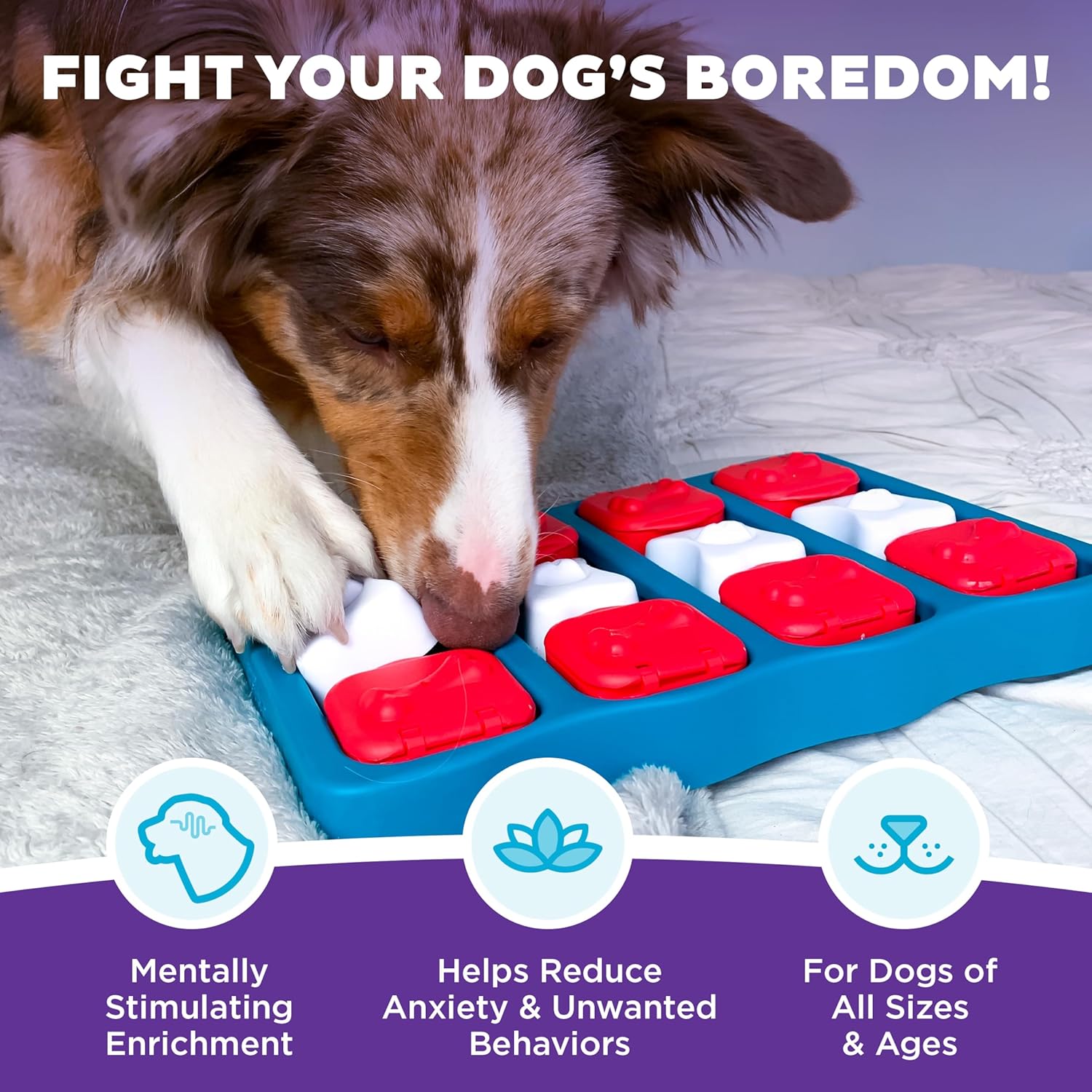
When Your Dog Solves Every Puzzle in Minutes: Moving Beyond Level 2
Dog puzzle toys are interactive feeders — physical objects with hidden compartments, sliding covers, or spinning layers that a dog has to manipulate to release kibble or treats. The idea is simple: make your dog work for the food instead of inhaling it from a bowl. At the entry level (think a basic sliding-tile tray), most dogs figure out the pattern within a few sessions and then solve it on autopilot. That’s not failure — it means your dog learned the skill. The problem is that once a puzzle becomes automatic, it stops delivering the cognitive challenge that made it worth buying. If you’re here because your six-month-old beagle is emptying a Level 2 wheel in under three minutes, or because your eight-year-old Spitz mix just pushed every cover off and stared at you, this guide explains exactly what to do next.
| EDITOR'S PICKOutward Hound by Nina Ottosson… | Mid-tierOutward Hound by Nina Ottosson… | Budget pickOutward Hound by Nina Ottosson… | |
|---|---|---|---|
| Difficulty Level | Level 4 Expert | Level 2 Intermediate | Level 1 Beginner |
| Play Style | Multipuzzle | Brick | [Treat Tumble](https://www.amazon.com/dp/B0714JXCB9?tag=greenflower20-20) |
| Size | — | — | Small, 4.8" |
| Color | Green | Red, White, Blue | Blue |
| Toy Type | Interactive Puzzle | Interactive Treat Puzzle | Food-Dispensing Ball |
| Price | $26.70 | $13.77 | $6.35 |
| See on Amazon → | See on Amazon → | See on Amazon → |
What “Difficulty Level” Actually Means — and Where the System Breaks Down
Outward Hound’s Nina Ottosson line (the de facto industry standard for categorized puzzle difficulty) defines four levels based on the number and type of actions required to open each compartment. Per Outward Hound’s own product documentation:
- Level 1 (Beginner): Single action — paw or nose pushes one cover off.
- Level 2 (Intermediate): Two sequential actions — e.g., lift a bone, then slide a disk.
- Level 3 (Advanced): Three or more actions, often with locking mechanisms or misdirection elements.
- Level 4 (Expert): Multi-step sequences with hidden sub-compartments; some require a specific order of moves.
The practical gap between Level 2 and Level 3 is larger than the numbering implies, but the real issue practitioners run into is that “difficulty level” measures initial difficulty — how hard it is for a dog encountering the puzzle cold. Once a dog has internalized the motor pattern, a Level 2 puzzle solved in 30 minutes on Day 1 becomes a 3-minute autopilot task by Week 2. The AKC’s enrichment guidance notes that dogs rely heavily on spatial and procedural memory once a task is learned, which means repetition reduces cognitive load fast.
The Dog Brick (Level 2) and Dog Tornado (Level 2) are the toys most owners hit this wall with first. A common pattern across aggregated reviews: owners report that the Dog Tornado’s Challenge Slider variant — designed to add a harder layer — has durability issues, with pieces popping off on the second or third use. That’s a real tradeoff to flag before you upgrade within the same product line.
The Chewing Problem: When Your Dog Skips the Puzzle Entirely
Before spending money on harder puzzles, it’s worth diagnosing whether your dog is actually solving the current one or just dismantling it.
A pattern that shows up repeatedly in owner reviews of the Dog Brick: dogs chew the bone-shaped covers off rather than sliding them aside. Owners initially read this as destructive behavior, but one detailed account of re-introducing the puzzle to an eight-year-old Spitz/Husky mix describes the actual fix: teach the concept first. The bone cover is a tool, not the prize. Dogs that haven’t been shown this distinction default to brute force — which works, so they keep doing it.
The re-introduction protocol that reviewers describe most consistently:
- Load only one or two compartments with high-value treats.
- Guide the dog’s nose to a cover, then physically slide it for them the first time.
- Click or mark the moment they nose (not bite) the cover.
- Gradually reduce your assistance over five to ten sessions.
The Treat Tumble (Nina Ottosson) is worth mentioning here because of a specific design feature: the rubber lip extends over the edge of each treat well, which physically blocks a dog’s teeth from getting purchase on the plastic. Owners consistently note this is what keeps it intact — the geometry prevents the chew-bypass strategy rather than relying on the dog learning not to try it. That’s a meaningful differentiator if you’re buying for a power-chewer.
VCA Animal Hospitals’ cognitive enrichment guidance reinforces the same point from the other direction: a dog that hasn’t been introduced to object-manipulation tasks as a behavior category will default to the motor patterns it already has. The puzzle isn’t too easy — the dog doesn’t yet understand what “solve” means.
By the Numbers: Puzzle Complexity at a Glance
| Level | Typical actions required | Average first-solve time (owner-reported) | Re-solve time after 2 weeks |
|---|---|---|---|
| 1 | 1 | 5–15 min | < 1 min |
| 2 | 2–3 | 15–45 min | 2–5 min |
| 3 | 4–6 | 30–90 min | 8–20 min |
| 4 | 6+ | 60–120+ min | 20–45 min |
Compiled from aggregated owner reviews across Nina Ottosson product lines. Times vary significantly by breed, prior enrichment experience, and treat value.
Actual Upgrades: What to Move To When Level 2 Is Solved
If your dog solves Level 2 in under 5 minutes: Move directly to Level 3. The Nina Ottosson Dog Brick Plus and the Dog Smart Composite are the most commonly recommended stepping stones because they preserve familiar motions (sliding, lifting) while adding a locking peg mechanic that requires the dog to clear a blocker before the main compartment opens. Owners of scent-forward breeds — beagles, dachshunds, basset hounds — report these hold attention significantly longer because the locking pegs hide secondary scent pockets.
If your dog solves Level 3 quickly too: The Nina Ottosson Dog Pyramid and Dog Twister sit at the top of the commercial Level 3–4 range. The Dog Twister in particular gets consistent reviews noting that dogs who’ve mastered it still take 15–25 minutes on return sessions, because the rotating tray layers require the dog to hold a partial solution in working memory while completing the next step. Per Whole Dog Journal’s puzzle toy coverage, multi-layer rotation puzzles are among the few commercial formats that remain genuinely challenging past the initial learning curve.
If you’ve exhausted commercial Level 4: This is where the category honestly runs out of headroom, and practitioners need to shift strategy rather than just buy up. Three approaches that extend the challenge without new purchases:
- Rotation, not replacement. Whole Dog Journal’s enrichment guidance and PetMD’s mental stimulation overview both note that withdrawing a puzzle for two to four weeks and reintroducing it often resets a significant portion of the challenge — not to Day 1 levels, but enough to require active problem-solving again.
- Reduced-visibility conditions. Covering part of the puzzle with a towel, or introducing it in a less familiar room, removes the spatial memory advantage and forces the dog back into active searching behavior.
- Combination feeding. Using the puzzle as the first stage of a meal — then delivering the remainder from a snuffle mat or lick mat in a different location — chains tasks and extends the total engagement window without requiring a harder single toy.
Sniff Work, Sport Feeding, and the Tools That Live Above Level 4
For dogs that have genuinely outgrown the commercial puzzle tier, the practitioner framing shifts from “puzzle toy” to feeding enrichment modality — a broader category that includes:
- Snuffle mats (fabric strips that hide kibble in a scatter pattern): slower than Level 4 puzzles for most dogs, but engage olfactory processing more deeply. AKC enrichment guidance notes that nosework-style feeding can tire a dog more efficiently per calorie dispensed than motor-manipulation puzzles.
- KONGs and stuffable chews (frozen): extend engagement time through resistance rather than complexity. Not technically puzzles, but relevant when a dog needs duration, not novelty.
- Sport-style nose work introduction: For handlers already in the competitive sport dog space, transitioning enrichment to formal nosework targets (birch, anise, clove ORT work) is the logical ceiling. The DR CATCH Wheel — the toy the six-month-old beagle empties in under three minutes — is a reasonable gateway to this transition. Owners report it works well as a phase-out tool: use it to introduce scent-searching mechanics, then move to formal nose work hides once the dog is searching rather than pattern-solving.
A Note on Cross-Species Use
Multiple reviewers of both the Dog Brick and the Dog Tornado report using these puzzles for cats — and finding them effective. If you’re a multi-species household, Level 2 puzzles tend to translate well because the cover-sliding mechanic maps naturally to cat object-manipulation behavior. Level 3 and above tend to frustrate cats rather than challenge them, based on the pattern in owner accounts, likely because the multi-step sequences require a persistence style more typical of scent-driven dogs. Worth knowing if you’re deciding whether one puzzle purchase can serve the whole household.
Frequently Asked Questions
How do I stop my dog from just chewing the pieces off a puzzle instead of solving it? Teach the concept before you expect the behavior. Guide the dog through the first several solves manually — nose contact on the cover, then you slide it. Mark nose contact, not biting. Repeat until the dog is reliably nudging covers rather than grabbing them. The Treat Tumble’s rubber-lip design physically prevents the chew-bypass strategy and is worth considering if you’re starting over with a power-chewer.
What is the actual difference between a Level 2 and a Level 4 puzzle? Level 2 requires two to three sequential actions; Level 4 requires six or more, often with locking sub-mechanisms that must be cleared in a specific order. The cognitive load difference is real: Level 4 requires working memory of a partial solution state, not just motor repetition of a learned sequence.
My dog solves every puzzle in under 5 minutes — is there anything harder? Commercially, Level 4 Nina Ottosson puzzles are the ceiling. Past that, the strategy shifts: rotate toys to reduce memory advantage, introduce puzzles in novel environments, or move toward formal nose work, which has no practical upper difficulty limit.
Can puzzle toys actually tire a dog out, or is physical exercise still necessary? Both. PetMD’s mental stimulation overview and VCA’s cognitive enrichment guidance both note that mental effort produces measurable fatigue — owners consistently report dogs being calmer after 20–30 minutes of puzzle feeding than after equivalent free time. But it doesn’t replace aerobic exercise. Think of puzzle feeding as an additive drain on the energy budget, not a substitute for physical activity.
Are Nina Ottosson puzzles safe to leave with a dog unsupervised? The manufacturer’s standard guidance is supervised use only — and that’s the correct answer for most dogs on Level 3 and Level 4 puzzles with moving parts. Level 1 and 2 puzzles with no small detachable components are lower risk, but owners report that dogs who’ve mastered a puzzle and found nothing in it will sometimes attempt to dismantle it. The lowest-risk unsupervised format in this category is a frozen stuffable like a KONG, not a puzzle with separable pieces.