September 13, 2026 • Marisol Vane • 9 min reading time • Prices verified June 4, 2026
Matching Bolster Bed Dimensions to Your Dog's Actual Sleep Style
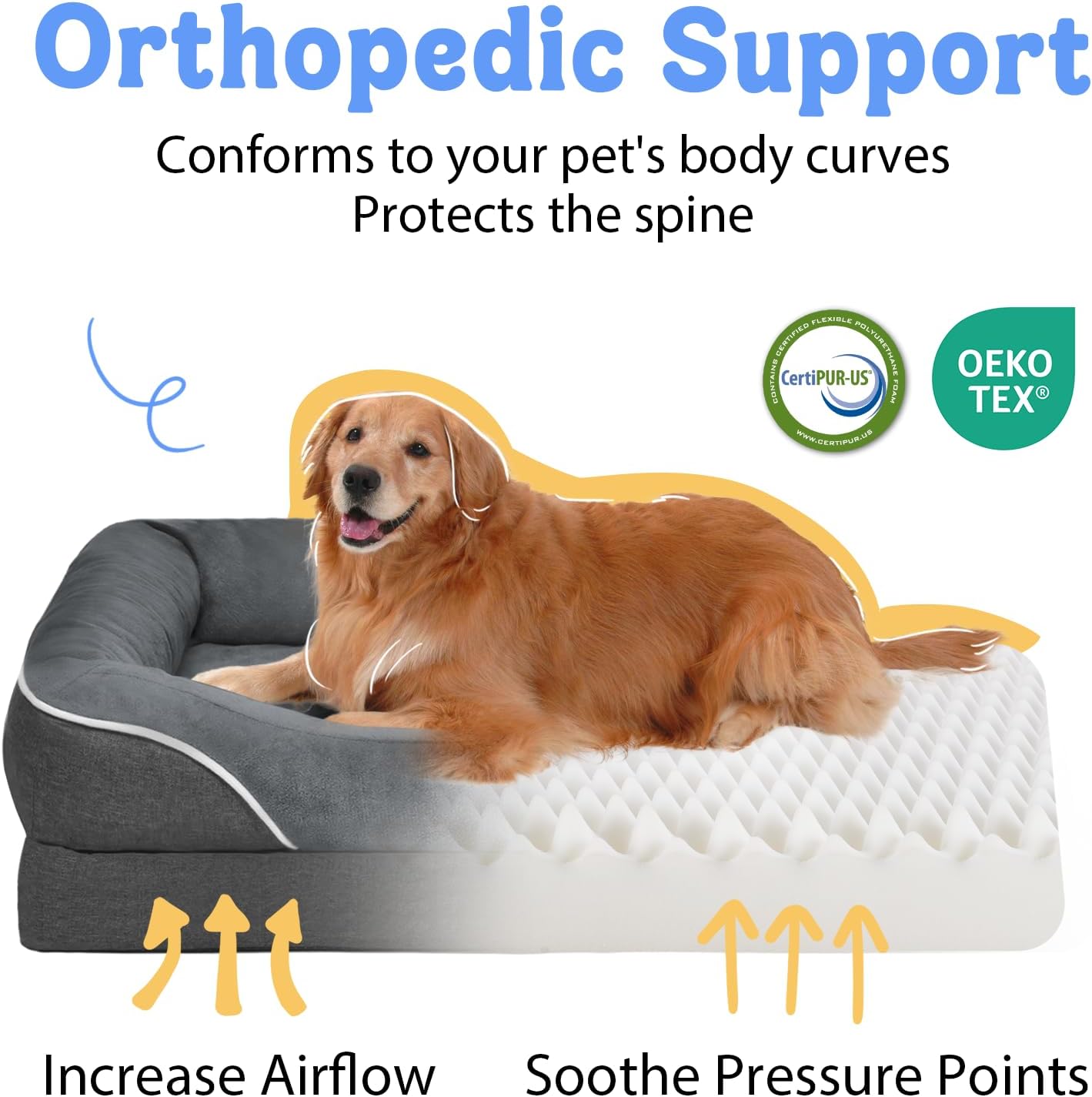
A bolster bed is simply a dog bed with raised, padded walls on three or four sides — like a couch cushion your dog can sink into and lean against. The appeal is obvious: most dogs instinctively seek a surface they can press their back against while sleeping, and a bolster delivers that without your dog commandeering the sofa corner. But bolster beds fail in a very specific way: owners buy by body weight rather than by how their dog actually sleeps, and they end up with a 36-inch oval that a 60-pound Greyhound completely overhangs, or a fortress-walled rectangle so deep that a short-legged Basset Hound can barely climb in. This guide fixes that. You’ll learn how to read your dog’s real sleep geometry, what dimensions actually matter (and which ones are marketing noise), and how to match spec to dog so the bed stays used past the first week.
Step One: Observe the Sleep Position Before You Measure Anything
Before you open a single product listing, spend two or three evenings watching where and how your dog naturally settles. Canine sleep researchers and veterinary behaviorists consistently identify four working positions that drive bed geometry decisions:
The Curler tucks nose toward tail, occupies roughly a circle equal to about 75–85% of body length in diameter. This dog wants a deep, high bolster — ideally on all four sides — and a bed diameter that matches their curl diameter, not their stretched-out length. Buying by body length dramatically oversizes the bed for a Curler and eliminates the sense of enclosure that motivated the position in the first place.
The Sprawler lies completely flat, often belly-down or on one side, with all four limbs extended. The AKC’s guide on choosing dog beds specifically calls out that Sprawlers and side-sleepers need significantly more surface area than weight-class charts suggest, because those charts are built on body length at rest, not fully extended. For a Sprawler, internal sleeping-surface dimensions matter far more than bolster height.
The Leaner sleeps curled or straight but actively presses against one wall. This dog needs at least one reinforced, firm bolster wall — not a pillow-soft wraparound — that holds its shape under lateral pressure. Owners of Leaner dogs frequently report that budget bolster beds collapse within weeks, because the foam inside the bolster wall is too low-density to sustain repeated pressure loading.
The Percher drapes over the bolster wall itself, using the raised edge as a chin or limb rest, like a dog version of a chaise lounge. For Perchers, bolster height and width are the primary spec — too tall and they can’t get comfortable; too narrow and the bolster can’t support the weight of a head or foreleg.
Note which category your dog falls into. Many dogs are hybrids (Leaner-Curlers are extremely common in herding breeds and sighthounds), and that just means you’re shopping for two criteria simultaneously.
The Measurements That Actually Matter — and How to Take Them
Once you know your dog’s sleep style, you need three numbers. These take about four minutes with a fabric tape measure.
Nose-to-tail length (NTL): Measure your dog standing in a natural pose, from the tip of the nose to the base of the tail — not the tip of the tail. This is your baseline. Every bed manufacturer publishes “recommended dog length” on their sizing charts, and they mean NTL.
Curl diameter: For Curlers, have your dog lie down in their natural curl and measure the outer diameter of their body — roughly from the outermost curve of the spine to the tucked paws. This number is almost always 15–25% smaller than NTL and is your real bed-diameter target.
Shoulder-to-hip width at widest point: Measure your dog lying on their side fully extended. This is critical for Sprawlers and is routinely ignored in weight-based sizing. A 55-pound American Bulldog has a dramatically different hip-width than a 55-pound Siberian Husky, and the bed has to accommodate the wider dog’s body at its widest, not just its length.
By the Numbers: Size Multipliers by Sleep Style
| Sleep Style | Minimum Bed Interior Length | Minimum Bed Interior Width |
|---|---|---|
| Curler | 1.0× curl diameter | 1.0× curl diameter |
| Sprawler | 1.1× NTL | 1.25× shoulder-hip width |
| Leaner | 1.0–1.05× NTL | 1.1× shoulder-hip width |
| Percher | 1.0× NTL | 1.1× shoulder-hip width + bolster ≥3” wide |
Add 4–6 inches to each dimension for dogs under 40 lbs; add 6–8 inches for dogs 40–90 lbs; add 8–10 inches for dogs over 90 lbs. This buffer accounts for positional shifting during REM sleep — the deeper sleep phase where dogs exhibit the most involuntary limb movement — and prevents the dog from rolling into the bolster wall unintentionally.
Bolster Wall Specs: Height, Firmness, and Foam Density
Bolster geometry is where most online reviews go quiet, because reviewers rarely report the actual foam specs inside the walls. Here’s what to look for.
Bolster height should be roughly ear-to-shoulder height for Leaners and Curlers — enough that the dog’s head can rest comfortably on the wall without neck strain. For a 50-pound Labrador, that’s typically 7–9 inches of bolster wall height. For a 15-pound French Bulldog, 4–5 inches is usually sufficient. Perchers need a slightly lower bolster, around 5–7 inches, so the wall becomes a resting ledge rather than a barrier.
Foam density inside bolster walls is almost never published openly, but you can infer quality from two signals: price per square inch (beds with properly dense bolster foam in larger sizes cost more to make, and pricing usually reflects this) and long-run owner reports. Across aggregated reviews on large-format bolster beds priced under $60, owners consistently report bolster wall collapse within 3–6 months of daily use, particularly in Leaner dogs. Beds in the $90–$180 range with high-density polyfoam rated for furniture-grade applications (look for spec sheets that reference 1.8 lb/ft³ density or higher — that’s the foam’s weight per cubic foot, which is the standard measure of foam durability) show dramatically better longevity in long-run reviews.
Base foam ILD — ILD stands for Indentation Load Deflection, which is a standardized number measuring how firm a foam feels; higher ILD means firmer — matters most for dogs with orthopedic needs. Tufts University’s Your Dog publication and VCA Animal Hospitals both note that dogs with osteoarthritis or hip dysplasia benefit from base foam firm enough that the dog doesn’t sink fully through to the floor surface beneath. For a 70-pound dog, a base ILD below 25 typically allows full sinkage under the dog’s weight. Target 28–35 ILD for large dogs with joint concerns.
Breed Body Type Is Not the Same as Weight Class
This is the intuition gap that separates good bolster bed fits from mediocre ones. The Whole Dog Journal’s guide on dog bed selection specifically flags this: manufacturers size by weight because it’s easier to display on a label, but body geometry varies so widely within weight classes that weight-only sizing is often wrong.
Consider the contrast between a 65-pound Whippet and a 65-pound Staffordshire Bull Terrier. The Whippet has a narrow, elongated torso, a deep chest, and minimal lateral width — it is almost always a Curler or Leaner, and it fits comfortably in a bolster sized for a 45-pound weight class if the internal diameter matches the curl. The Staffy is wide, low, muscular, and almost always a Sprawler — it will overflow a bed sized for its weight class by two to four inches on each side.
The practical fix: always cross-reference the manufacturer’s internal sleeping surface dimensions (not the overall bed dimensions, which include bolster wall overhang) against your actual measurements. Reputable brands publish interior sleeping surface dimensions separately. If a brand only lists overall bed size, subtract roughly 8–10 inches from each dimension to approximate the usable interior — and treat that as a minimum-confidence number until you can verify.
Dogs with disproportionate body plans — Dachshunds, Basset Hounds, Corgis — need special attention to entry-height clearance on the bolster wall. A 4-inch bolster wall is a minor obstacle for a Labrador; for a Dachshund with intervertebral disc disease risk (a spinal condition common in the breed), it’s a genuine daily stress event. Low-entry bolster designs with one open or lowered side are the correct product category for this population.
The Decision Framework: If X, Then Y
If your dog is a Curler under 30 lbs: Target interior diameter equal to 1.0× curl diameter, bolster height 4–6 inches, all-around wall design. Beds in the $45–$80 range with polyfoam bolsters rated ≥1.8 lb/ft³ are appropriate; you don’t need orthopedic-grade base foam unless the dog has joint issues.
If your dog is a Sprawler over 50 lbs: Internal sleeping surface is your primary spec — calculate 1.1× NTL by 1.25× shoulder-hip width, add the 8-inch buffer, and don’t compromise. Bolster height matters less; prioritize base foam ILD ≥28 and a cover that launders well, because Sprawlers typically overheat and sweat more into the fabric than Curlers do.
If your dog is a Leaner with joint issues: Buy one size up from your dimension calculation specifically to give the dog room to shift without rolling into the bolster wall involuntarily, and verify bolster wall foam density before purchase. Operators running small-scale rehabilitation practices consistently specify memory foam base layers (which conform to pressure points rather than pushing back against them) with a high-density polyfoam bolster — not memory foam in the walls, which collapses under sustained lateral pressure.
If your dog is a Percher and a breed with short legs or barrel chest (Bulldogs, Bassets, Corgis): Look specifically for bolster beds with a three-sided wall rather than four, lower entry clearance of 2 inches or less on the open side, and a bolster wall width of at least 3 inches on the resting side — narrow bolsters under paw and chin weight compress quickly and lose their function within months, which is the most common single complaint in long-run reviews for this profile.
The math and the observation together take less than ten minutes. The alternative — buying by weight class and hoping — costs you a $120 bed that becomes a room decoration by month two. Do the four minutes of measuring first.